4 French Toast Recipes: Casserole, Brioche, Cinnamon & Savory
 ""
 Pin it
In this post
This french toast recipe collection brings together four versions — an overnight casserole, brioche, cinnamon, and savory Parmesan-herb — so you can jump straight to the one you want. Use the links below to go to any section of the post.
- Which French Toast Should You Make?
- What All Four Versions Have in Common
- Recipe 1: Overnight French Toast Casserole
- Recipe Card: Overnight French Toast Casserole
- Recipe 2: Brioche French Toast
- Recipe Card: Brioche French Toast
- Recipe 3: Cinnamon French Toast
- Recipe Card: Cinnamon French Toast
- Recipe 4: Savory French Toast
- Recipe Card: Savory French Toast
- Swapping in What You Already Have
- Keeping Leftovers
- Questions Readers Ask
- Which One to Make Next
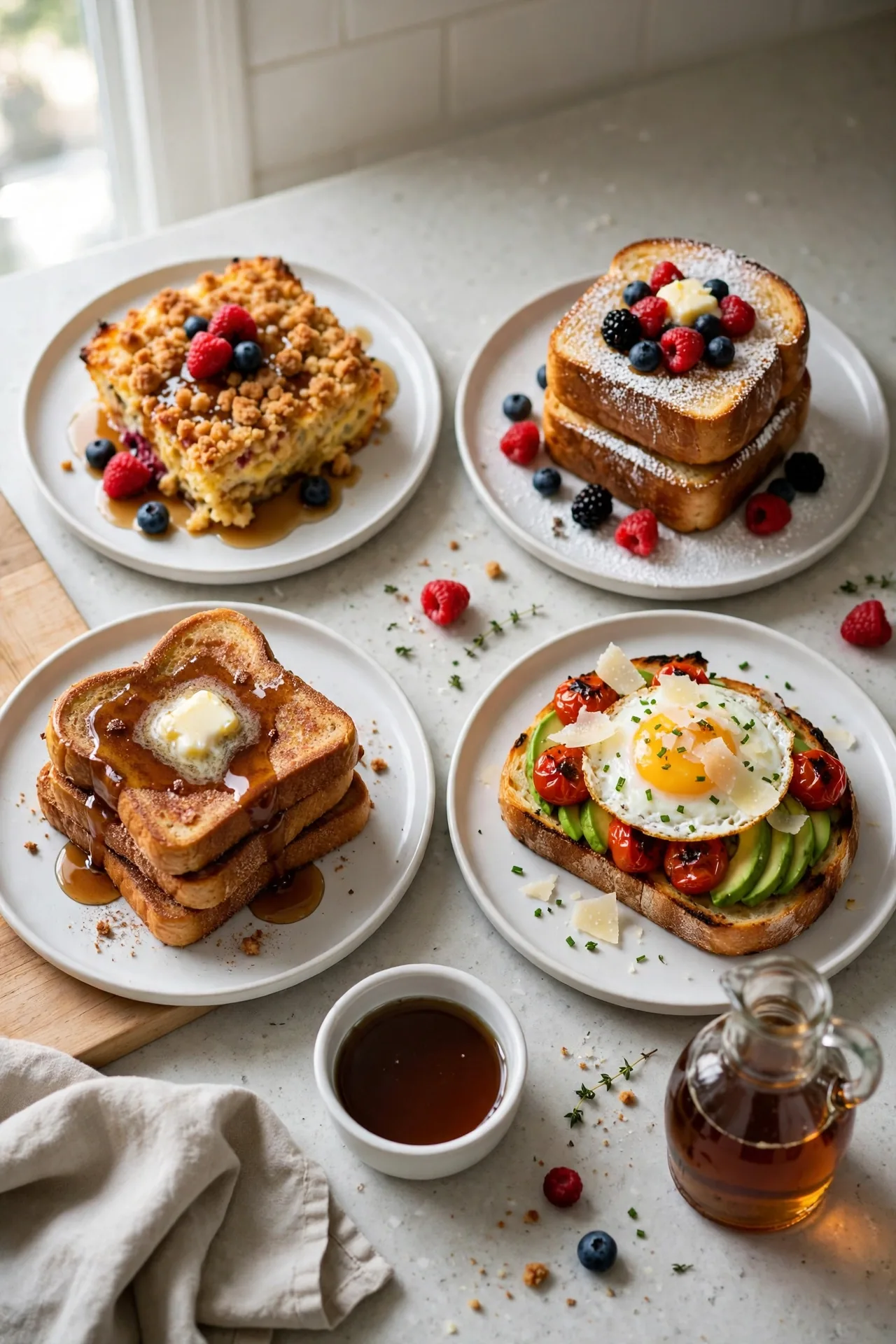
French toast comes down to three decisions: how dry the bread is, how much custard it soaks up, and how hot the pan runs. Change any one of them and the same loaf gives you a different breakfast. This post puts four versions side by side, each built on a different set of choices: an overnight casserole for a crowd, thick brioche slices that stay custardy inside, a cinnamon-forward classic for an ordinary morning, and a savory version (also spelled savoury) with Parmesan, herbs, blistered tomatoes, and a fried egg.
Each recipe has its own ingredient list, an image for every stage, doneness cues, and a recipe card.
Jump to a recipe:
Which French Toast Should You Make?
| Version | Best for | Hands-on time |
|---|---|---|
| Casserole | Feeding 8, prepping the night before | About 35 minutes, plus chilling and baking |
| Brioche | Rich, custardy slices for 4 | About 35 minutes |
| Cinnamon | A weekday classic for 4 | About 30 minutes |
| Savory | Brunch or a light dinner for 4 | About 40 minutes |
What All Four Versions Have in Common
Bread
Dry, sturdy bread soaks up custard without falling apart. Soft, fresh sandwich bread tends to go limp, turn gummy in the middle, and tear when you lift it. Day-old brioche, challah, French bread, or sourdough holds its shape. If your loaf is fresh, slice it and leave the slices on a wire rack for an hour or two. In a hurry, set them in a 300°F (150°C) oven for a few minutes, flipping once, until the surface feels dry and the inside is still soft.
The custard
For the stovetop versions, a working ratio is about 1 egg to 1/4 cup (60 ml) of liquid. Less liquid and the toast cooks up eggy and dense; more and the center stays wet. The casserole runs looser, 8 eggs to 2 1/2 cups of dairy, because the cubes sit and soak for hours instead of seconds.
Pan heat
Medium to medium-low suits every pan version here. Sugar, butter, and milk solids brown quickly, and a pan that runs too hot gives you a dark crust over a raw center. Wipe out browned butter between batches.
Doneness and food safety
Judge by the center, not the crust. A cooked slice springs back slightly when you press the middle, and a cut slice shows no wet, shiny custard. For a firm answer, push an instant-read thermometer into the thickest part. US food safety guidance sets egg dishes, including casseroles, at 160°F (71°C). Refrigerate leftovers within 2 hours (1 hour if the room is above 90°F), eat them within 3 to 4 days, and reheat them to 165°F (74°C), as outlined in USDA Food Safety and Inspection Service guidance.
Equipment worth having
- A 12-inch skillet (cast iron, nonstick, or stainless) for the stovetop versions
- A shallow dish wide enough to lay a slice flat, such as a 9-inch pie plate
- A wire rack set on a rimmed sheet pan, for drying bread and holding cooked toast in a warm oven
- A serrated knife, which cuts soft bread without squashing it
- An instant-read thermometer
- A 9×13-inch (23×33 cm) baking dish for the casserole
Recipe 1: Overnight French Toast Casserole
Cubed bread soaks in cinnamon-vanilla custard overnight, then bakes under a brown sugar streusel. You assemble it the evening before and the oven handles the morning. It is the only version here that cooks all 8 servings at once, which is the reason to pick it over the stovetop recipes.
Serves 8 · Hands-on 35 minutes · Chill 4 to 12 hours · Bake 45 to 55 minutes · Rest 10 minutes
Contains eggs, milk, and wheat (gluten).
Casserole Ingredients
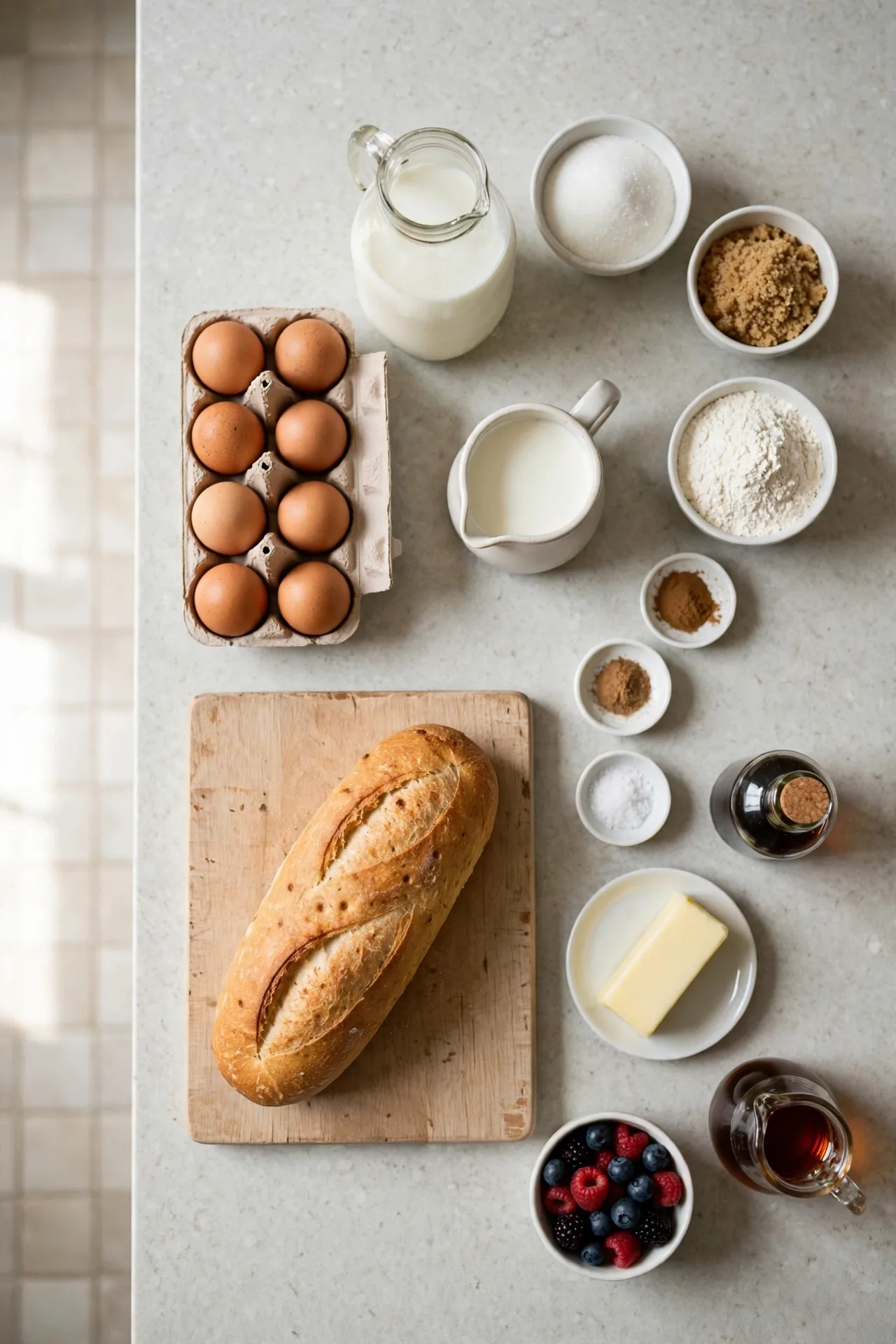
For the bread
- 1 loaf (about 14 oz / 400 g) French bread, challah, or brioche, preferably a day old
- 1 tablespoon softened butter, for the dish
For the custard
- 8 large eggs
- 2 cups (480 ml) whole milk
- 1/2 cup (120 ml) heavy cream
- 1/3 cup (about 67 g) granulated sugar
- 2 teaspoons vanilla extract
- 1 teaspoon ground cinnamon
- 1/4 teaspoon ground nutmeg
- 1/2 teaspoon kosher salt
For the streusel topping
- 1/2 cup (about 105 g) packed light brown sugar
- 1/2 cup (about 60 g) all-purpose flour
- 1 teaspoon ground cinnamon
- 1/8 teaspoon kosher salt
- 4 tablespoons (57 g) cold unsalted butter, cut into small cubes
To serve
- Maple syrup, fresh berries, and powdered sugar, as you like
How to Make Overnight French Toast Casserole
Step 1: Cut and Dry the Bread
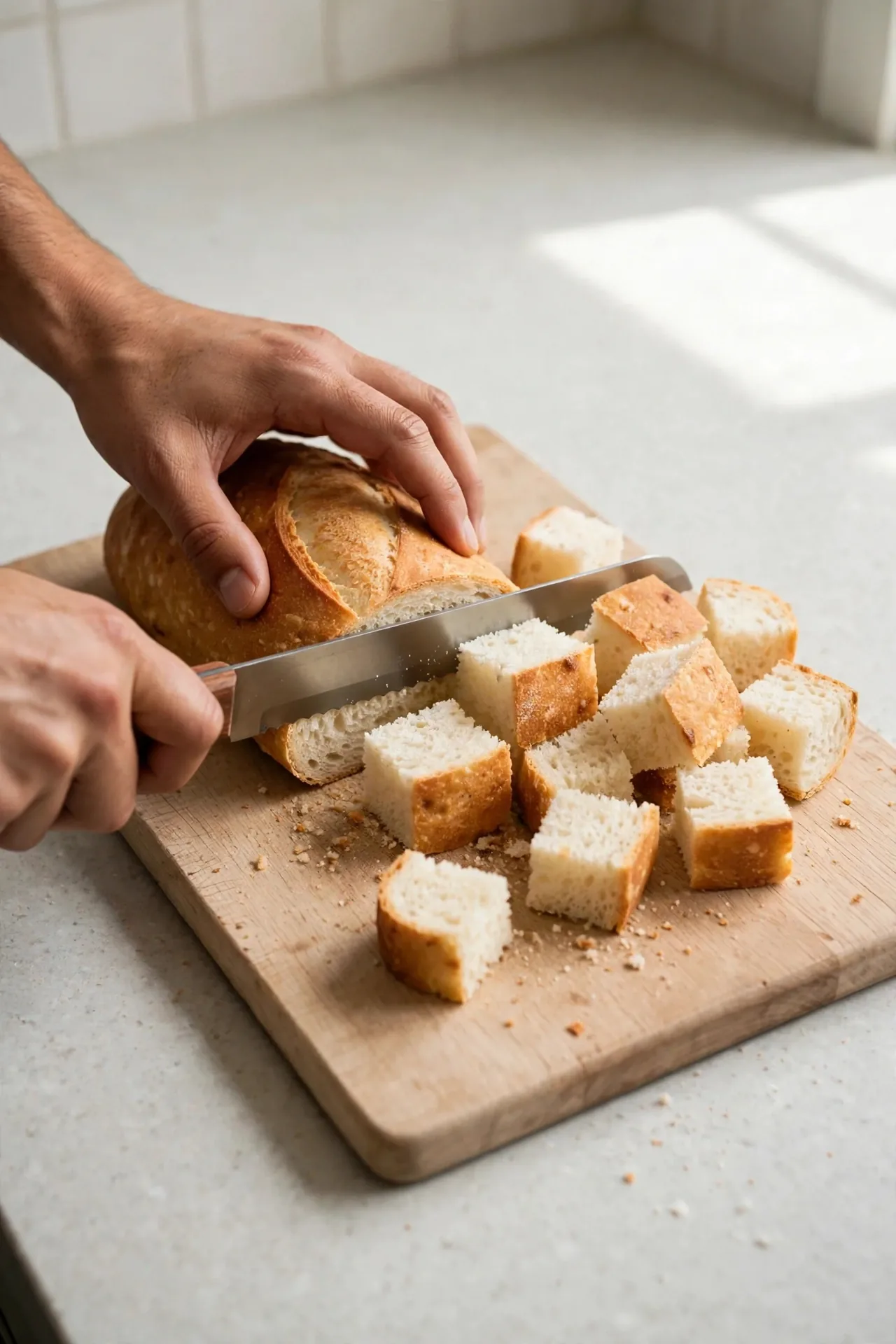
Cut the loaf into 1-inch (2.5 cm) cubes with a serrated knife, crust included. The crust helps the cubes hold together once they are soaked.
Spread the cubes in a single layer on a rimmed sheet pan. Leave them out uncovered for several hours or overnight, or dry them in a 300°F (150°C) oven for 10 to 15 minutes, stirring once. They are ready when the outsides feel dry and firm and the centers are still soft. Pale is the goal here, not toasted.
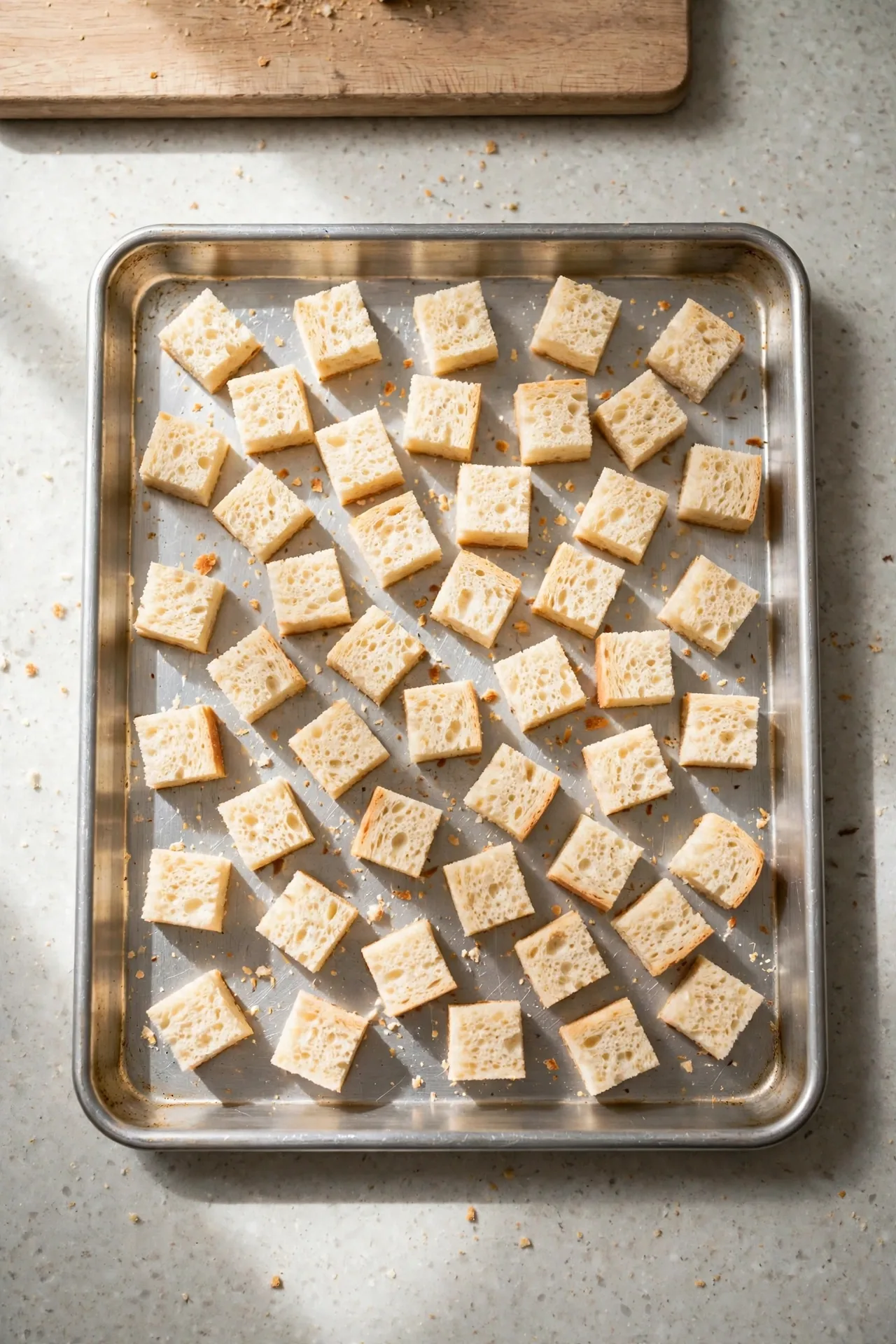
Why the cubes dry first. Fresh bread already holds moisture in its crumb, so it saturates quickly and leaves a dense, wet layer at the bottom of the dish. Dry cubes have room to drink up custard and still keep their shape.
Step 2: Butter the Dish and Add the Bread
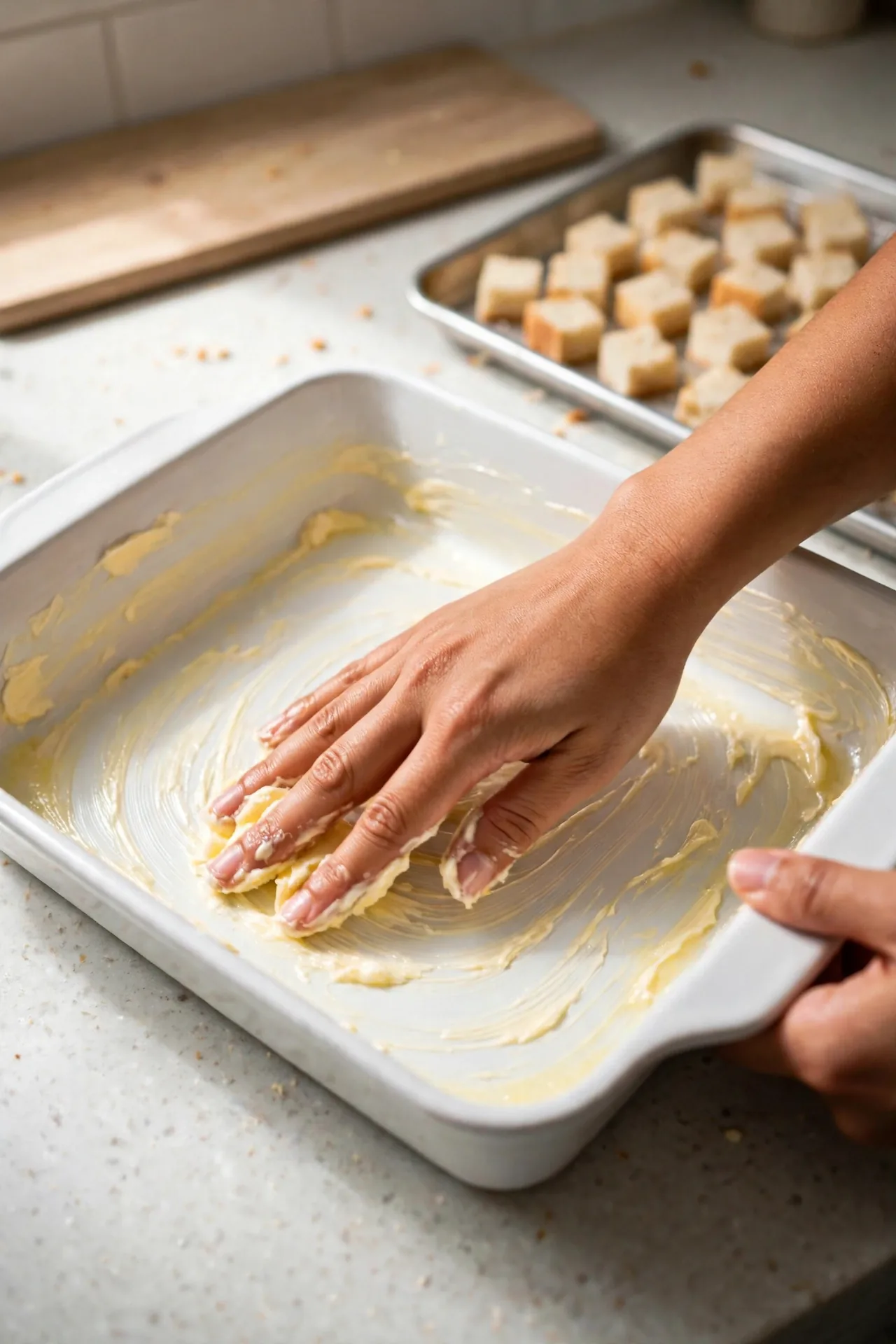
Rub the softened butter over the bottom and sides of the 9×13-inch baking dish. The butter keeps the edges from fusing to the dish.
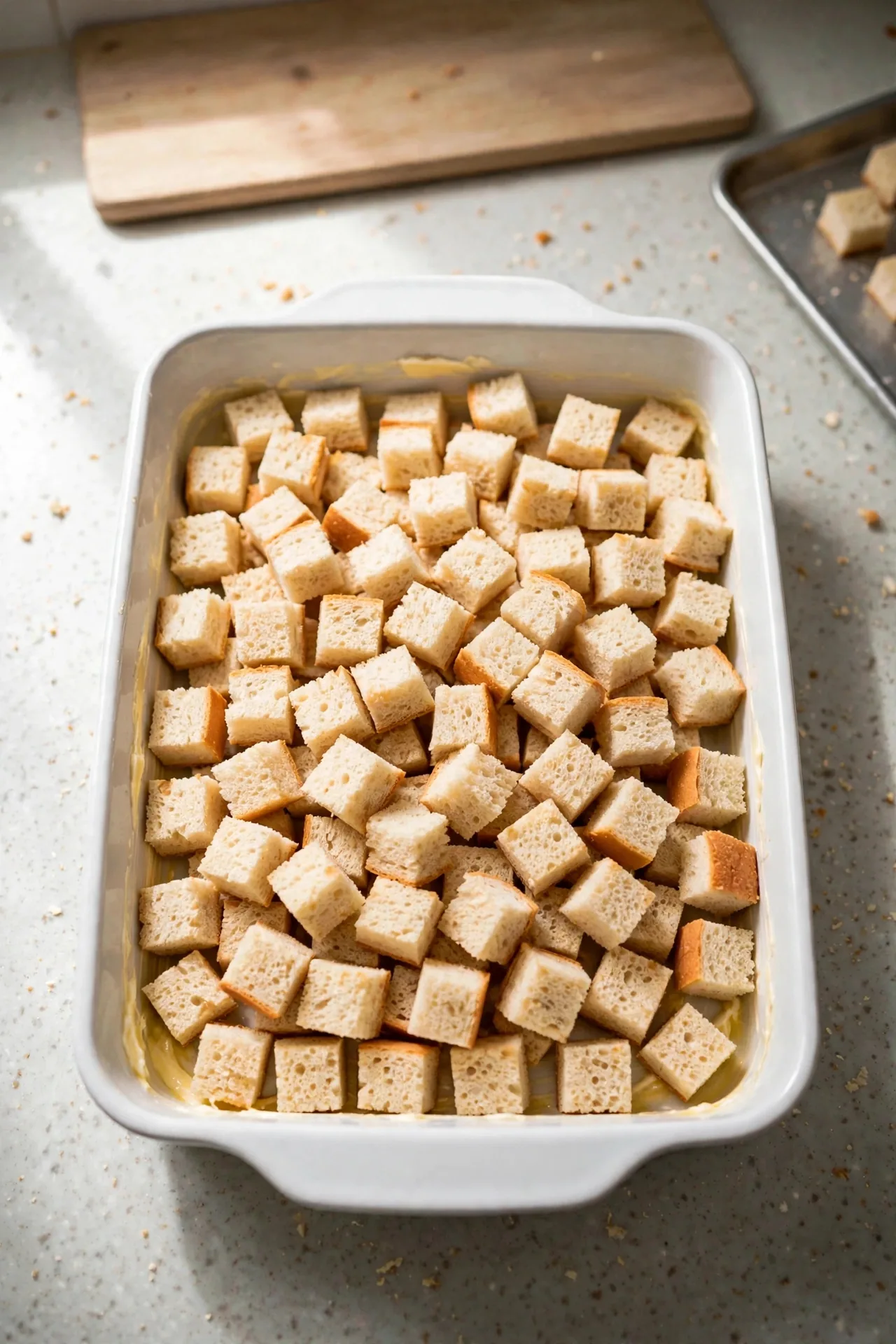
Tip in the cubes and spread them into an even layer. They should fill the dish snugly with a slight mound in the center. Leave them uncompressed for now.
Step 3: Whisk the Custard
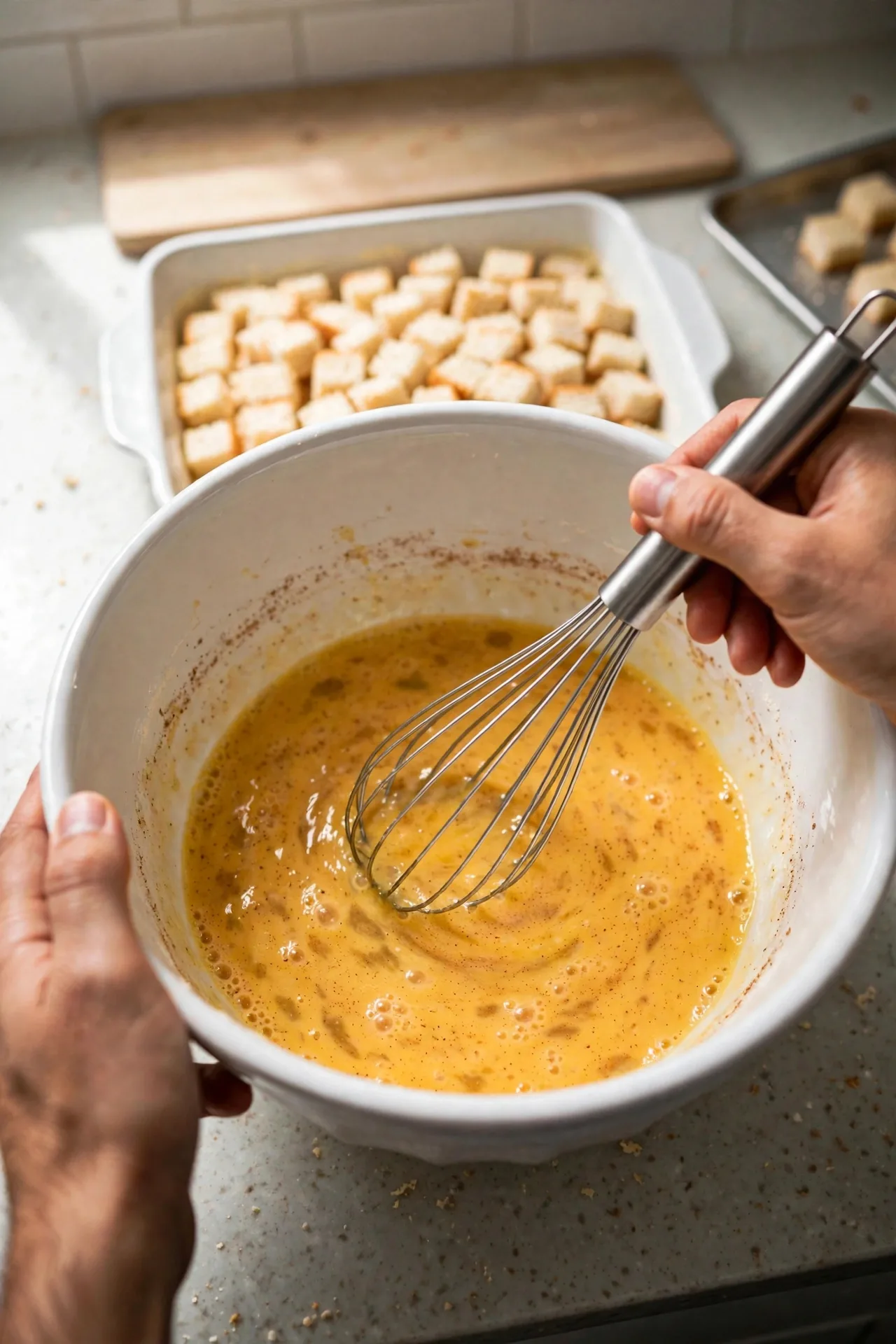
In a large bowl, whisk the eggs with the sugar, cinnamon, nutmeg, and salt until no streaks of yolk remain and the cinnamon is mixed through. Whisking the spices into the eggs first breaks up the dry clumps. Added straight to milk, cinnamon floats on top in small beads.
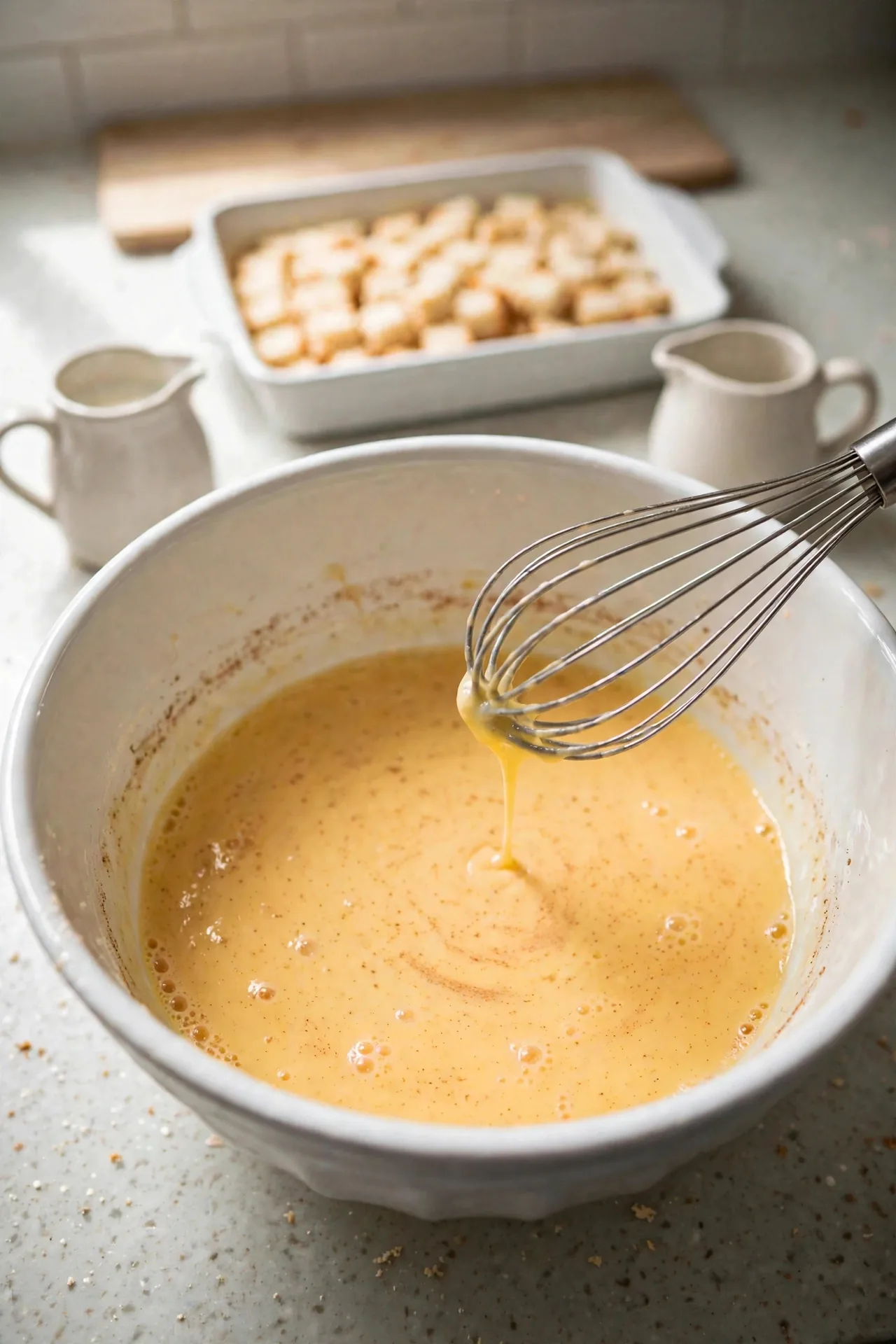
Whisk in the milk, cream, and vanilla until the custard is smooth, pale yellow, and flecked with spice.
Step 4: Pour, Press, and Chill
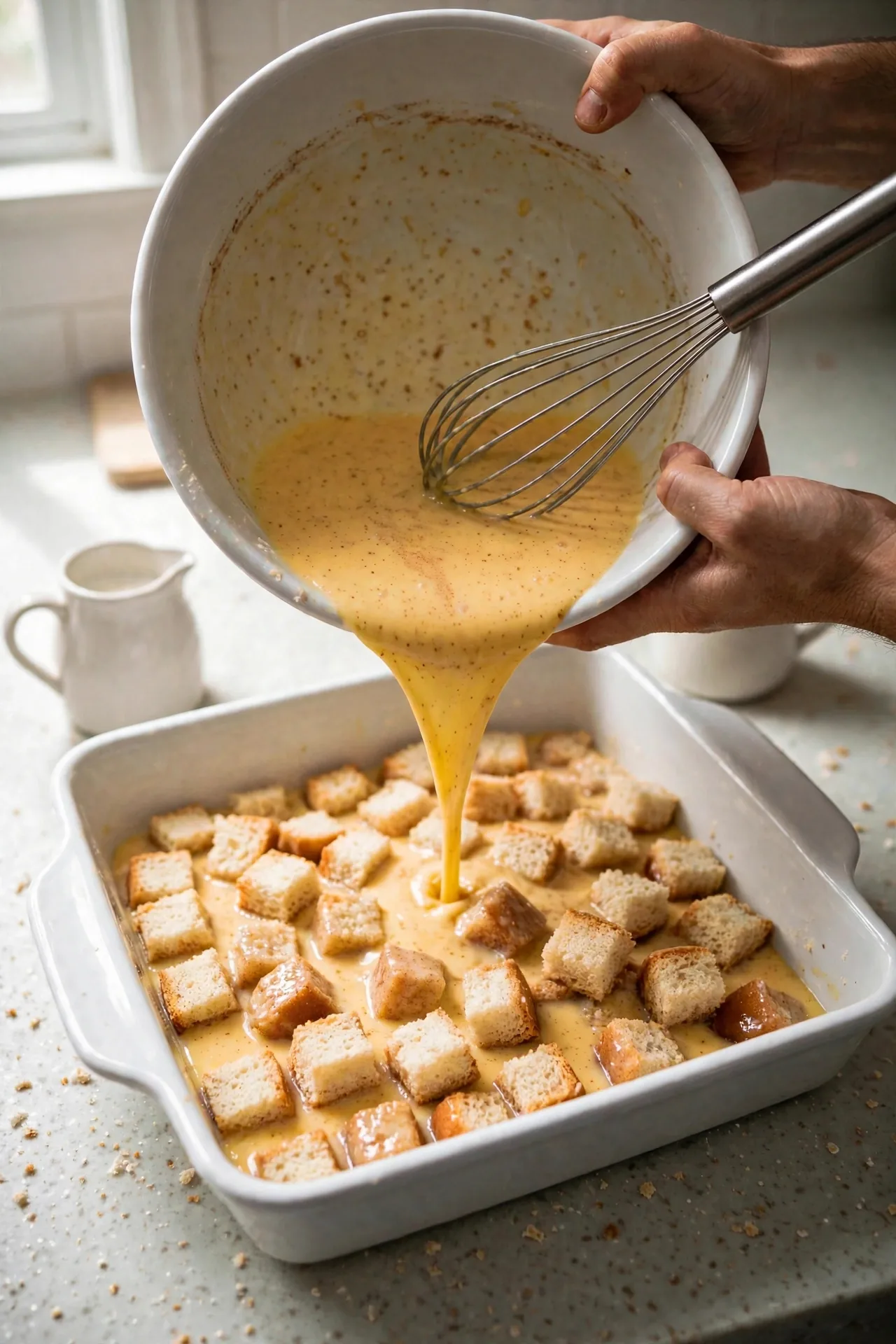
Pour the custard slowly and evenly over the cubes, moving across the whole dish so no corner is missed.
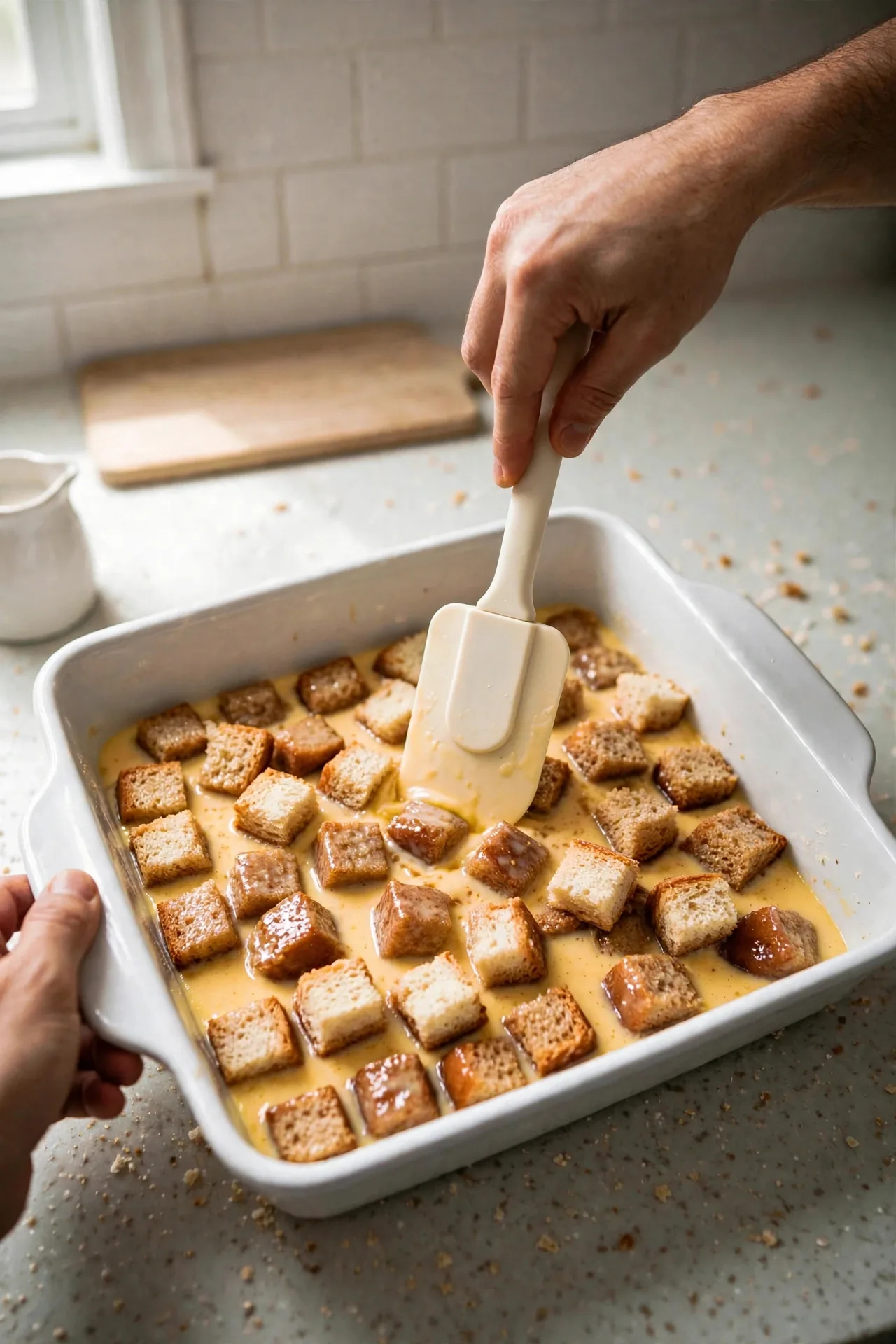
Press the cubes down gently with a spatula so every piece touches liquid. Flip any cubes that still look dry on top.
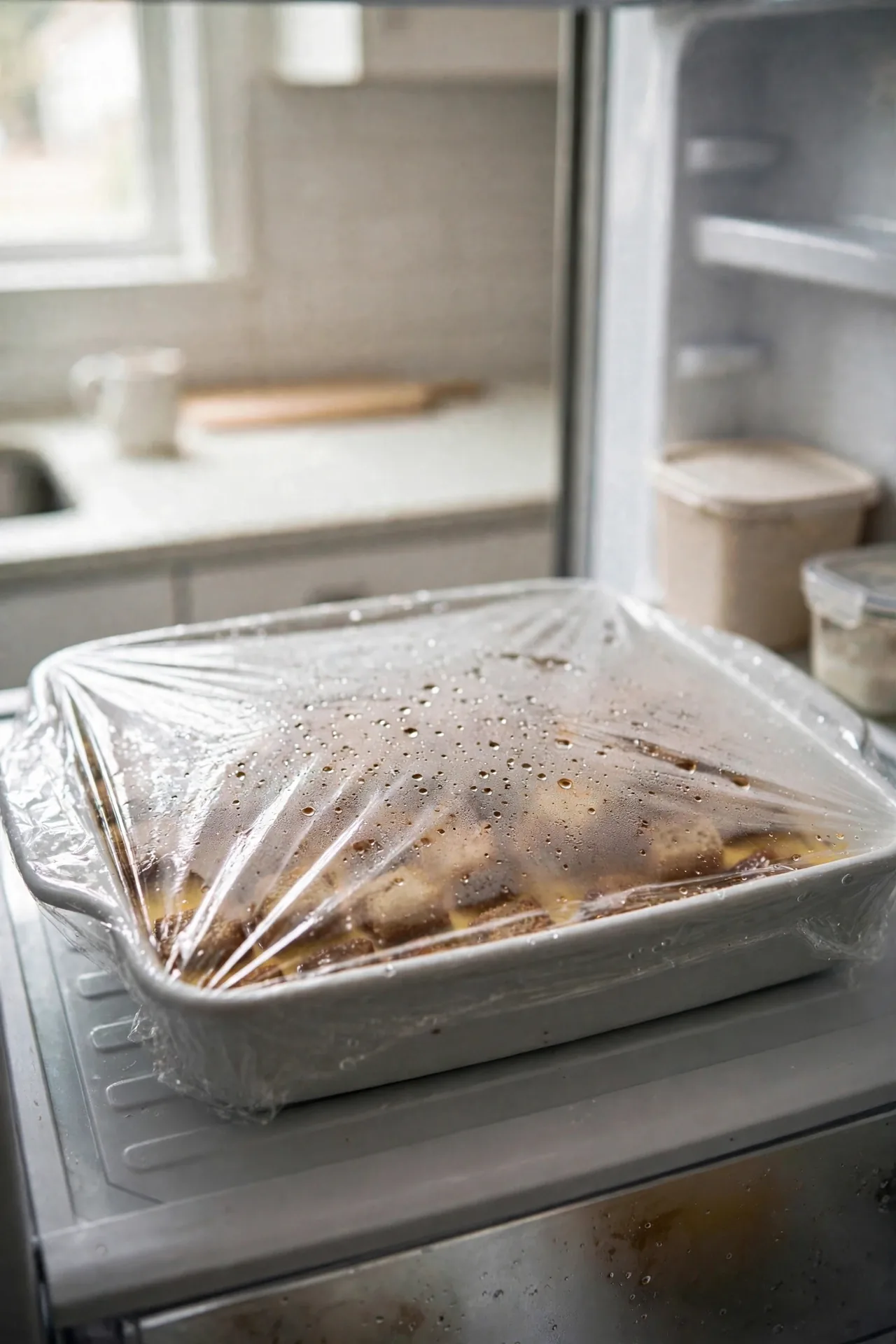
Cover the dish tightly with plastic wrap or foil and refrigerate for at least 4 hours, up to 12. The dish holds raw egg, so it stays in the refrigerator the entire time.
Press, don’t stir. Stirring breaks softened cubes into paste and leaves a gluey texture. Pressing wets the dry pieces without wrecking the wet ones.
Step 5: Check the Soak and Add the Streusel
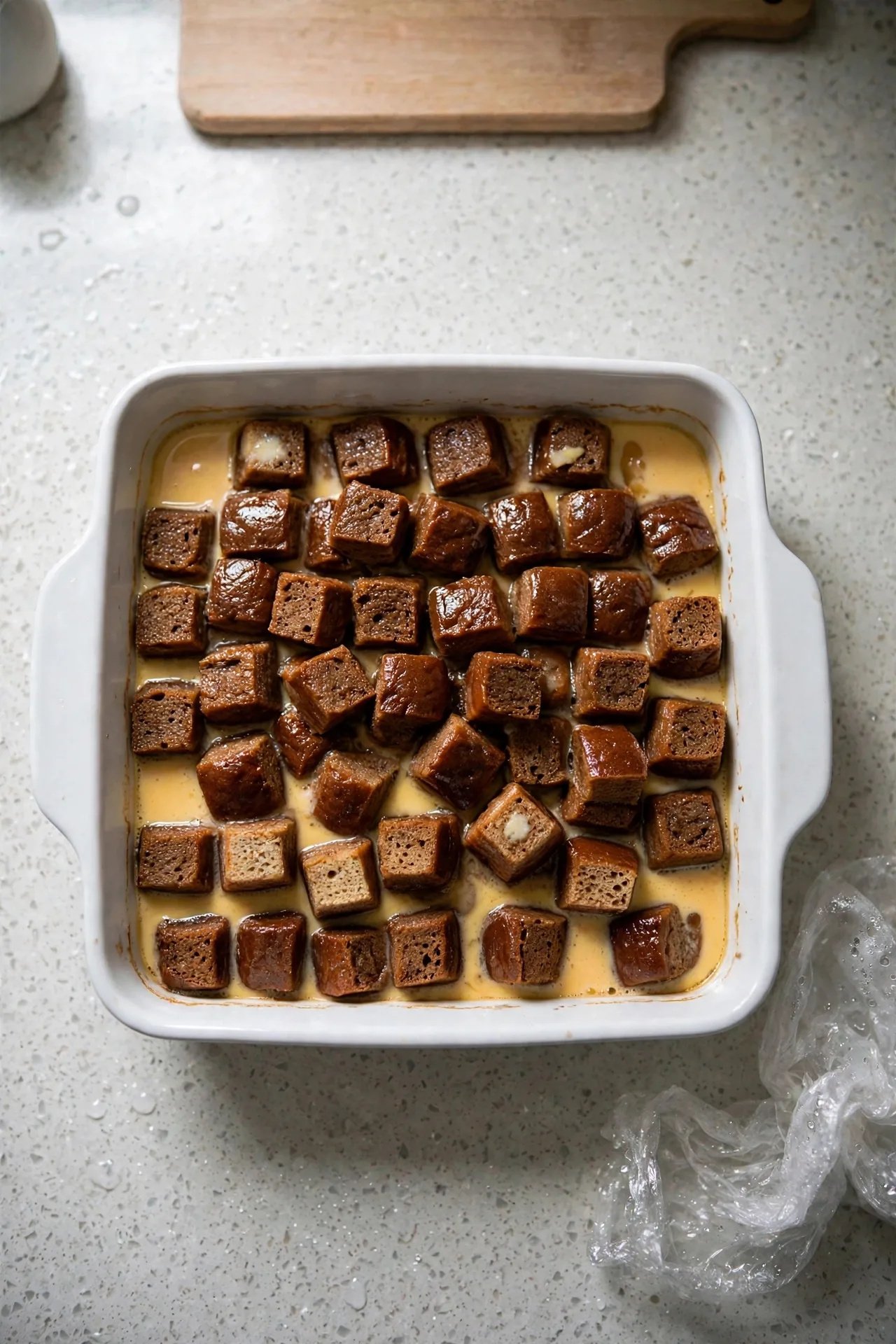
About 30 minutes before baking, take the dish out of the refrigerator, remove the cover, and heat the oven to 350°F (175°C) with a rack in the center. Letting the dish lose some of its chill helps the casserole bake evenly and lowers the chance of a ceramic dish cracking.
The cubes should look evenly soaked, with only a little custard pooling in the corners. Press any dry-looking cubes into the liquid.
In a bowl, mix the brown sugar, flour, cinnamon, and salt. Add the cold butter and rub it in with your fingertips until the mixture looks like coarse, uneven crumbs with some pea-size pieces.
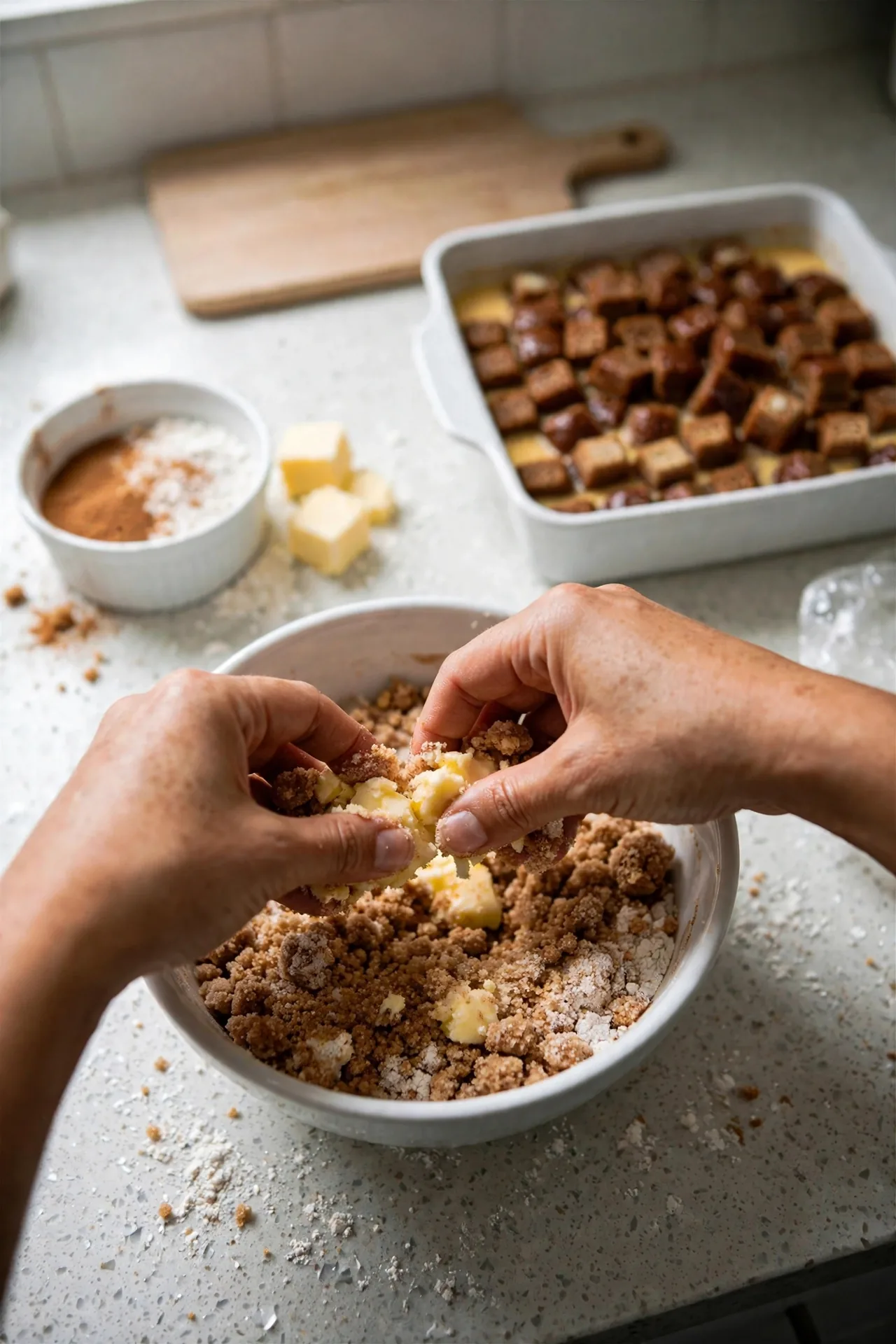
Scatter the streusel over the soaked bread, covering it evenly out to the edges.
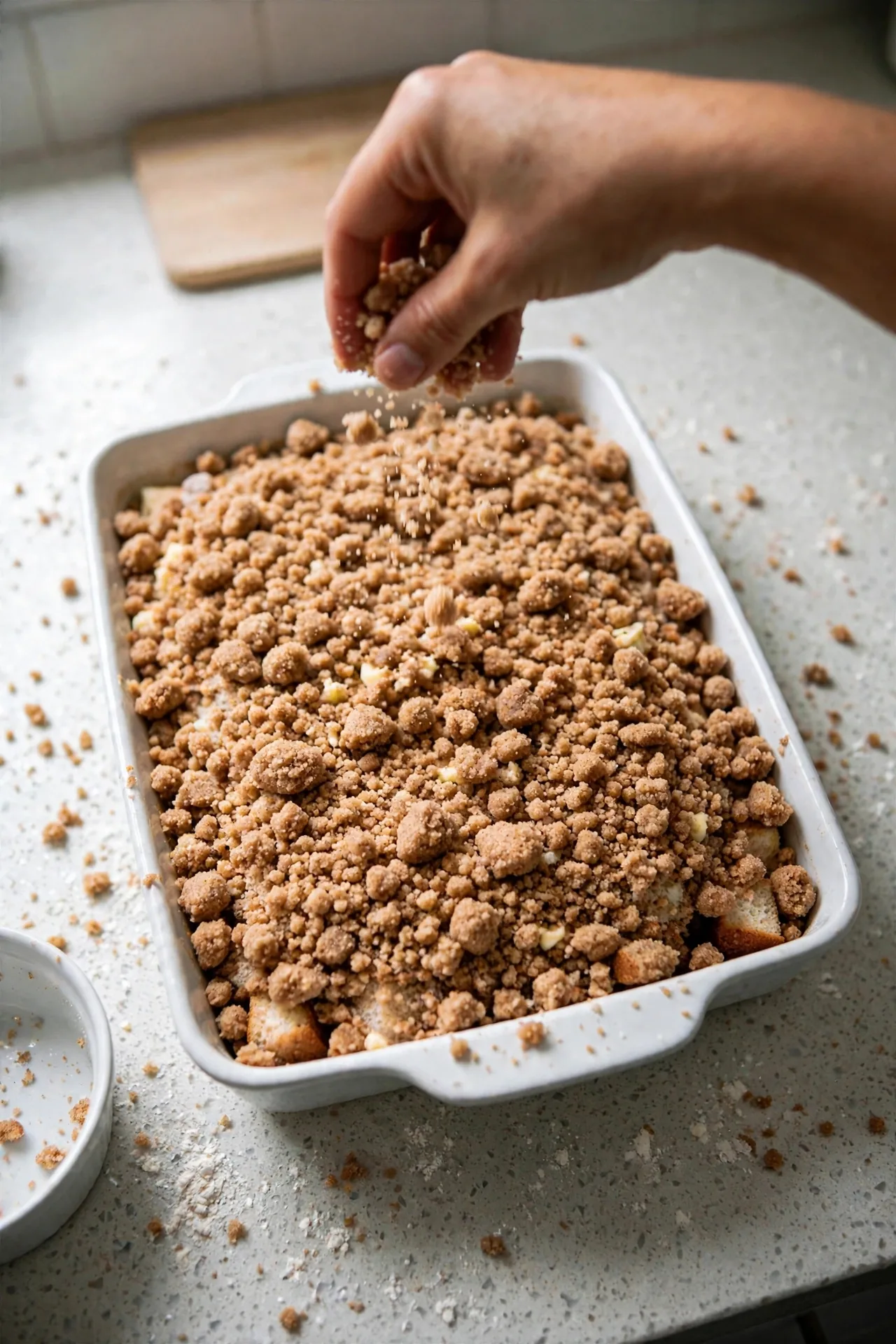
Step 6: Bake Covered, Then Uncovered
Tent the dish with foil, keeping the foil from touching the streusel, and bake on the center rack for 20 minutes. The foil keeps the topping from browning before the custard begins to set.
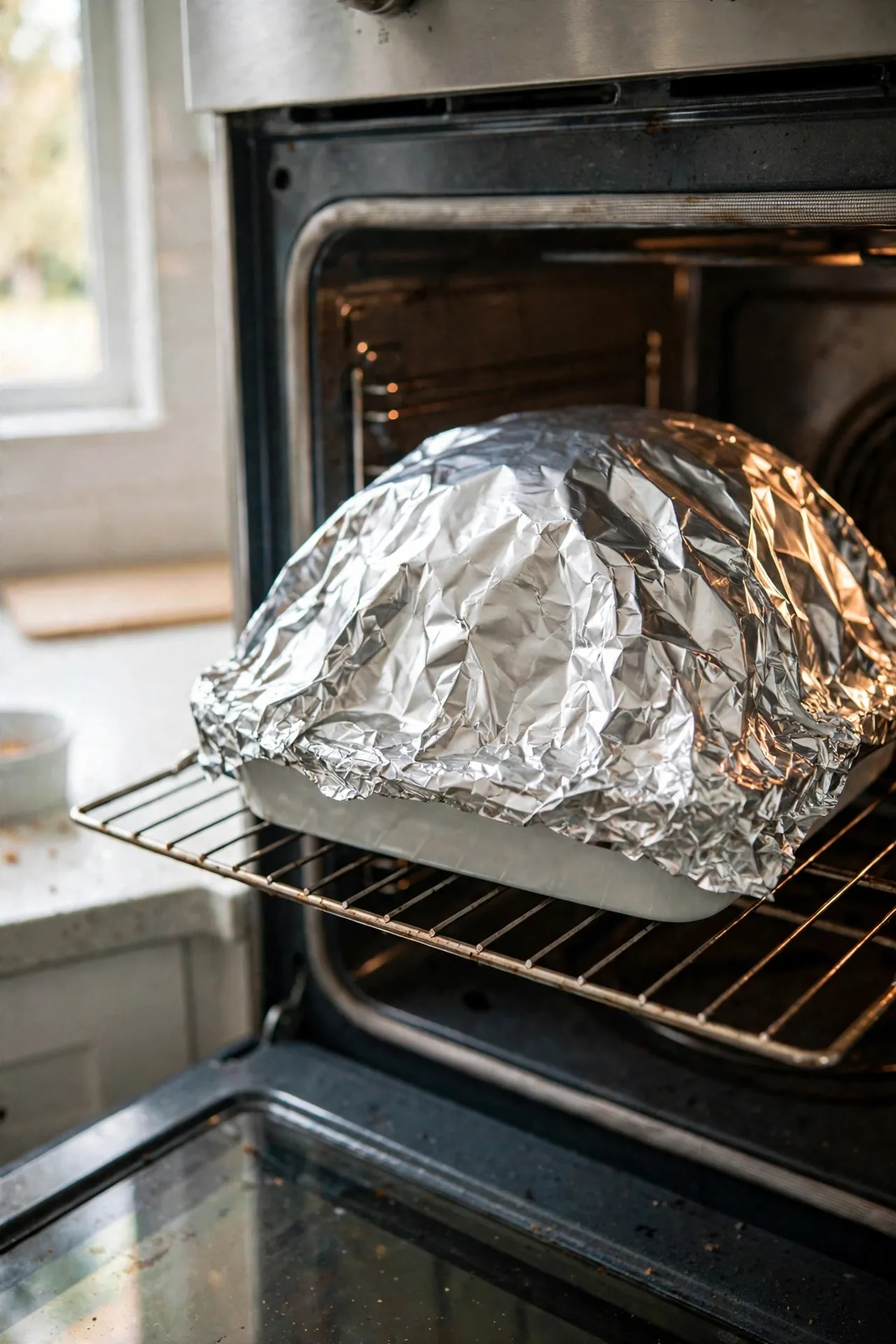
Remove the foil. The top should look puffed and set, with the streusel melted into the surface but still pale. Bake uncovered for 25 to 35 minutes more, until the top is golden and the center no longer jiggles when you nudge the dish.
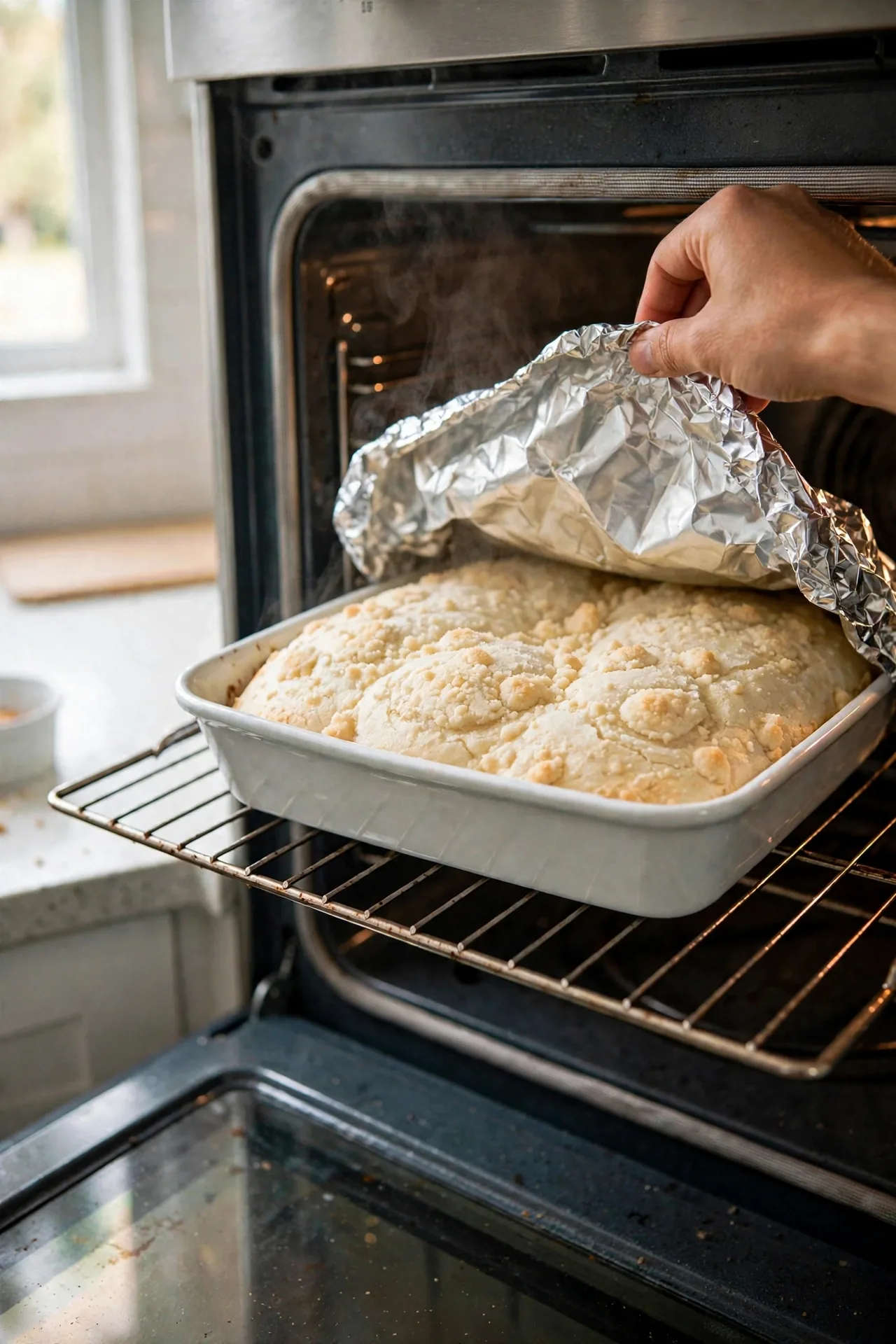
Step 7: Confirm the Center Is Done
Slide an instant-read thermometer into the center, reaching the middle of the custardy layer without touching the dish. 160°F (71°C) is the target. If it reads lower and the top is already dark, tent loosely with foil and bake 5 to 10 minutes more, then check again.
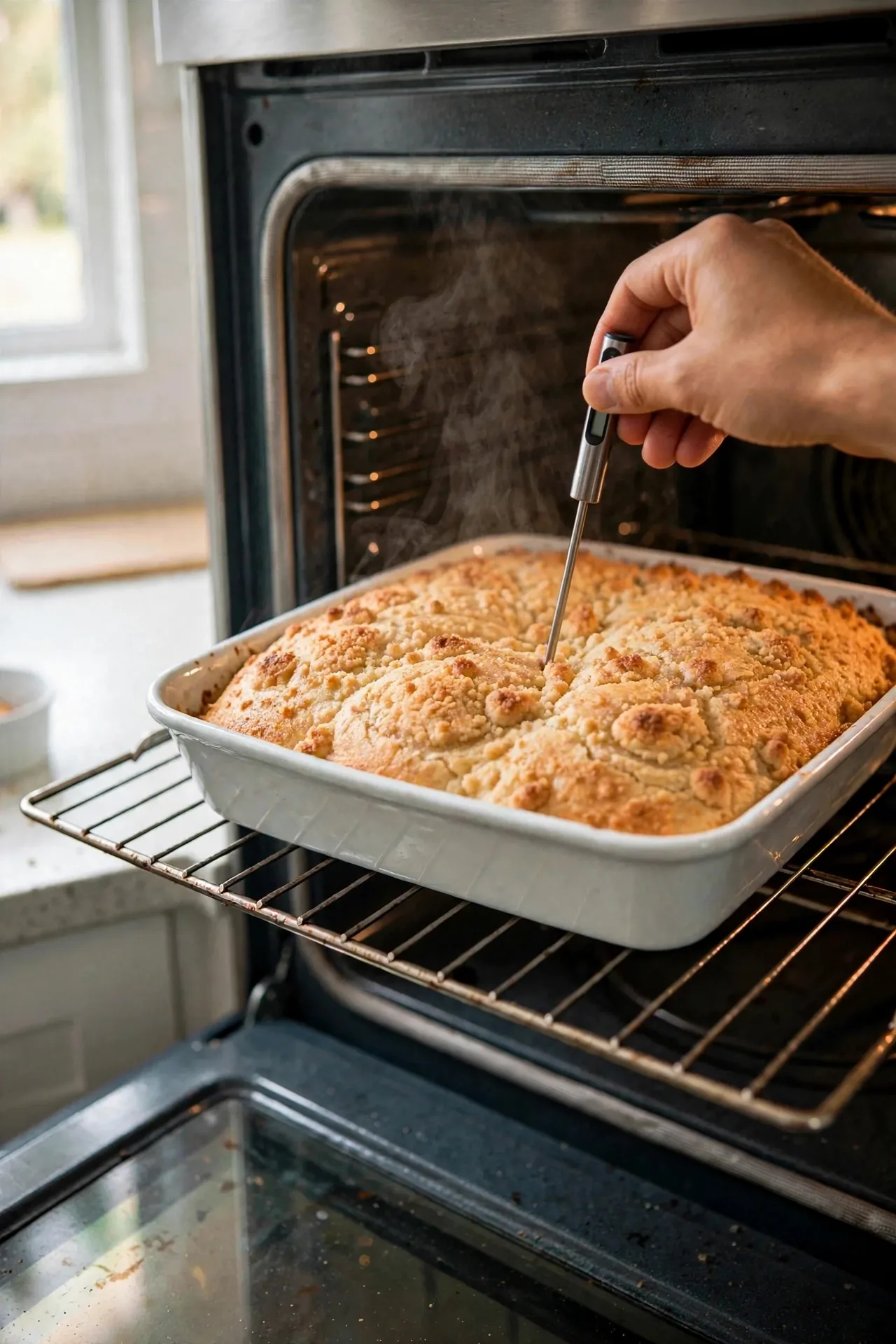
Doneness check: the middle, not the top. A golden streusel can sit on top of a center that is still loose, since the surface browns from oven heat while the middle takes longer to set. The thermometer settles it.
Step 8: Rest, Cut, and Serve
Let the casserole rest for 10 minutes. The custard finishes setting as it cools slightly, so the squares hold together when cut. Cut into 8 squares and lift out the first with a spatula. The cut face should show soft, evenly set custard between the bread pieces with no pools of liquid.
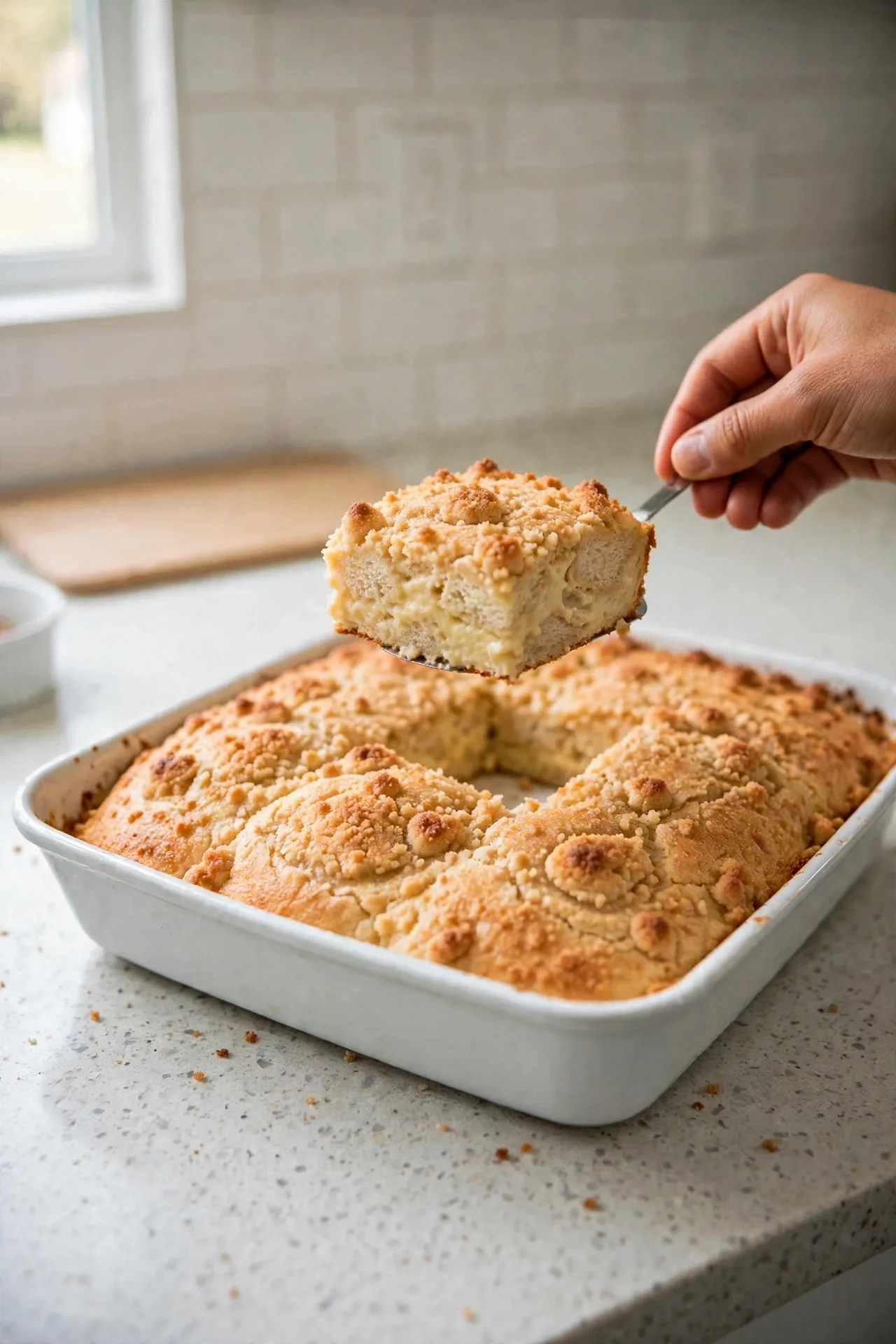
Serve warm with maple syrup, berries, or a dusting of powdered sugar.
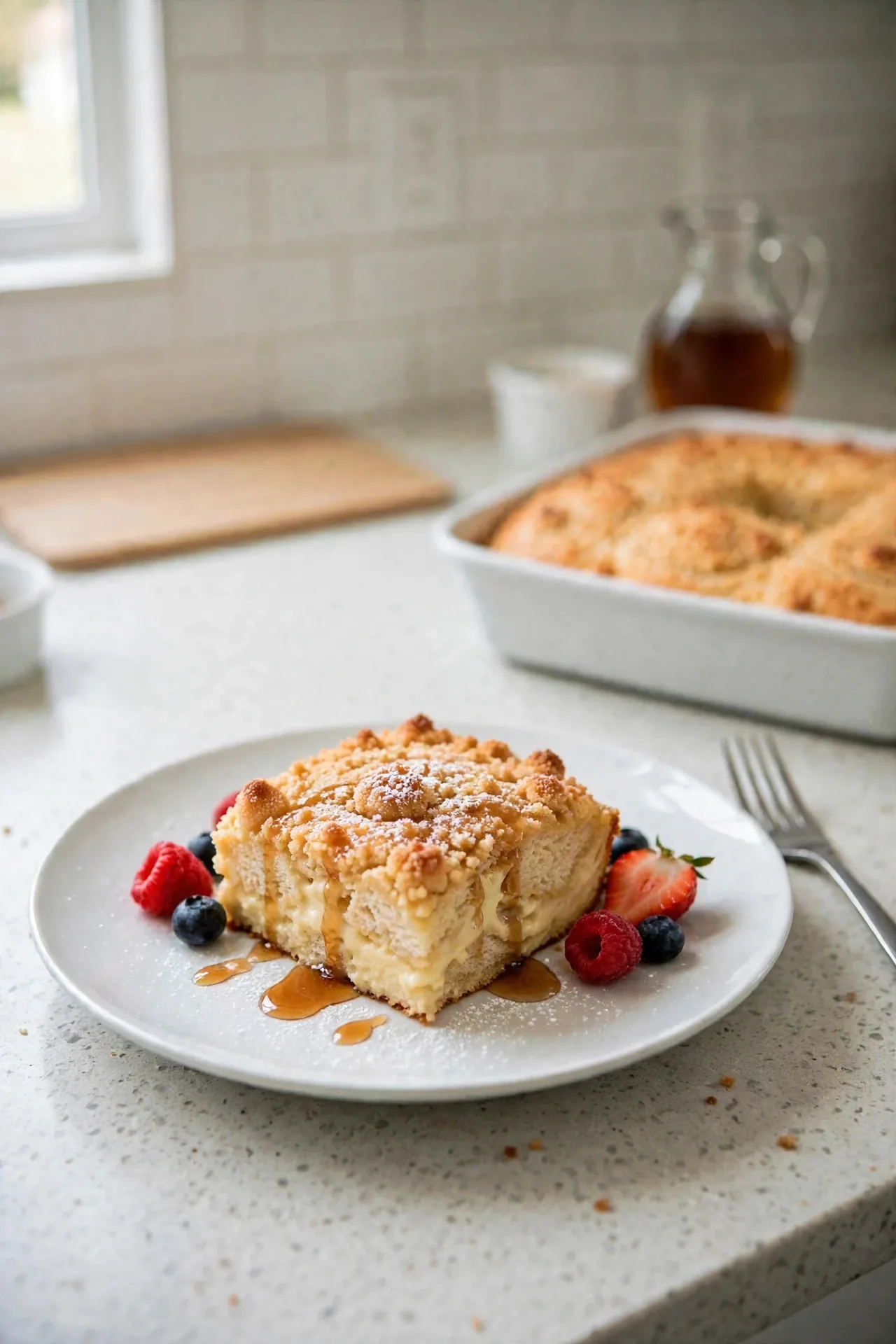
Recipe Card: Overnight French Toast Casserole
Overnight French Toast Casserole
Ingredients
Method
- Dry the bread cubes on a sheet pan: leave them out several hours, or bake at 300°F (150°C) for 10 to 15 minutes, stirring once, until dry outside and soft inside.
- Rub 1 tablespoon softened butter over a 9×13-inch dish and add the cubes in an even layer.
- Whisk the eggs with the sugar, cinnamon, nutmeg, and salt. Whisk in the milk, cream, and vanilla.
- Pour the custard over the cubes, press them down gently, cover, and refrigerate 4 to 12 hours.
- About 30 minutes before baking, uncover the dish and heat the oven to 350°F (175°C). Press any dry cubes into the custard.
- Mix the streusel ingredients, rubbing in the butter to coarse crumbs, and scatter over the top.
- Tent with foil and bake 20 minutes. Remove the foil and bake 25 to 35 minutes more, until golden and the center reaches 160°F (71°C).
- Rest 10 minutes, cut into 8 squares, and serve with maple syrup and berries.
Notes
Recipe 2: Brioche French Toast
Brioche is enriched with eggs and butter, so it browns faster and tastes richer than ordinary bread. Cut thick, it gives you a buttery, crisp crust around a center like soft custard. This version adds orange zest and vanilla to the custard.
Serves 4 (2 slices each) · Hands-on 35 minutes · Cook 20 to 25 minutes · Optional drying time 1 to 2 hours
Contains eggs, milk, and wheat (gluten). Check the brioche label for other ingredients.
Brioche Ingredients
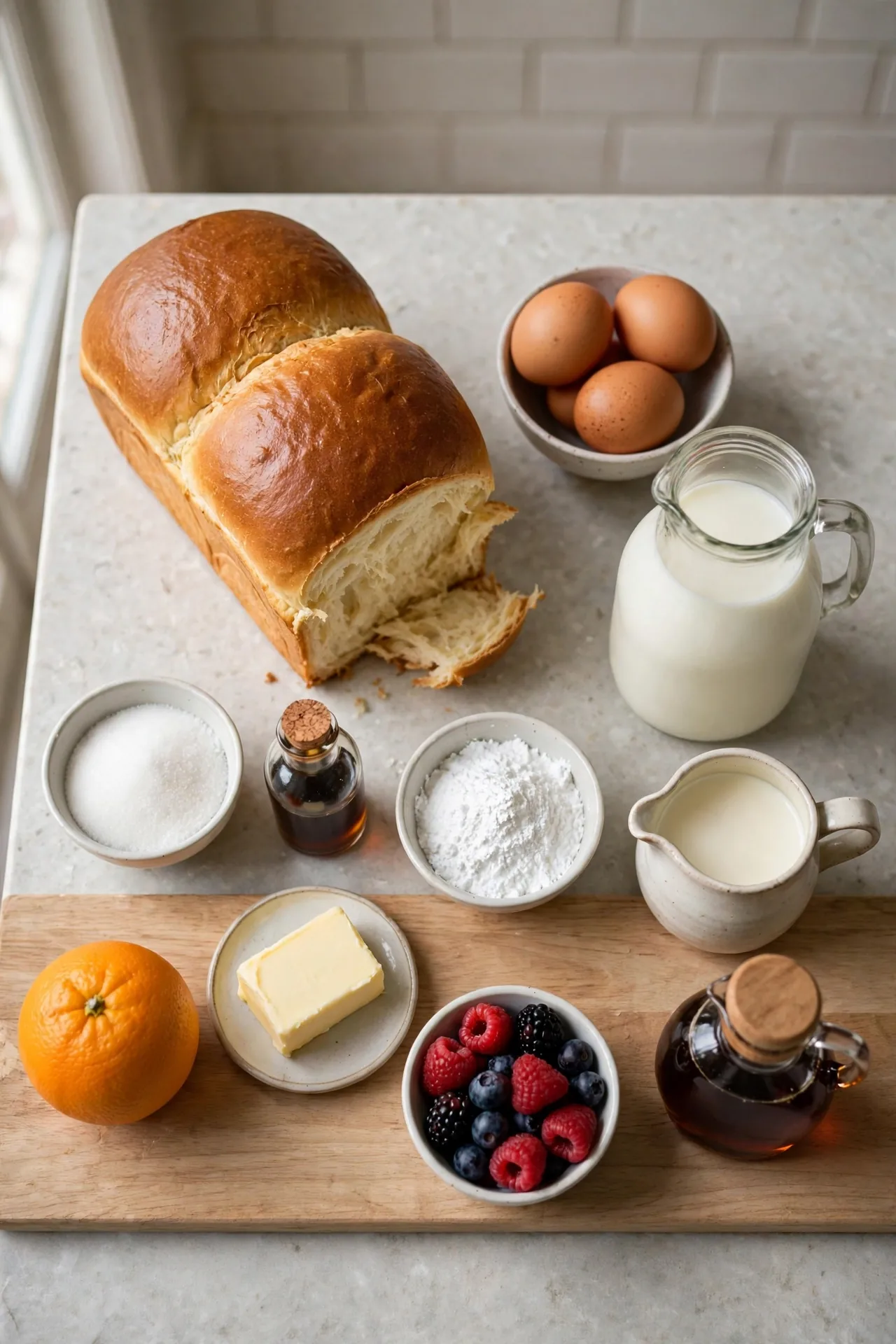
For the bread
- 1 loaf brioche (about 1 lb / 450 g), cut into 8 slices, each 1 inch (2.5 cm) thick
For the custard
- 4 large eggs
- 3/4 cup (180 ml) whole milk
- 1/4 cup (60 ml) heavy cream
- 1 tablespoon granulated sugar
- 1 teaspoon vanilla extract
- 1/2 teaspoon finely grated orange zest (from about half an orange)
- 1/4 teaspoon kosher salt
For cooking and serving
- 3 tablespoons unsalted butter, divided (1 tablespoon per batch)
- Powdered sugar, 1 cup mixed berries, maple syrup, and softened butter, to serve
How to Make Brioche French Toast
Step 1: Slice and Dry the Brioche
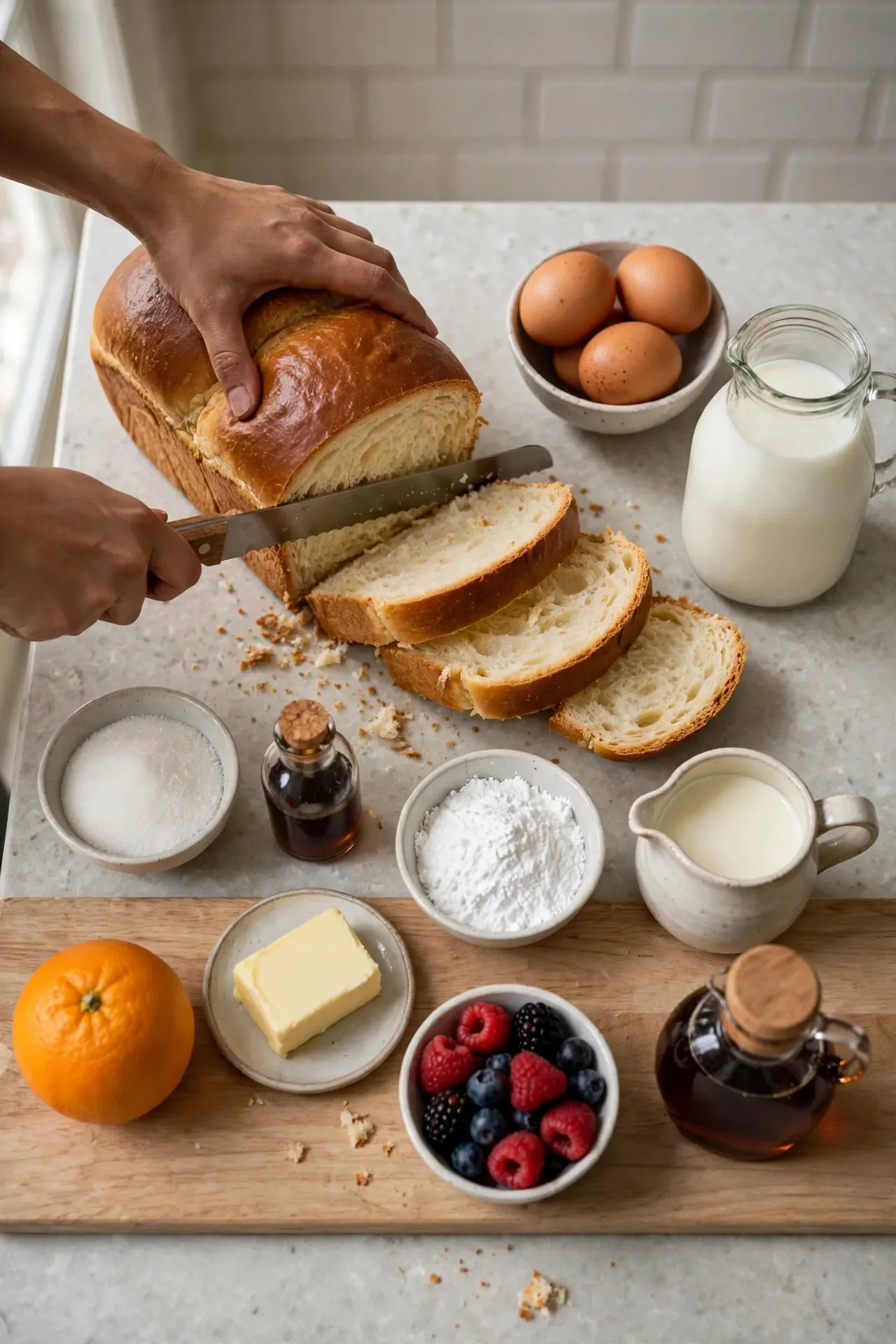
Cut the loaf into 8 slices, each 1 inch (2.5 cm) thick. Use a serrated knife and a gentle sawing motion so the soft crumb doesn’t compress.
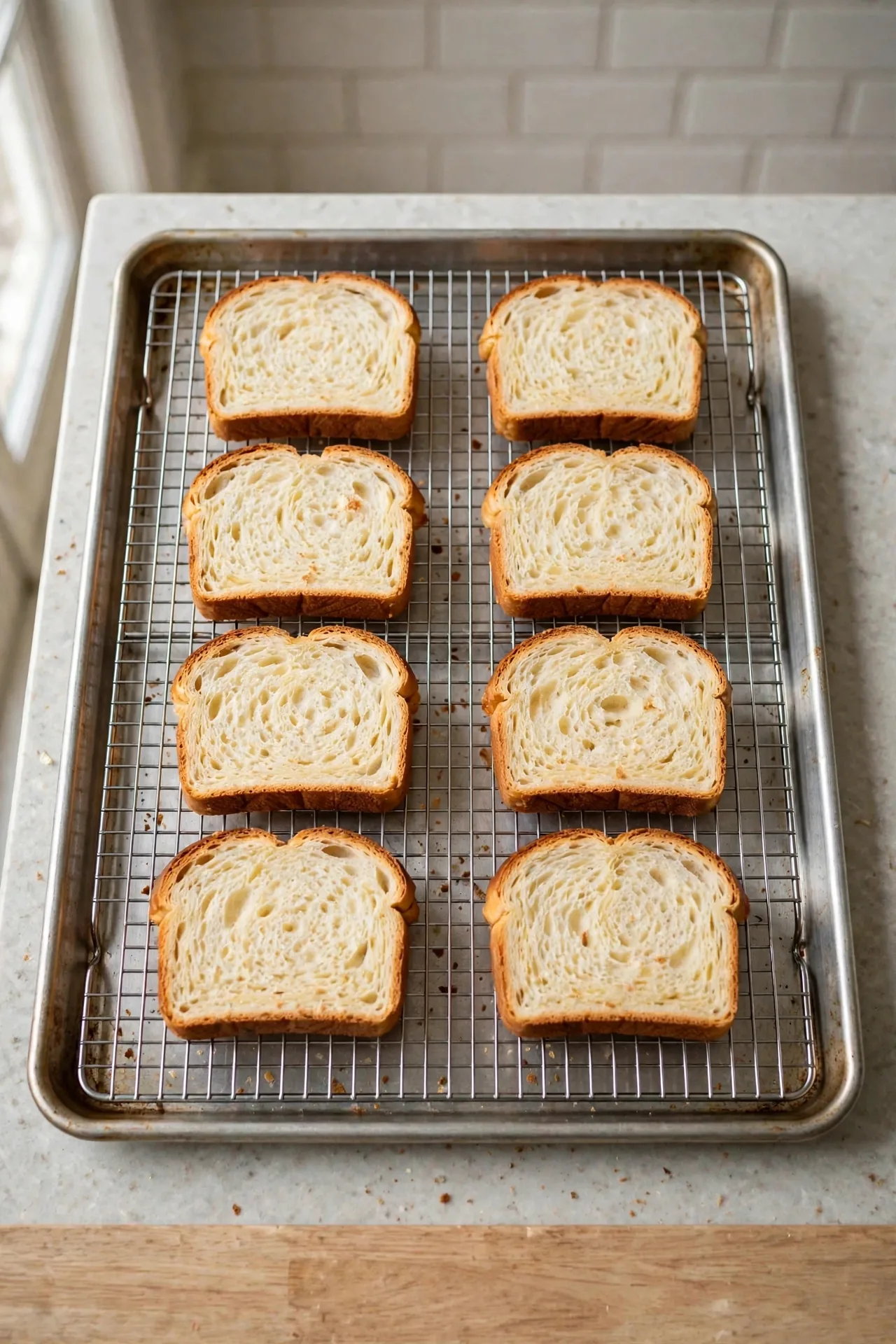
Lay the slices on a wire rack and leave them uncovered for 1 to 2 hours. Day-old brioche can skip this. The surface should feel slightly dry while the inside stays soft.
Step 2: Make the Orange-Vanilla Custard
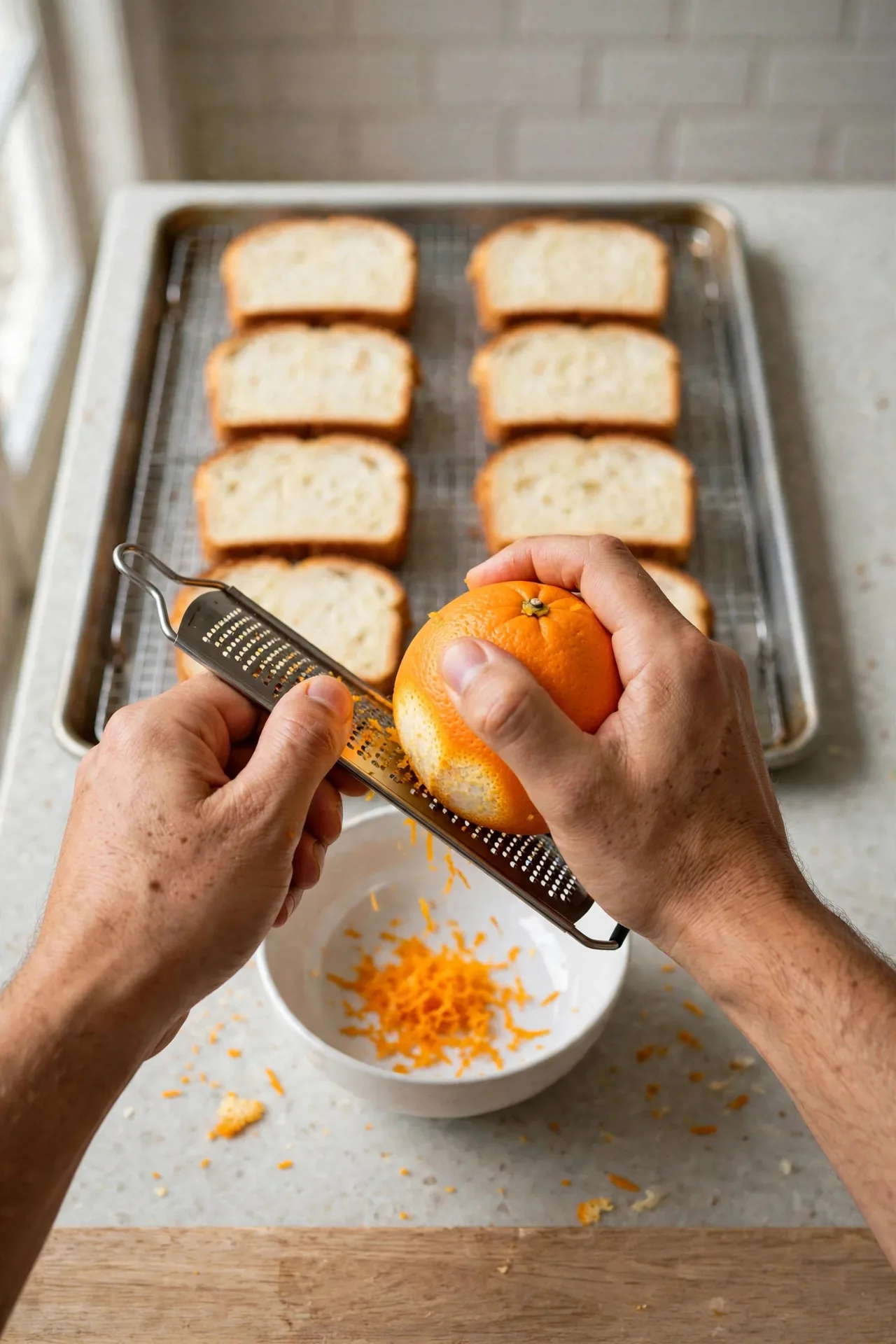
Finely grate the zest from about half an orange into a medium bowl. Stop before you reach the white pith, which tastes bitter.
Add the eggs, sugar, and salt and whisk until no streaks of yolk or white remain.
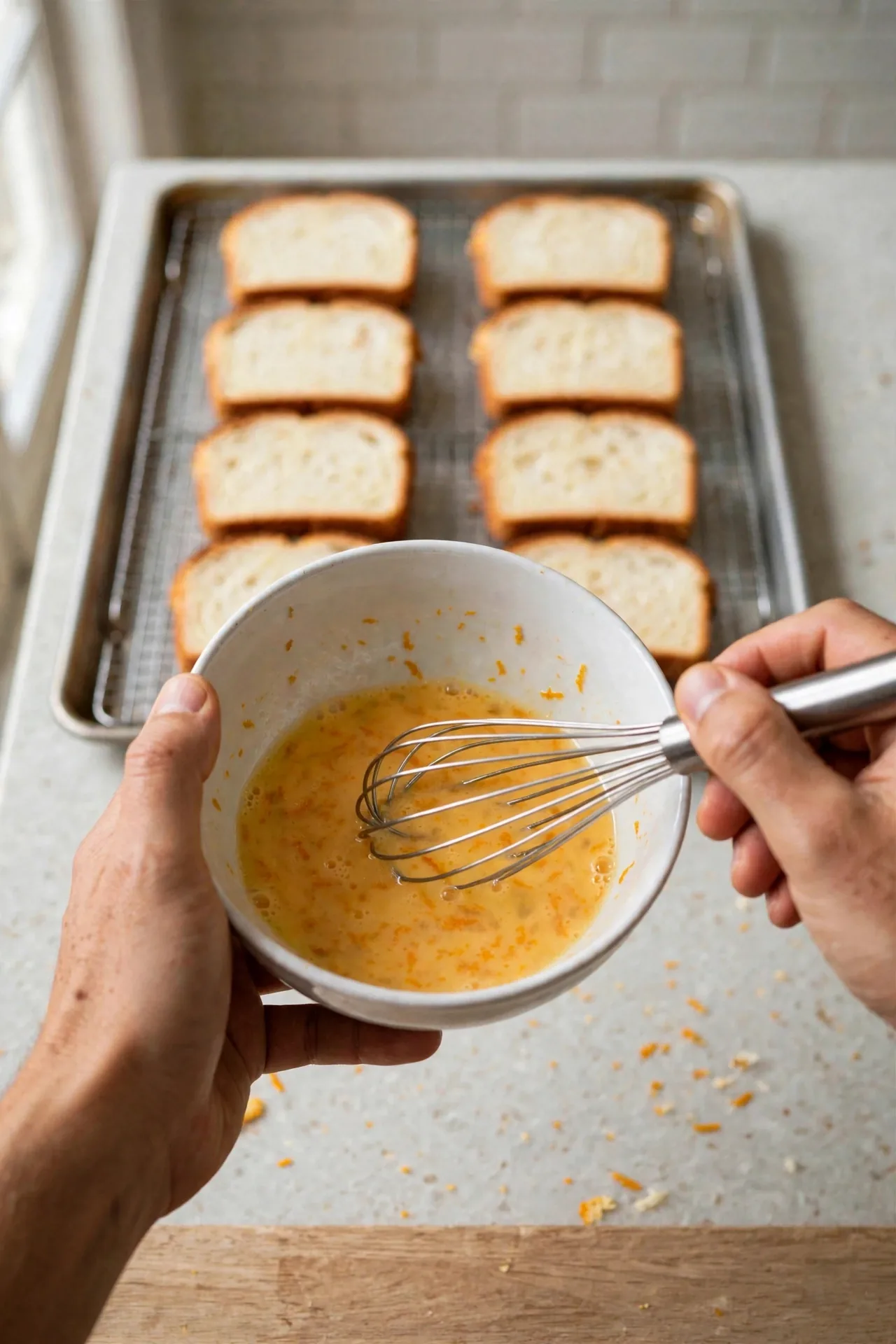
Whisk in the milk, cream, and vanilla, then pour the custard into a shallow dish wide enough to hold a slice flat.
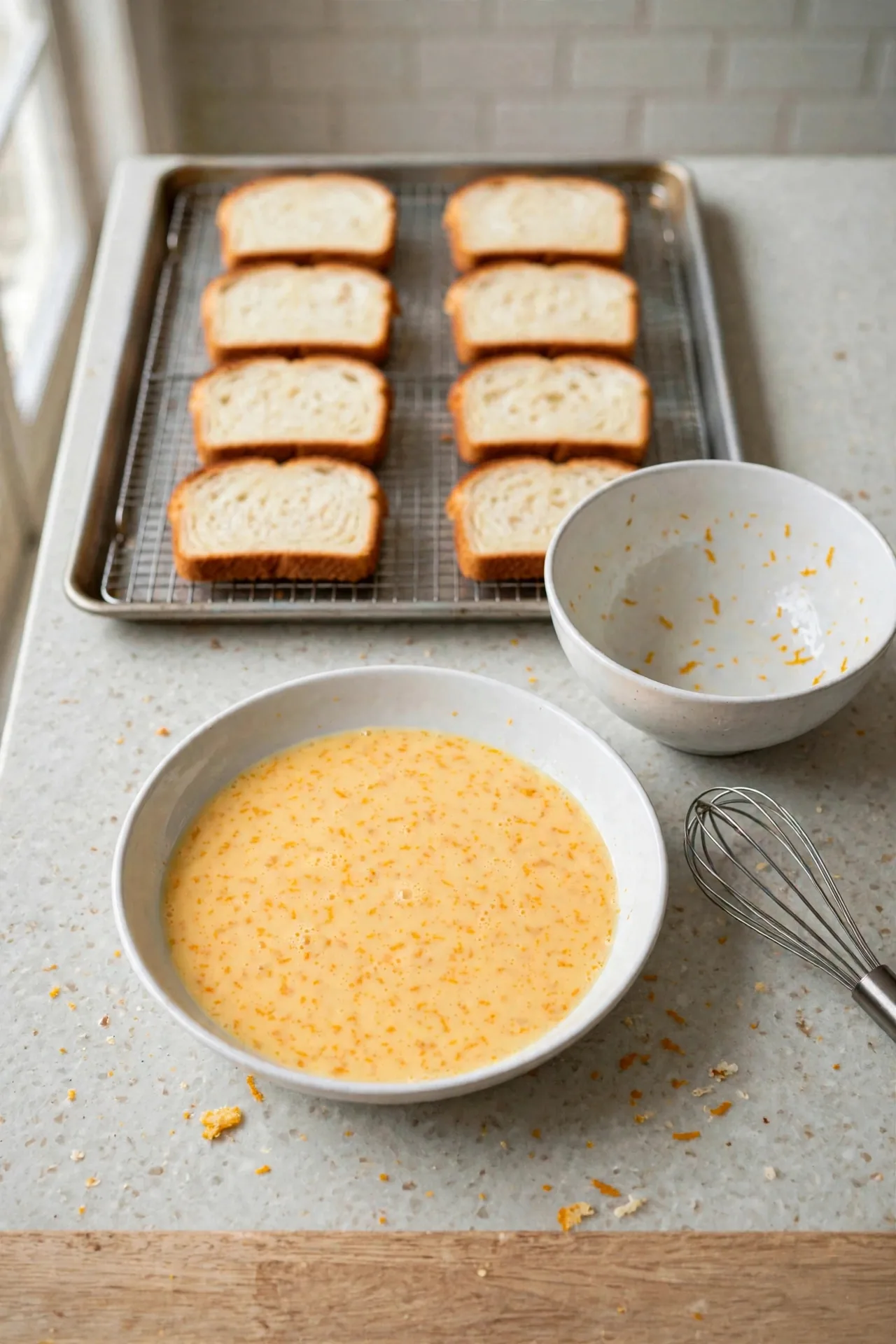
Step 3: Soak the Slices and Melt the Butter
Lay a slice in the custard for 20 to 30 seconds per side if the brioche is dry, or 10 to 15 seconds if it is fresh and soft. It should feel heavy and fully coated without slumping.
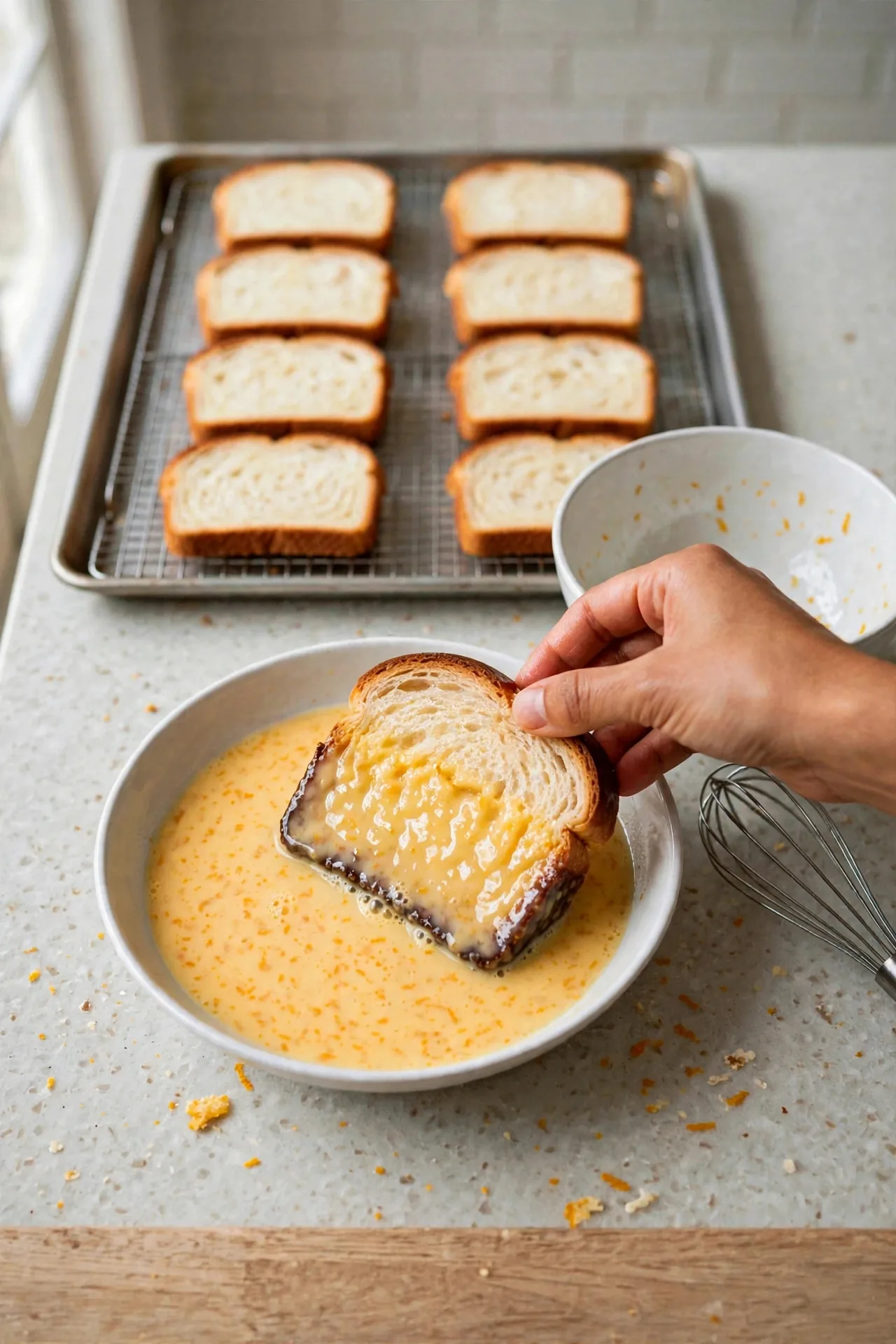
Lift the slice and hold it over the dish for a few seconds so the excess drips off. Soak only the slices for the first batch and keep the rest dry. Soaked brioche left standing turns fragile.
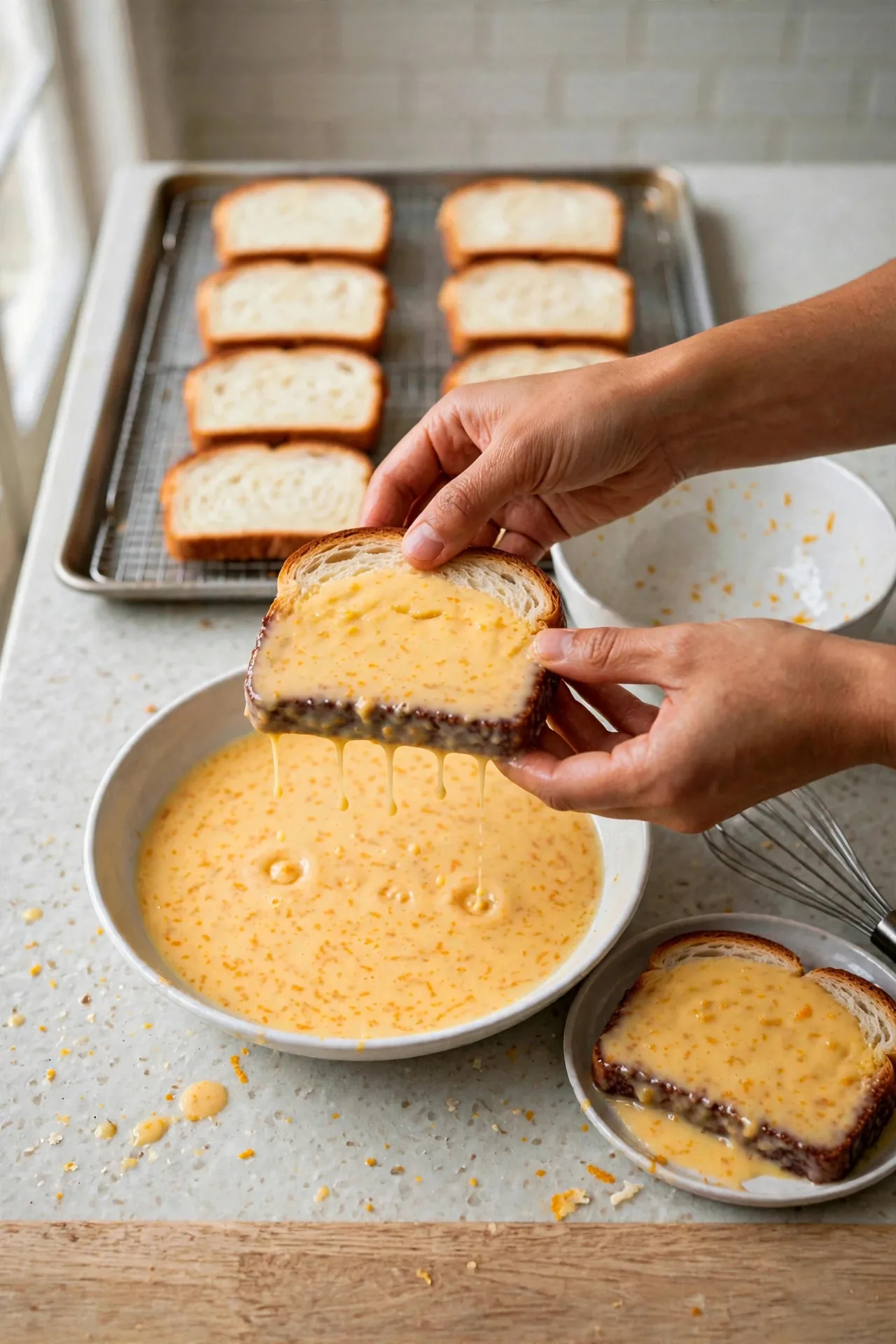
Watch for a soak that runs too long. Brioche soaked past about 30 seconds tears when lifted, steams in the pan, and often stays wet in the center. If a slice already feels waterlogged, cook it on lower heat for a little longer and expect a softer middle.
Set the skillet over medium-low heat, add 1 tablespoon of butter, and swirl until it foams. If it browns right away, lower the heat.
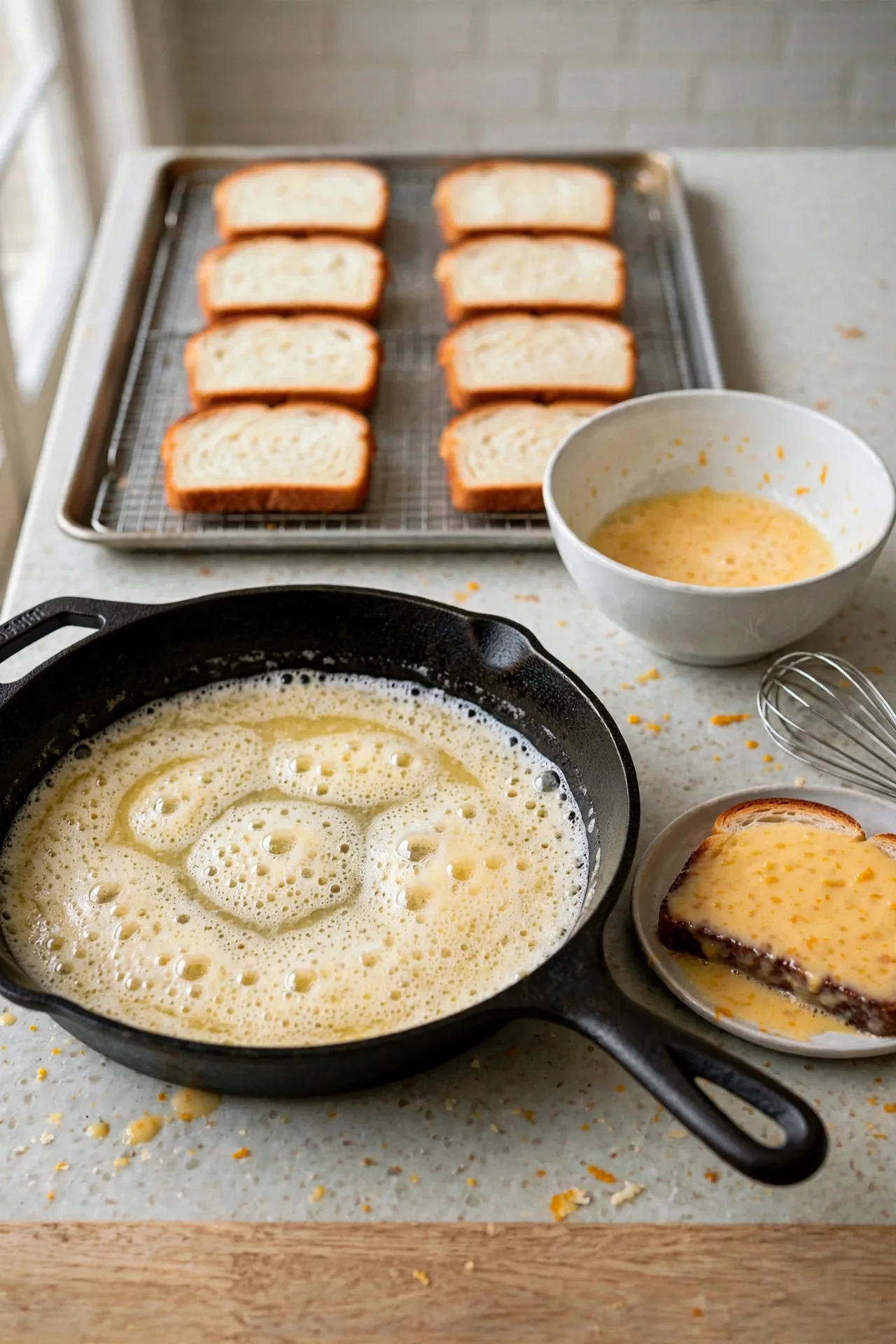
Step 4: Cook, Flip, and Hold Warm
Heat the oven to 200°F (95°C) with a wire rack on a sheet pan inside. Lay the soaked slices in the skillet in a single layer with space between them, 2 or 3 at a time depending on your pan. Cook 2 to 3 minutes, until the underside is deep golden.
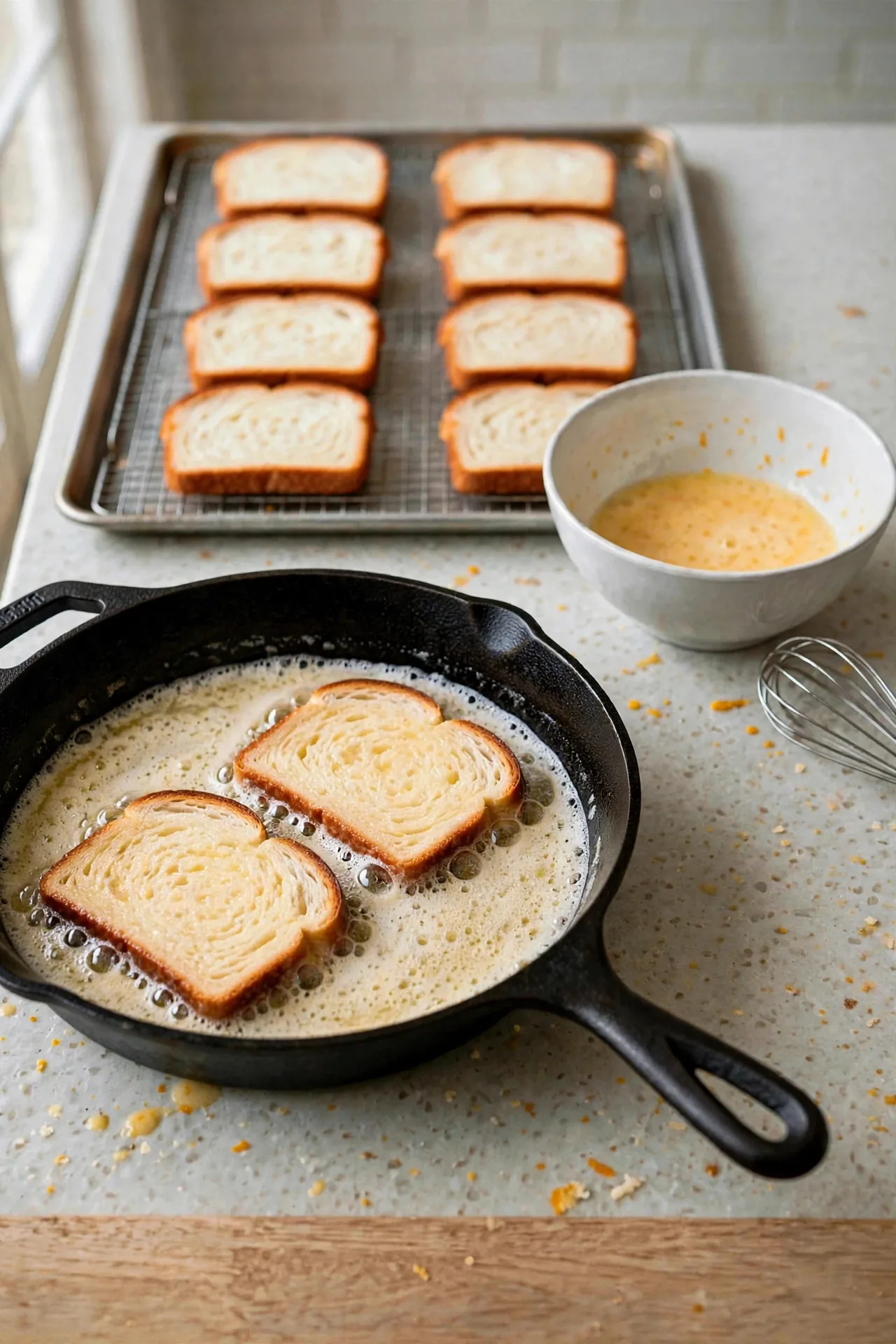
Flip with a thin spatula and cook 2 to 3 minutes more, until both sides are golden and the edges feel set when pressed.
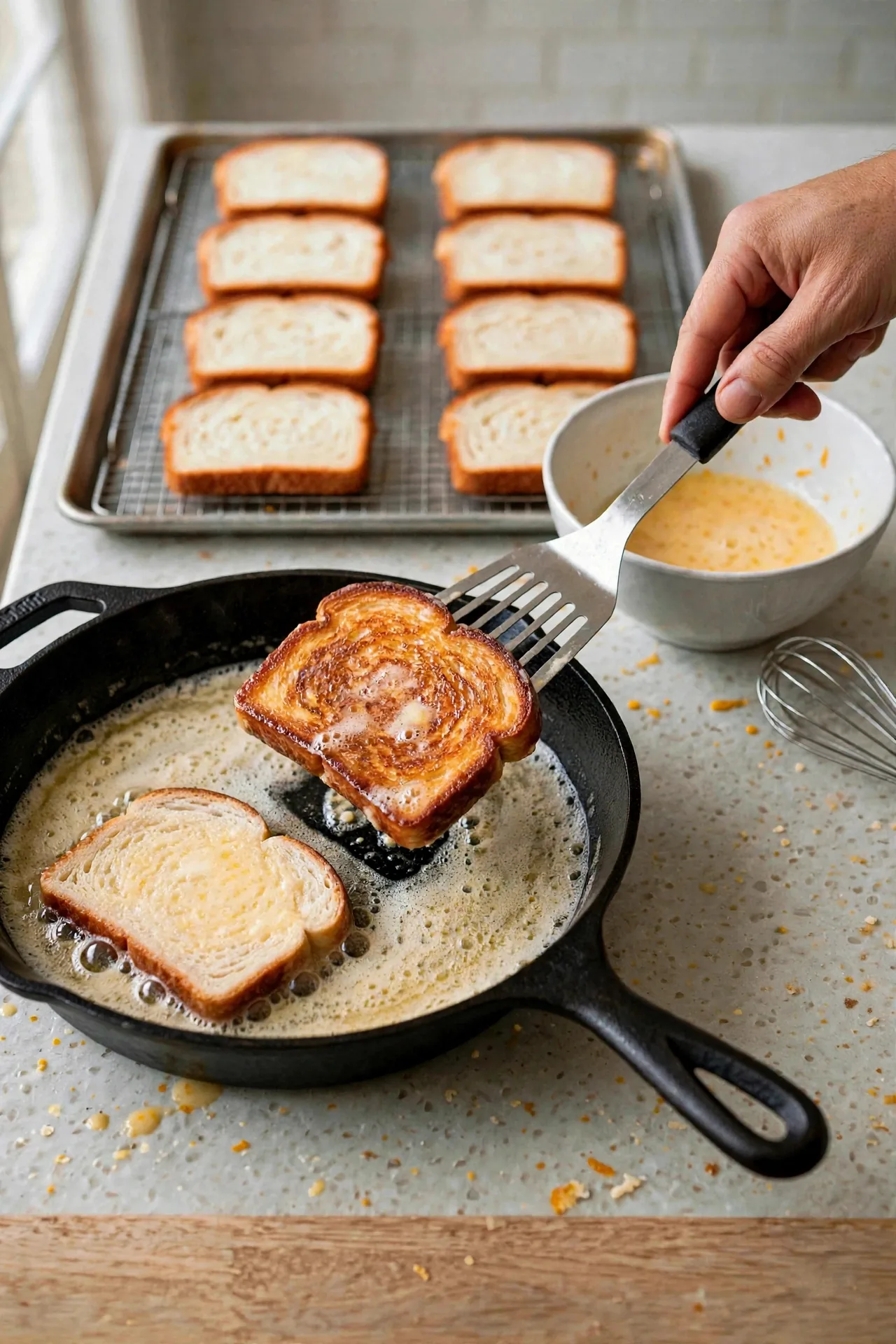
Why brioche burns before it cooks. The butter, milk, and sugar baked into the loaf brown at lower temperatures than plain bread does. Medium-low heat gives the center time to set before the crust darkens.
Move the cooked slices to the rack in the warm oven. Wipe the skillet with a paper towel, add another tablespoon of butter, and repeat with the next batch.
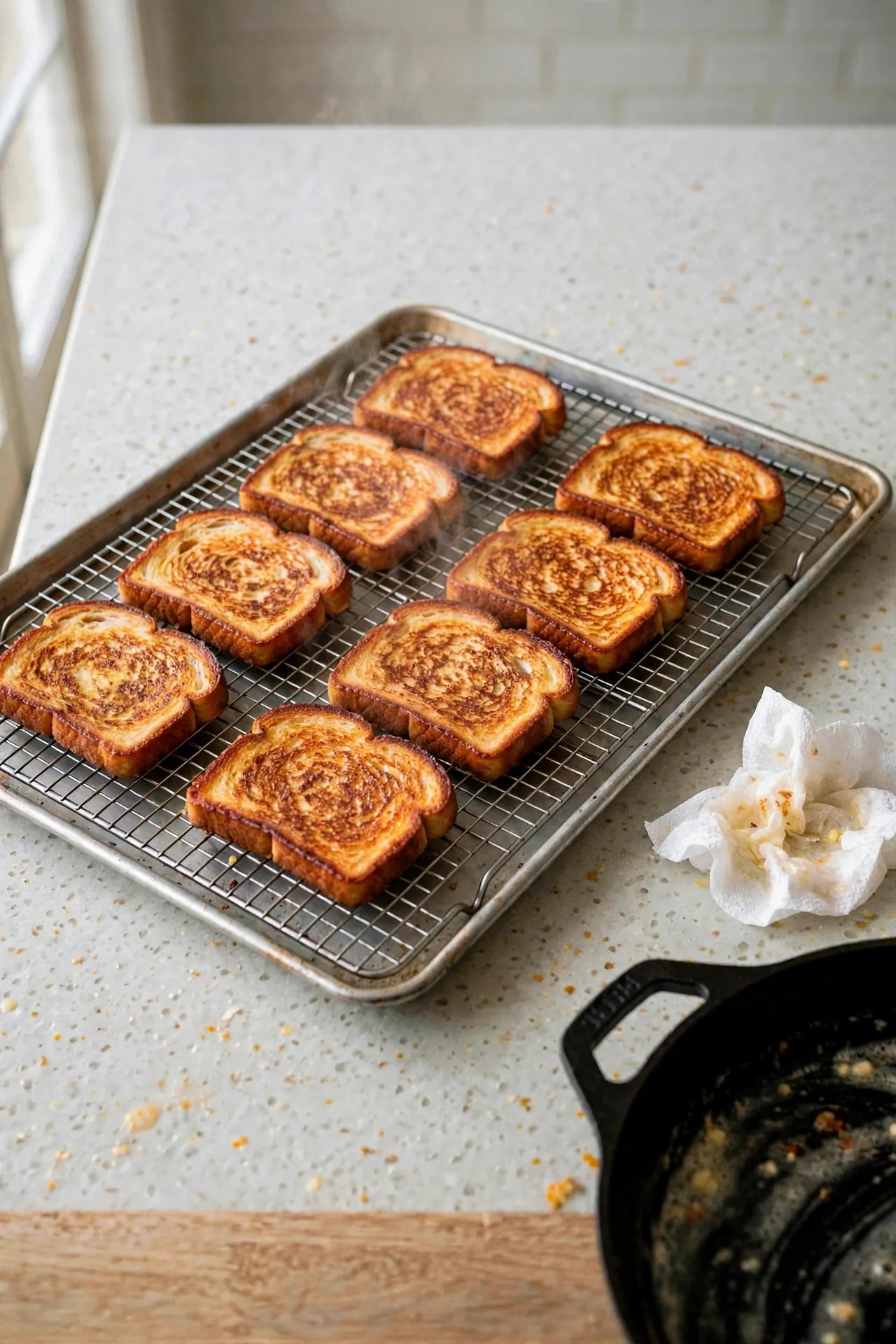
Step 5: Check the Center
Cut into the thickest slice from the first batch. The custard should be set and opaque, with no shiny, wet streaks. If it looks wet, lower the heat and give the remaining slices another 1 to 2 minutes per side. A thermometer in the center should read 160°F (71°C).
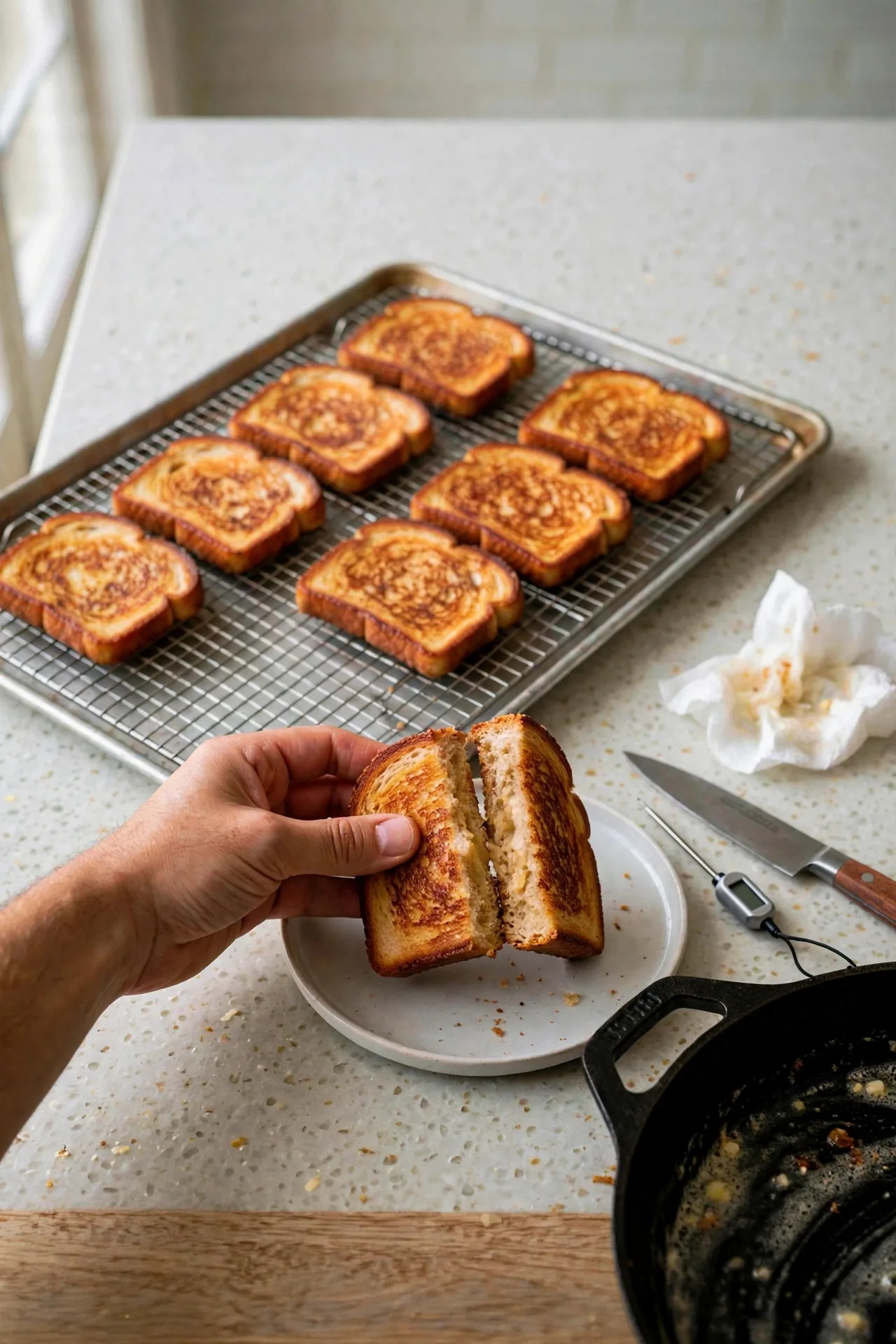
Step 6: Plate and Serve
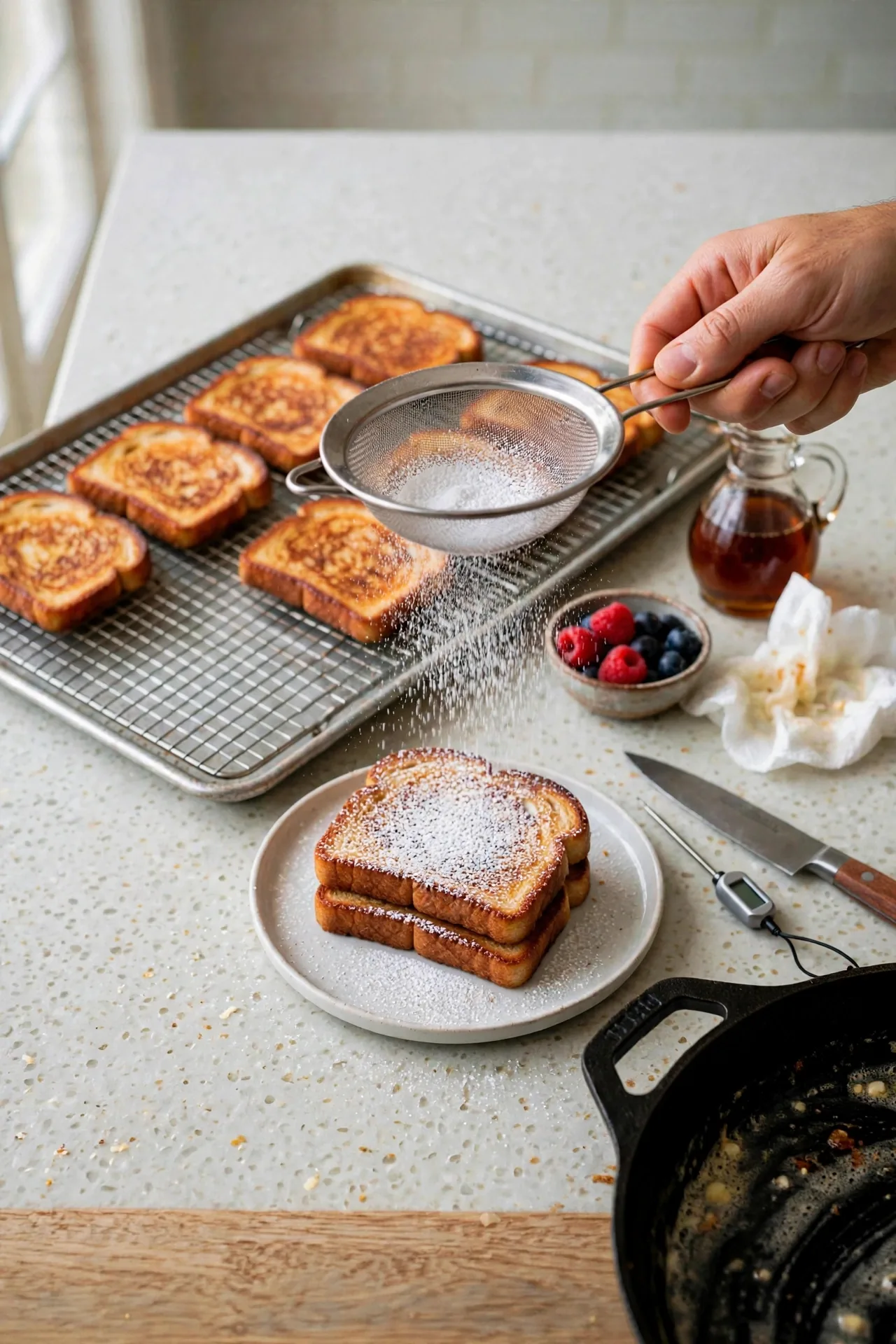
Stack 2 slices on each plate and dust them with powdered sugar through a fine sieve.
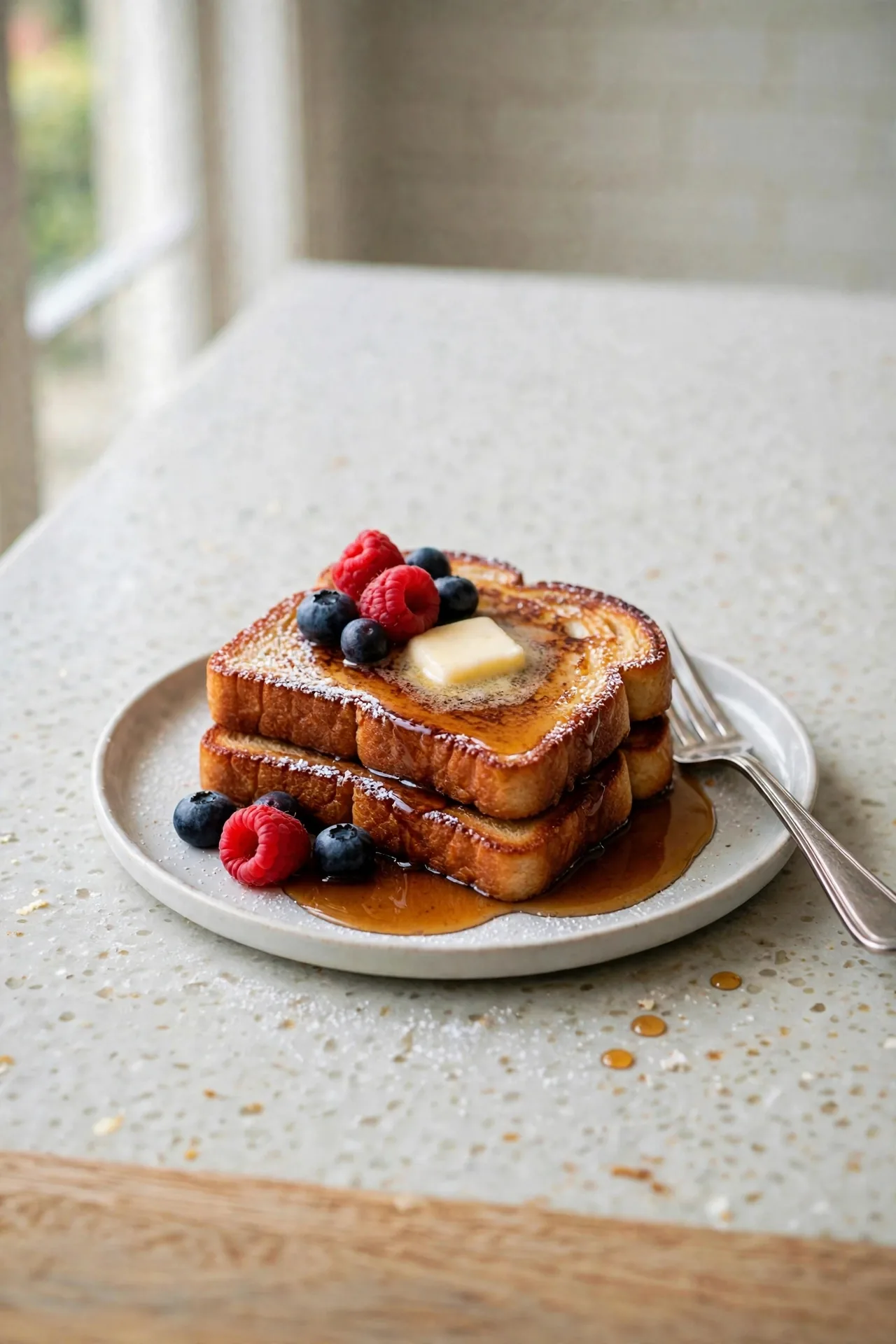
Add a handful of berries, a pat of butter, and a pour of maple syrup.
Recipe Card: Brioche French Toast
Brioche French Toast
Ingredients
Method
- Slice the brioche 1 inch (2.5 cm) thick and let it dry on a wire rack for 1 to 2 hours if it is fresh.
- Whisk the eggs, sugar, salt, and orange zest. Whisk in the milk, cream, and vanilla and pour into a shallow dish.
- Soak each slice 20 to 30 seconds per side (10 to 15 seconds if fresh and soft). Let the excess drip off.
- Heat the oven to 200°F (95°C) with a rack on a sheet pan. Melt 1 tablespoon butter in a skillet over medium-low heat.
- Cook 2 to 3 slices at a time, 2 to 3 minutes per side, until deep golden. Hold cooked slices on the rack in the oven. Wipe the pan and add fresh butter for each batch.
- Check one slice: the center should be set, or read 160°F (71°C).
- Dust with powdered sugar and serve with berries, butter, and maple syrup.
Notes
Recipe 3: Cinnamon French Toast
The classic version, with enough cinnamon to taste in every bite. The custard is simple, the edges come out crisp, and a coat of cinnamon sugar goes on while the toast is still hot so it clings to the surface.
Serves 4 (2 slices each) · Hands-on 30 minutes · Cook 15 to 20 minutes
Contains eggs, milk, and wheat (gluten).
Cinnamon French Toast Ingredients
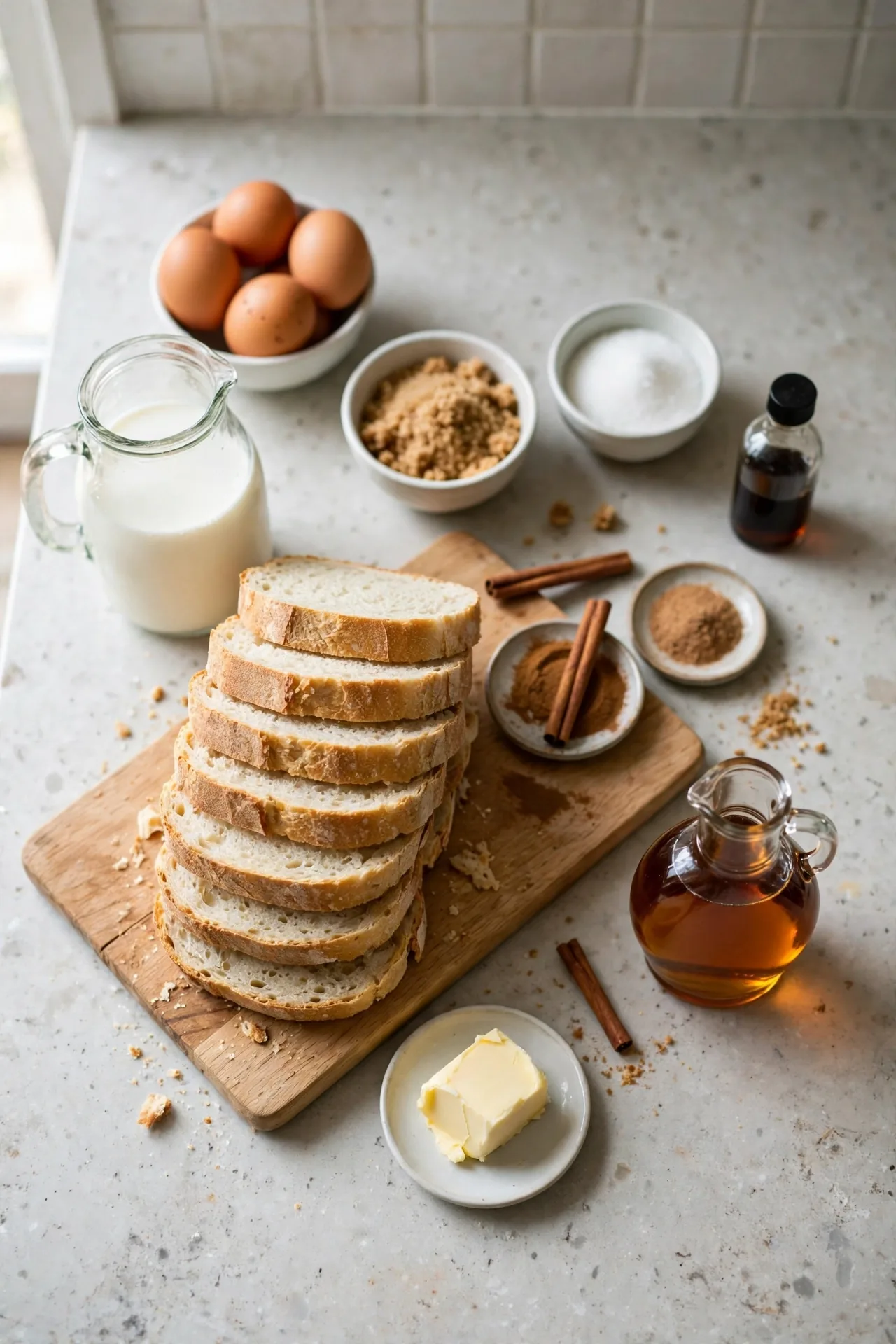
For the bread
- 8 slices thick-cut bread, 3/4 to 1 inch (2 to 2.5 cm) thick (challah, Texas toast, or thick-sliced white sandwich bread), a day old if possible
For the custard
- 4 large eggs
- 1 cup (240 ml) whole milk
- 2 tablespoons light brown sugar
- 2 teaspoons ground cinnamon
- 1/4 teaspoon ground nutmeg (optional)
- 1 teaspoon vanilla extract
- 1/4 teaspoon kosher salt
For the cinnamon sugar
- 2 tablespoons granulated sugar
- 1 teaspoon ground cinnamon
For cooking and serving
- 3 tablespoons unsalted butter, divided (1 tablespoon per batch)
- Butter and maple syrup, to serve
How to Make Cinnamon French Toast
Step 1: Whisk the Cinnamon Custard
In a shallow dish, whisk the eggs with the brown sugar, cinnamon, nutmeg, and salt for about 30 seconds, until no dry clumps of cinnamon remain.
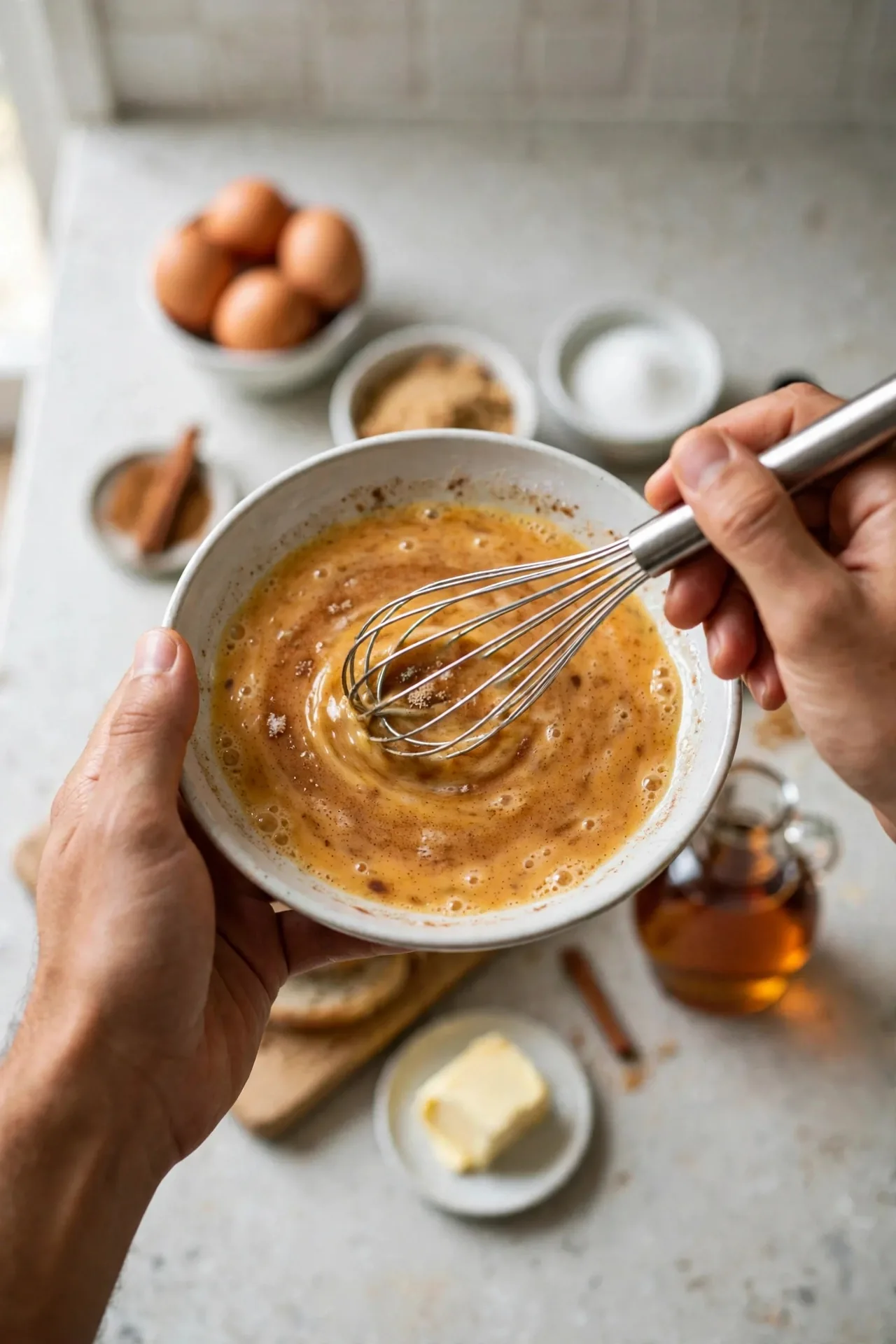
Add the milk and vanilla and whisk until smooth.
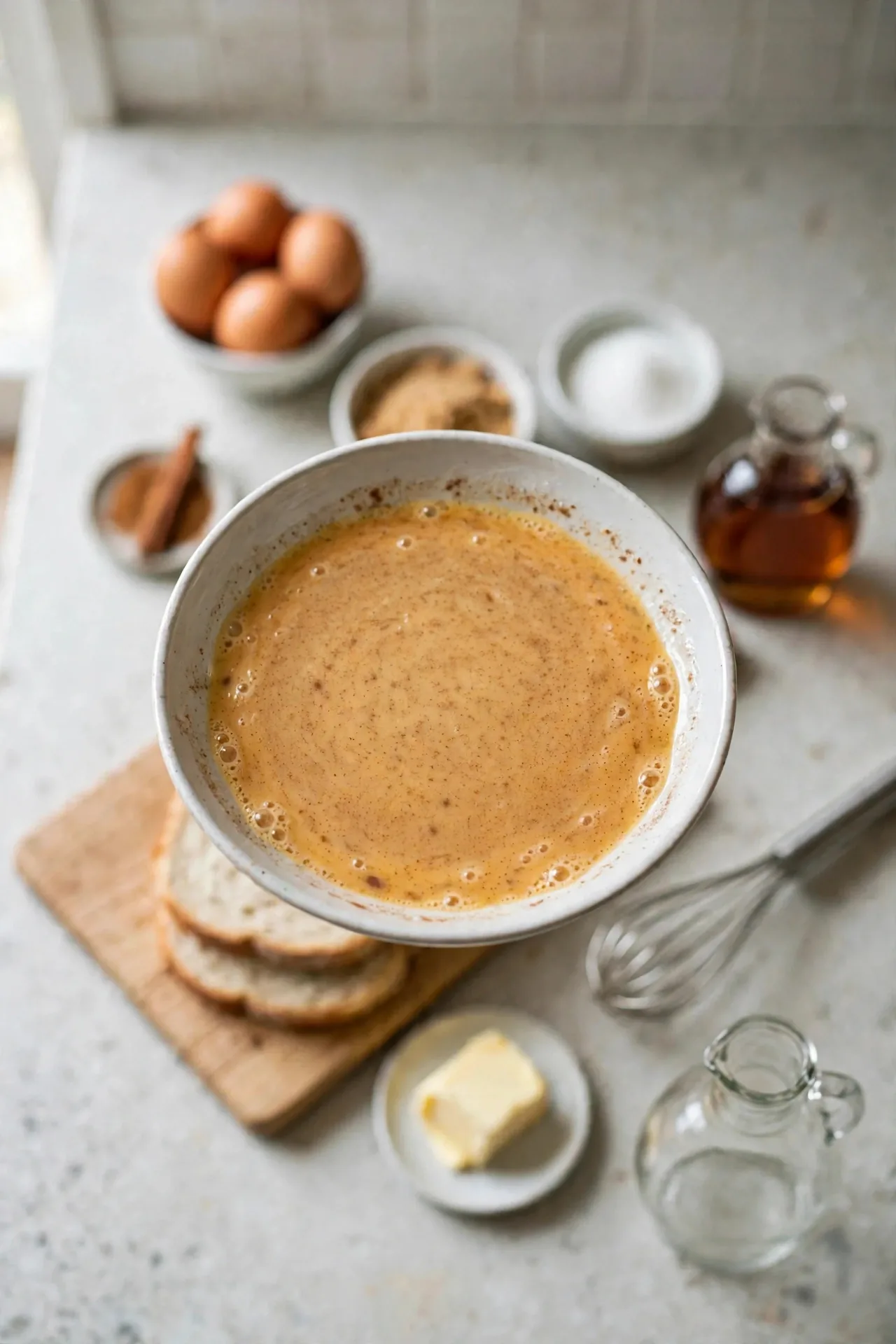
The cinnamon clump problem. Ground cinnamon repels liquid, so when it goes straight into milk it floats in dry specks and the toast ends up unevenly spiced. Whisking it into the eggs and sugar first coats the particles. If specks remain, press them against the side of the dish with the whisk.
Step 2: Mix the Cinnamon Sugar
Stir the granulated sugar and cinnamon together in a small bowl and set it near the stove.
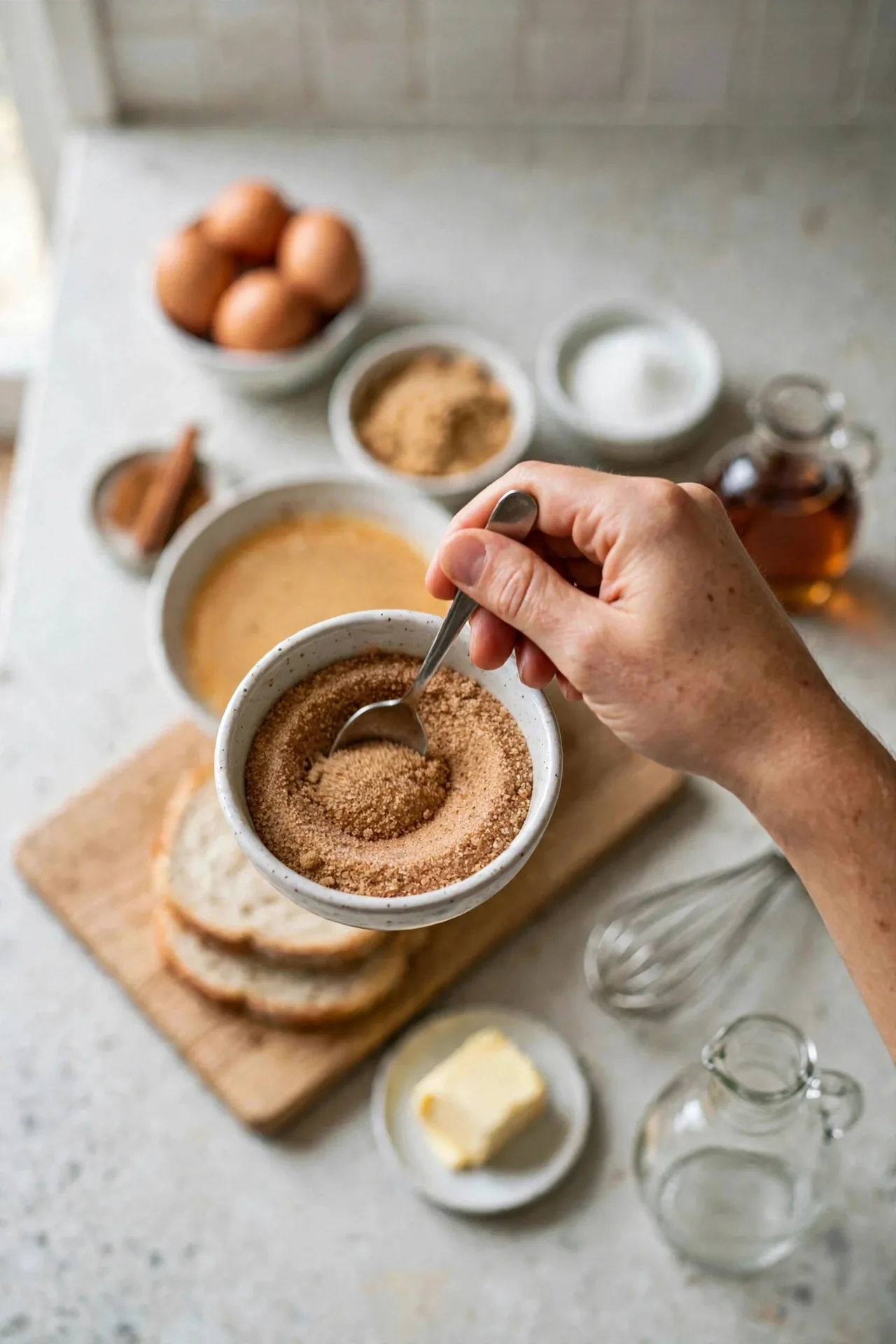
Step 3: Soak the Bread
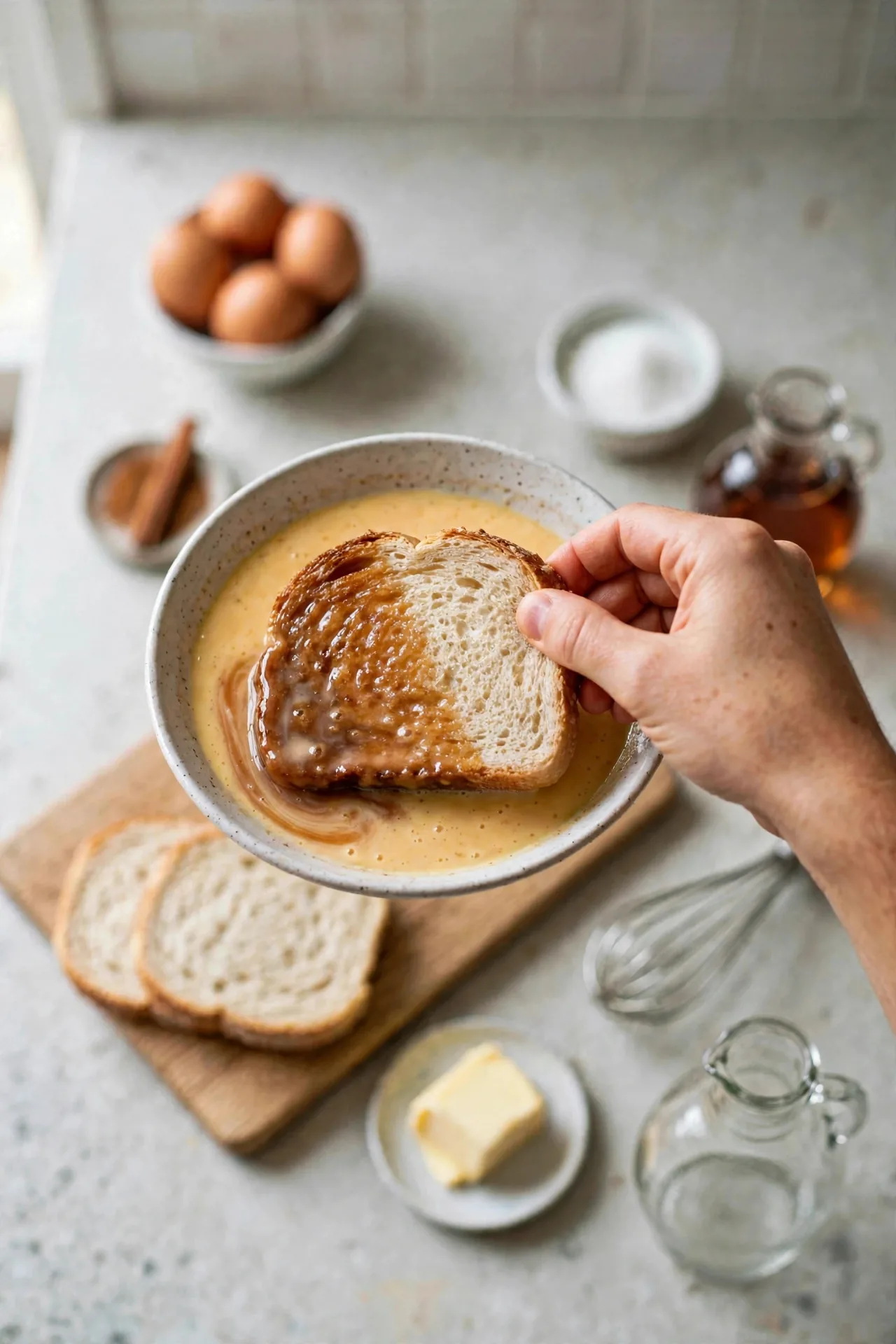
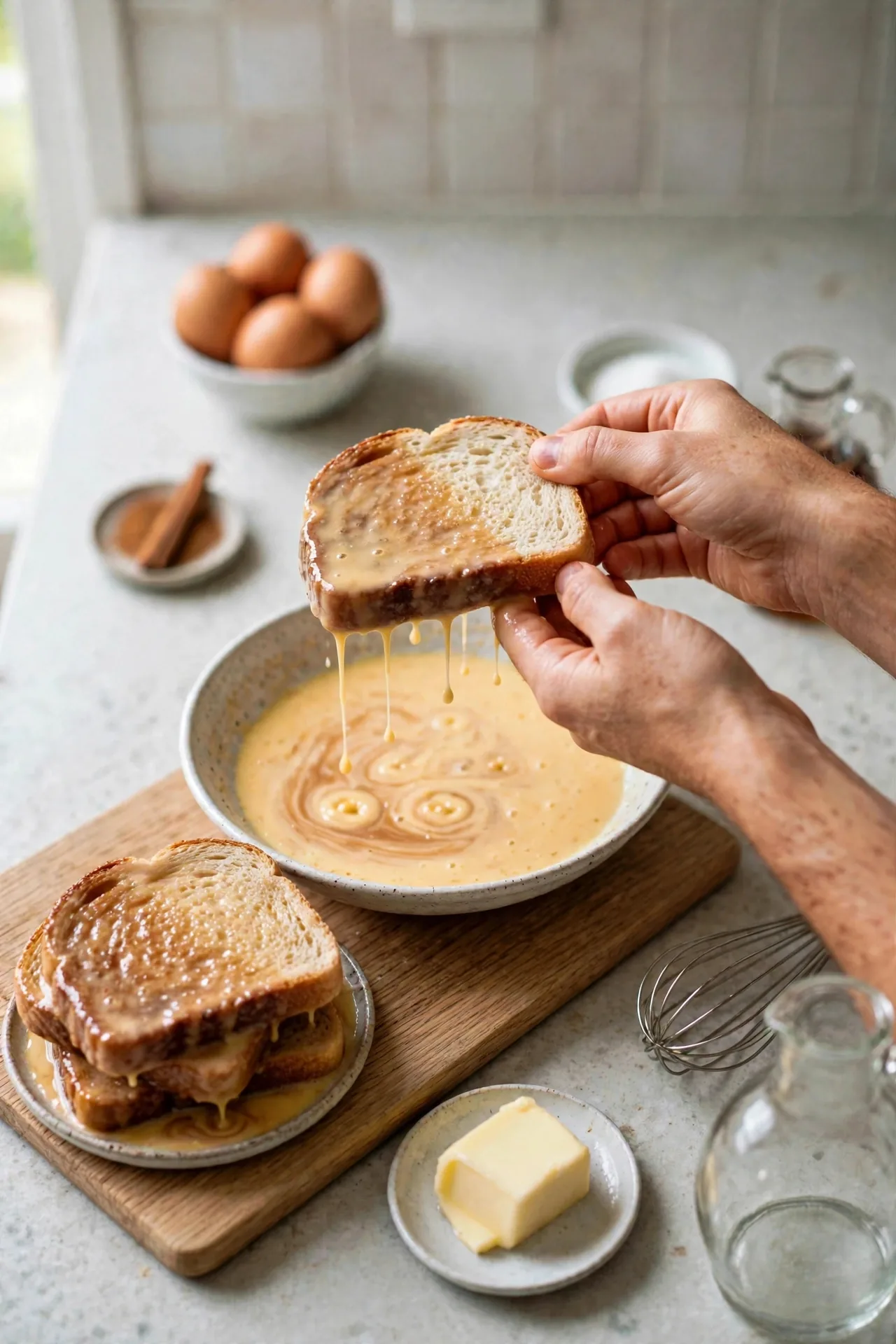
Dip a slice into the custard for 15 to 20 seconds per side, a little longer if the bread is very dry. It should look glossy and feel heavy without dripping.
Lift the slice and let the extra custard run back into the dish for a few seconds.
Step 4: Cook Until Golden
Set the skillet over medium heat, add 1 tablespoon of butter, and let it foam.
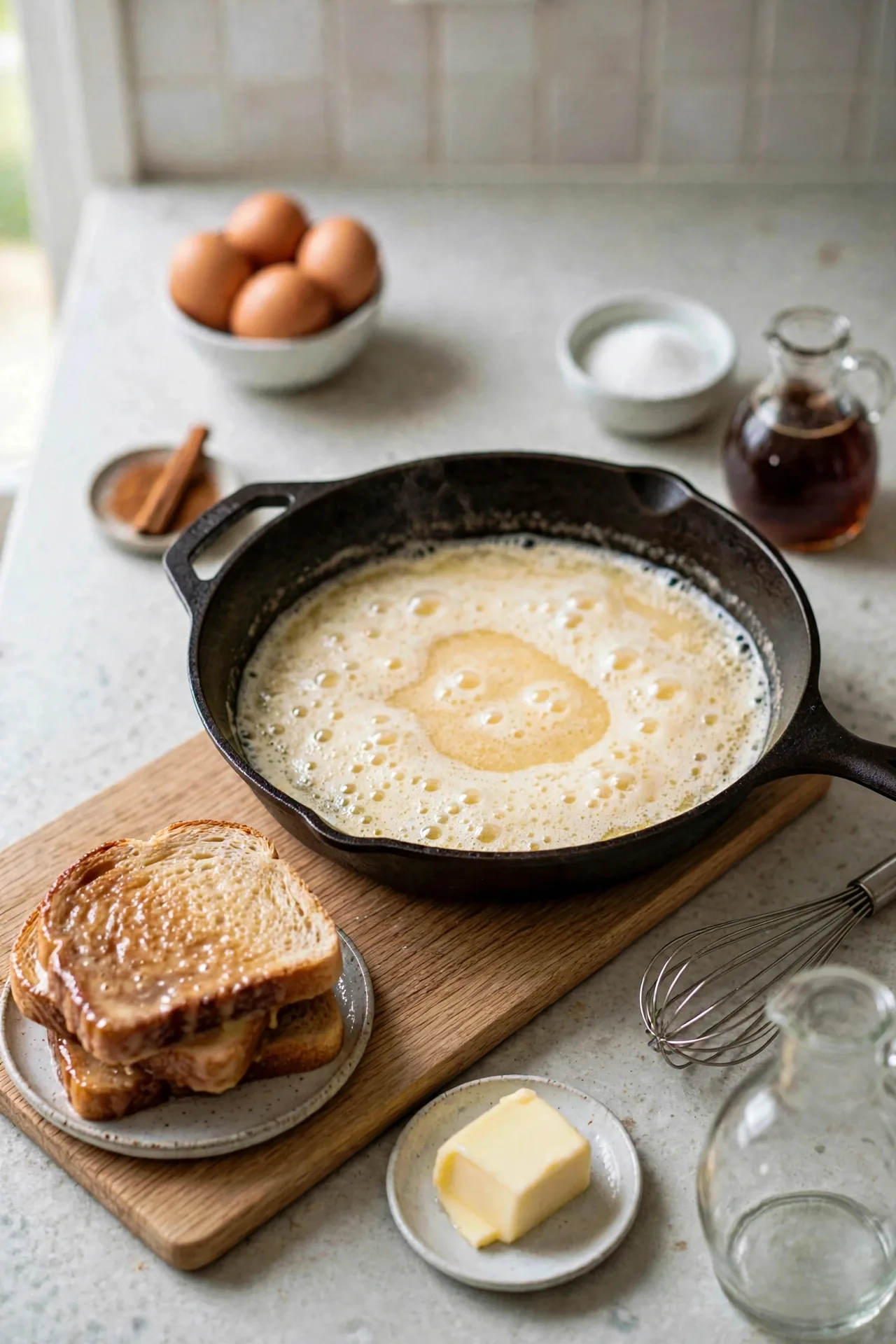
Watch for butter that goes past foaming. Once it turns brown and smells nutty before the bread is in, the milk solids will burn on the toast. Wipe the pan, add fresh butter, and lower the heat slightly.
Lay 2 or 3 soaked slices in the pan with room between them and cook 2 to 3 minutes, until the underside is golden brown and the edges look set.
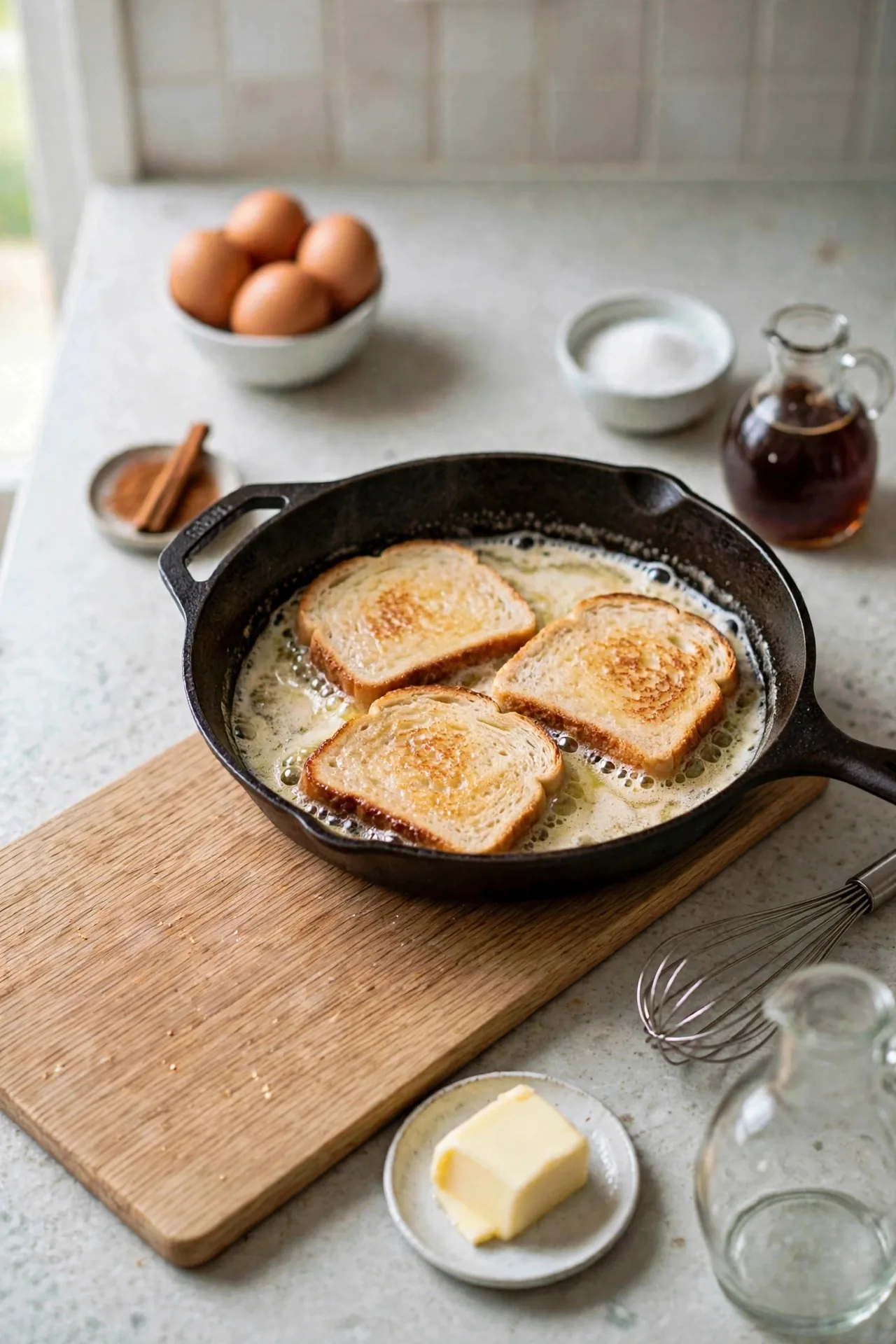
Flip and cook the second side for 2 to 3 minutes. Both sides should be an even golden brown.
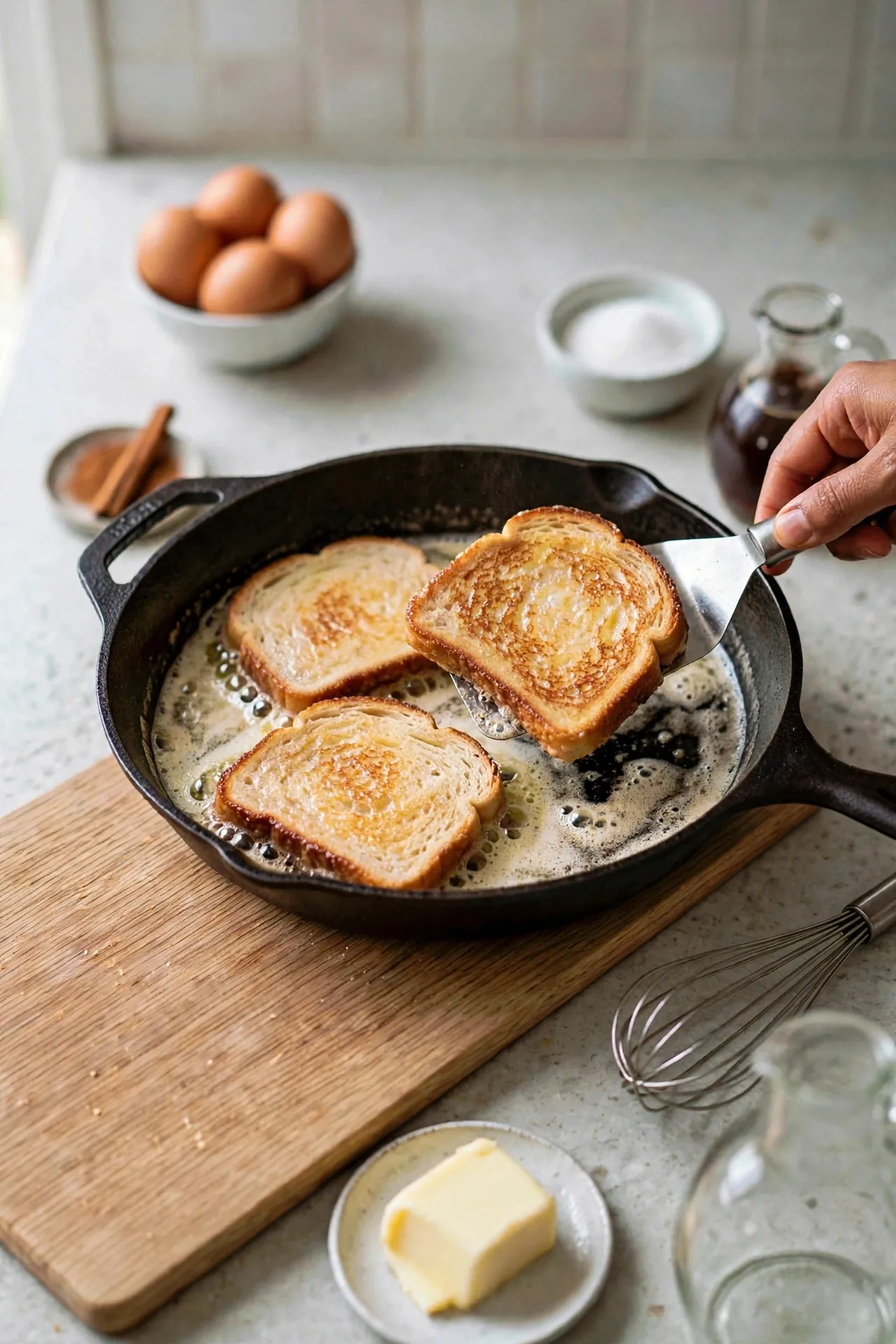
Wipe the skillet and repeat with fresh butter for the remaining slices.
Step 5: Coat with Cinnamon Sugar
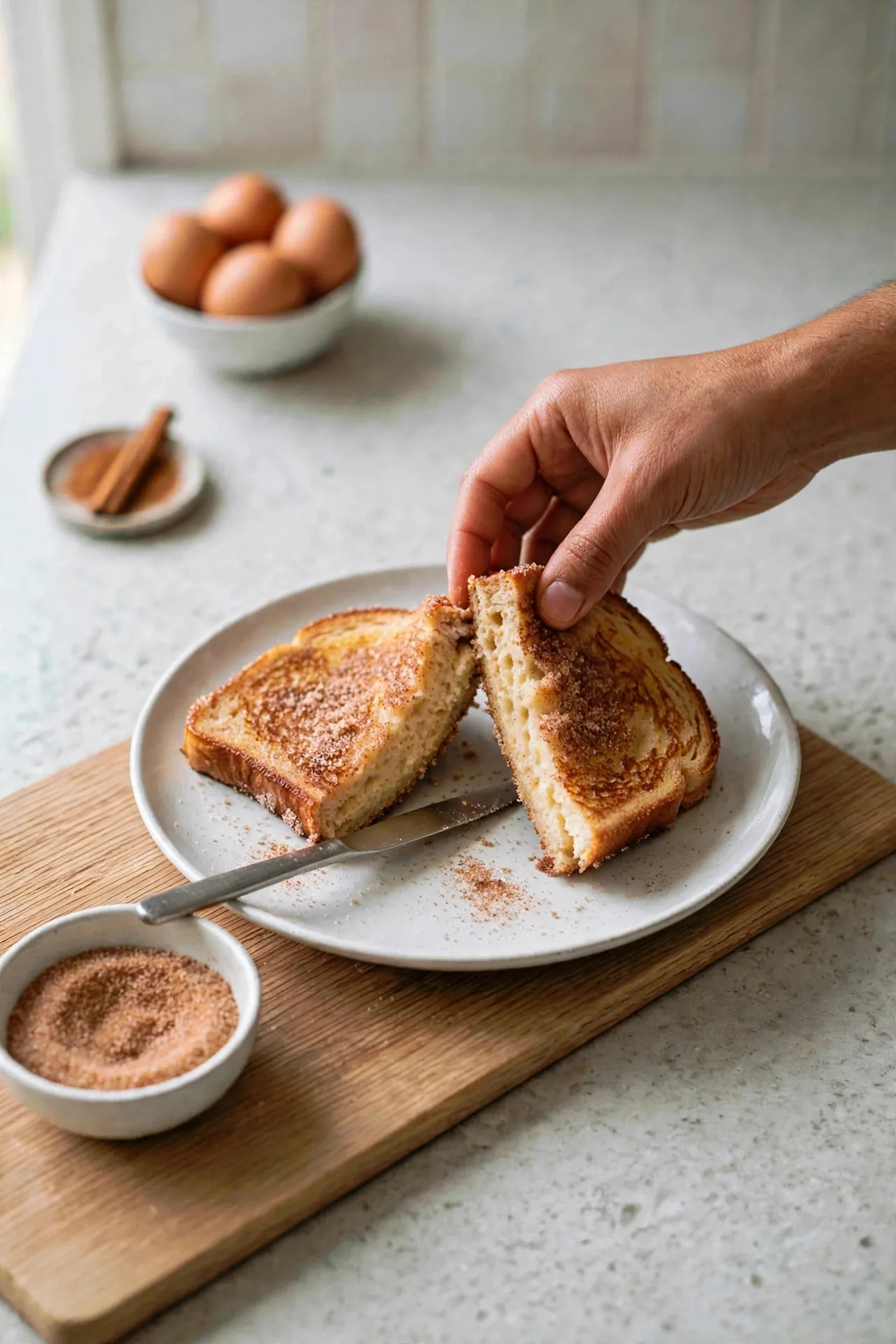
Move each batch to a plate or rack and sprinkle the cinnamon sugar over the slices right away. The hot surface is slightly tacky, so the sugar sticks and begins to melt into a thin crust.
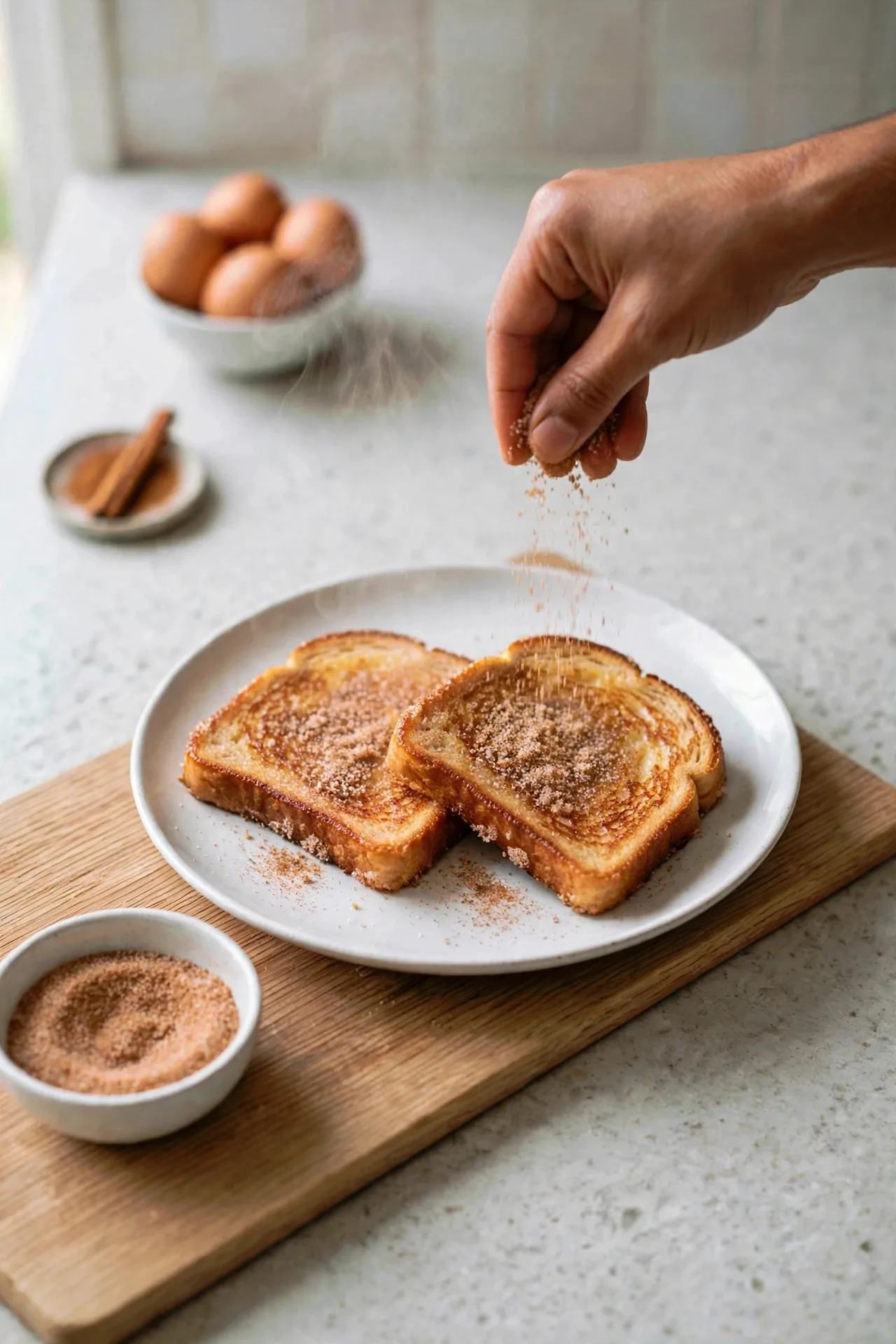
Why the sugar goes on after the pan. Sugar added before cooking caramelizes and then burns in the time it takes the center to set. Adding it at the end keeps the flavor without the bitterness.
Step 6: Check the Center
Cut into the thickest slice. The custard should look set with no wet, shiny streaks. A thermometer in the center should read 160°F (71°C). If the middle is still loose, return the remaining slices to the pan over lower heat for another minute or two per side.
Step 7: Serve
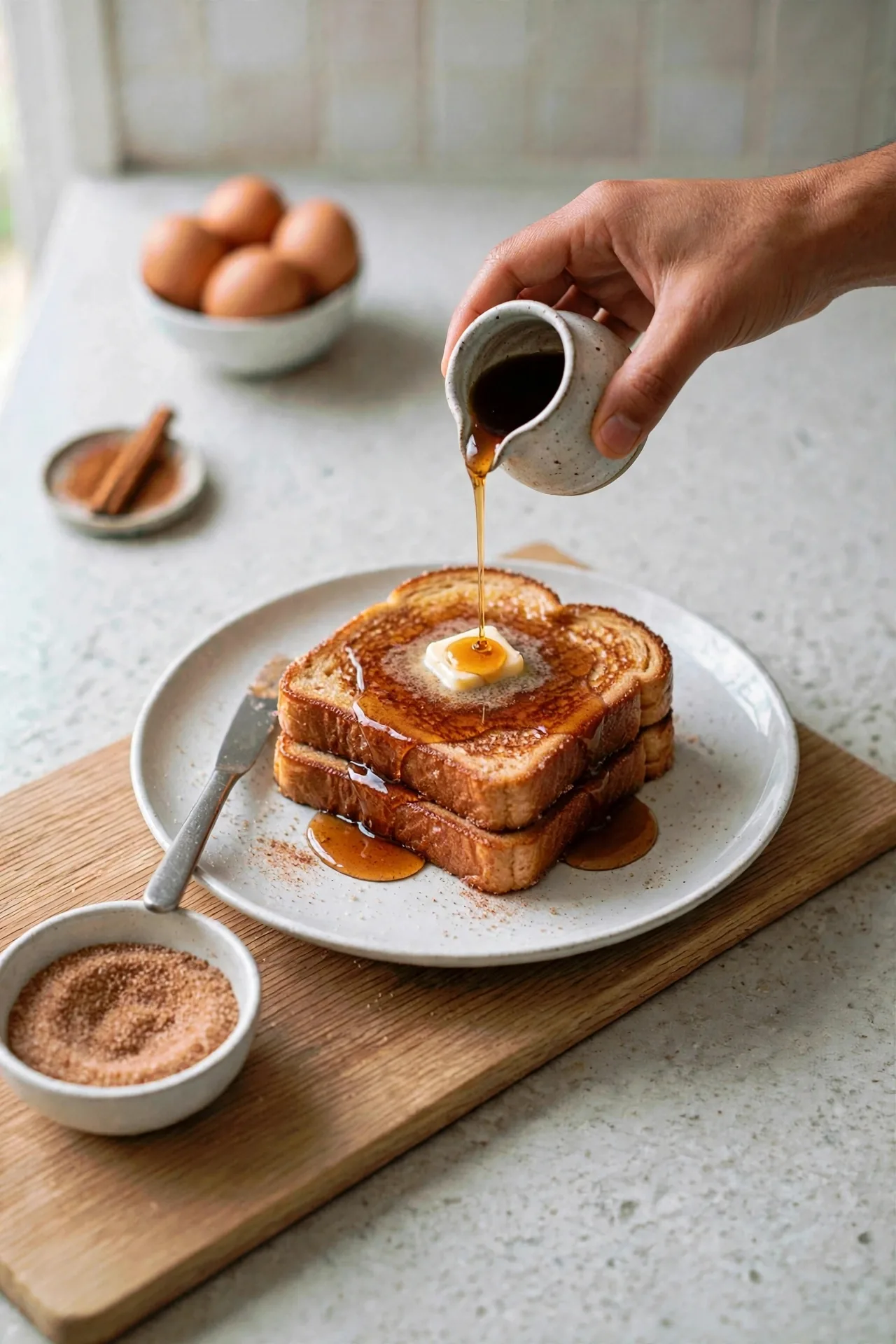
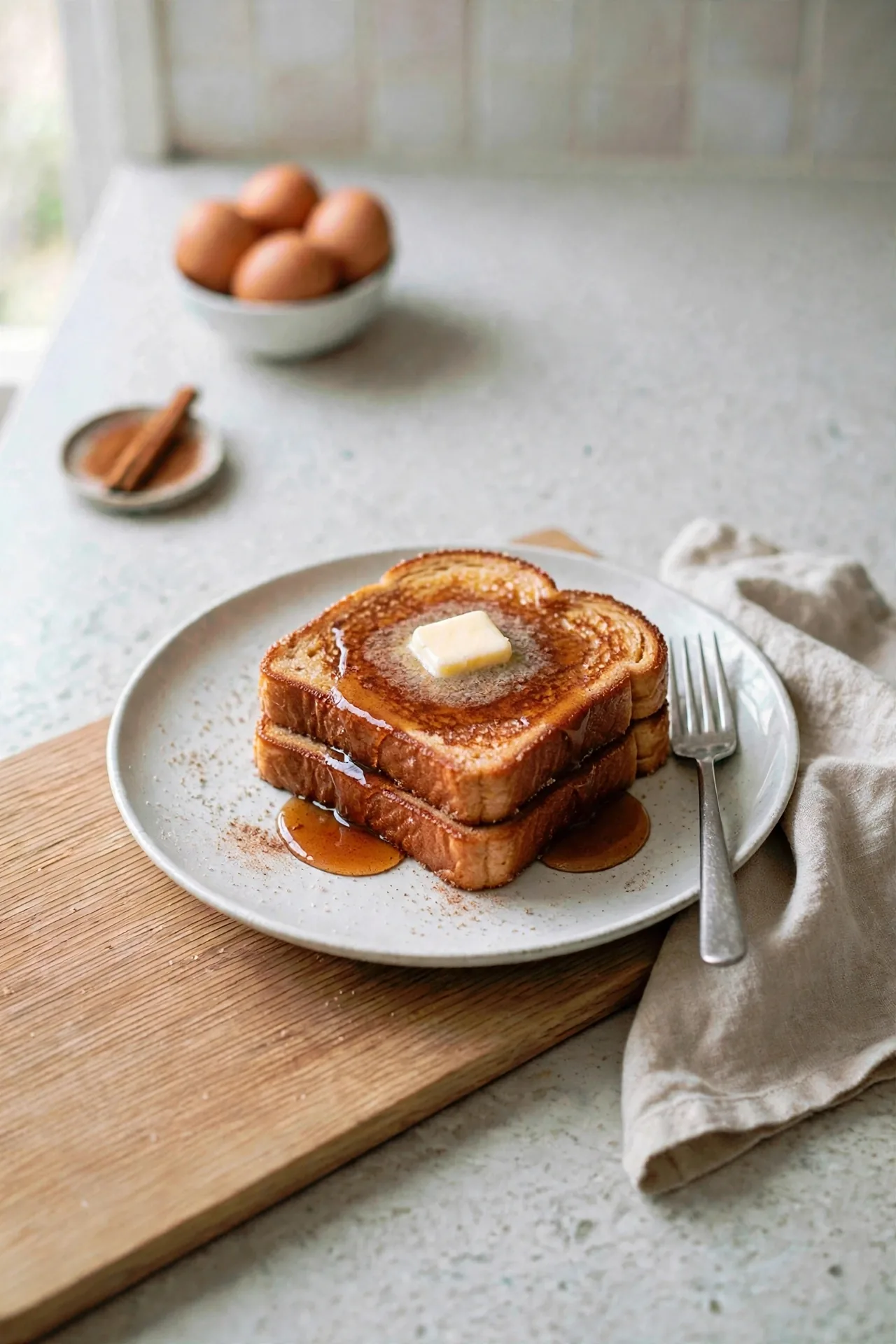
Stack 2 slices per plate, top each stack with a pat of butter, and pour maple syrup over the top.
Recipe Card: Cinnamon French Toast
Cinnamon French Toast
Ingredients
Method
- Whisk the eggs, brown sugar, cinnamon, nutmeg, and salt until no cinnamon clumps remain. Whisk in the milk and vanilla and pour into a shallow dish.
- Stir the cinnamon sugar together in a small bowl.
- Soak each slice 15 to 20 seconds per side and let the excess drip off.
- Melt 1 tablespoon butter in a skillet over medium heat until foaming.
- Cook 2 to 3 slices at a time, 2 to 3 minutes per side, until golden brown. Wipe the pan and add fresh butter for each batch.
- Sprinkle the hot slices with cinnamon sugar right away.
- Check one slice: the center should be set, or read 160°F (71°C).
- Serve with butter and maple syrup.
Notes
Recipe 4: Savory French Toast
No sugar and no vanilla here. The custard carries Parmesan, chives, thyme, garlic powder, and a little Dijon, and the toast is served with blistered cherry tomatoes, avocado, and a fried egg. It works for brunch and holds up as a light dinner.
Serves 4 (2 slices and 1 egg each) · Hands-on 40 minutes · Cook 25 minutes
Contains eggs, milk, wheat (gluten), and mustard (if you use the Dijon). Traditional Parmigiano Reggiano is made with animal rennet, so vegetarians should check the label of the hard cheese they choose.
Savory French Toast Ingredients
For the bread
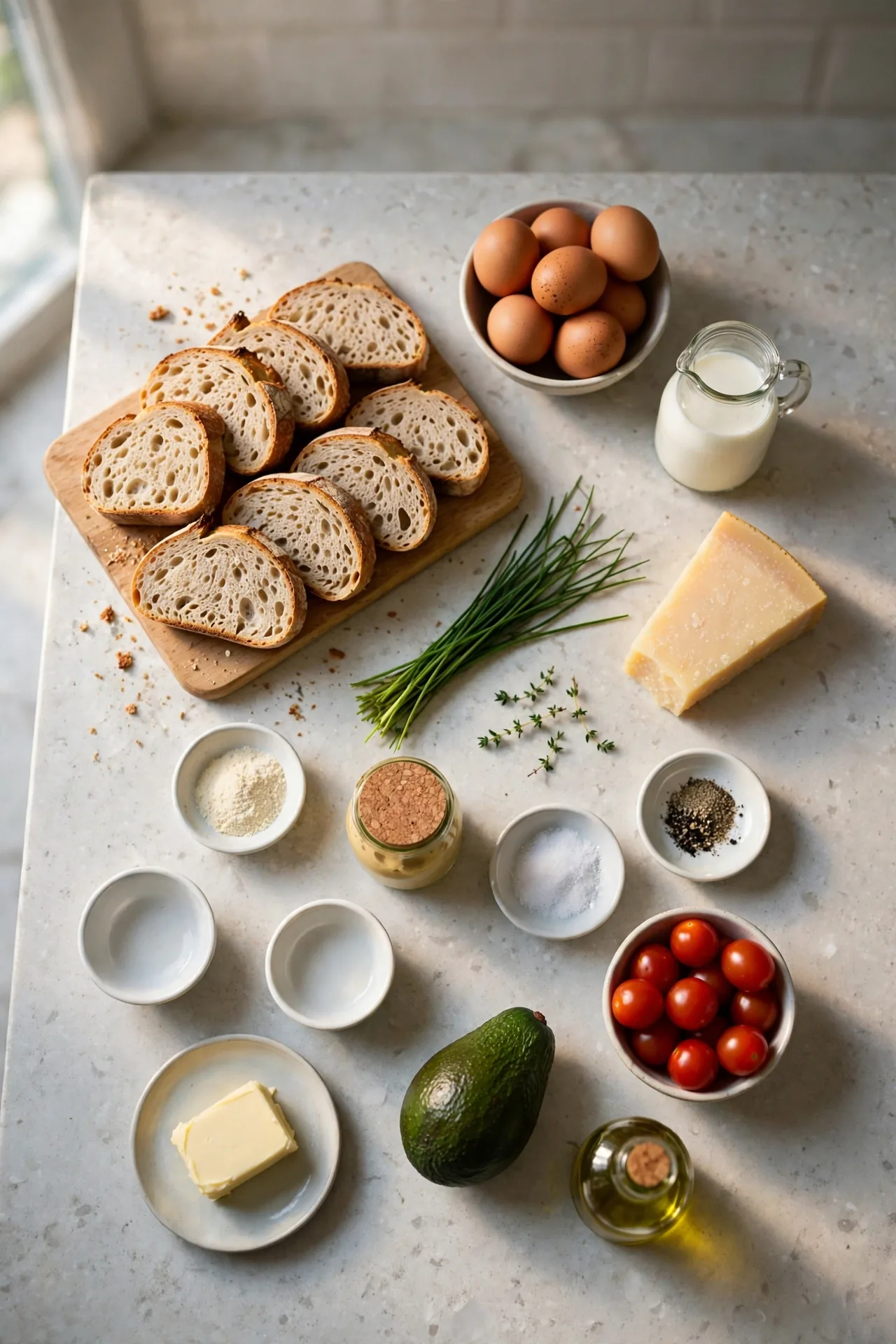
- 8 slices sourdough or country loaf, about 3/4 inch (2 cm) thick, a day old if possible
For the custard
- 4 large eggs
- 3/4 cup (180 ml) whole milk
- 1/3 cup finely grated Parmesan
- 2 tablespoons finely chopped chives
- 1 teaspoon fresh thyme leaves
- 1/2 teaspoon garlic powder
- 1 teaspoon Dijon mustard (optional)
- 1/2 teaspoon kosher salt
- 1/2 teaspoon freshly ground black pepper
For cooking the toast
- 2 tablespoons olive oil and 1 tablespoon unsalted butter, divided across batches (2 teaspoons oil and 1 teaspoon butter per batch)
For the topping
- 1 cup cherry tomatoes, halved
- 1 tablespoon olive oil
- Pinch of kosher salt
- 4 large eggs
- 1 tablespoon unsalted butter
- 1 ripe avocado, sliced
- Shaved Parmesan, chopped chives, and black pepper, to finish
How to Make Savory French Toast
Step 1: Prep the Cheese and Herbs
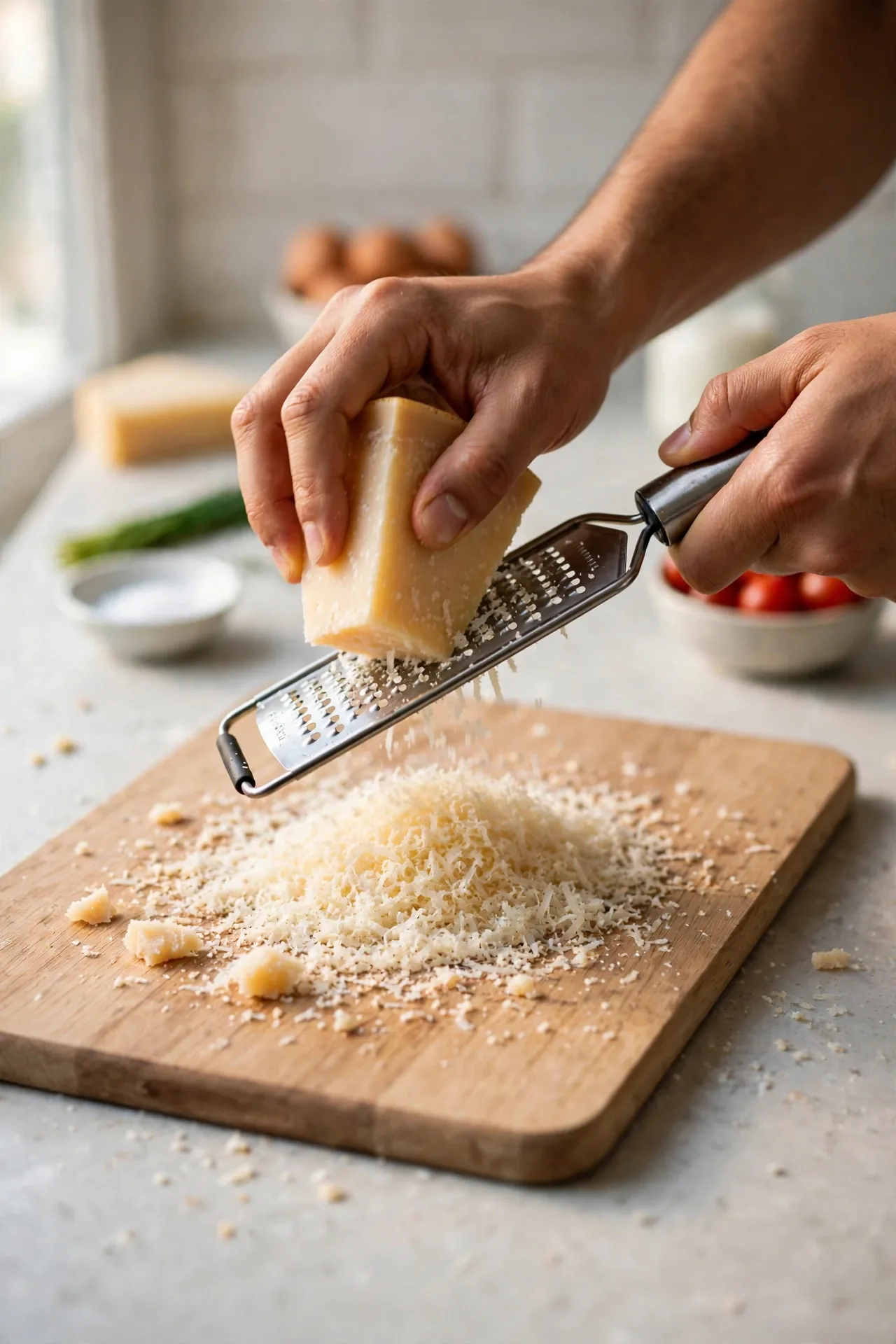
Grate the Parmesan on the fine side of a box grater or with a rasp-style grater until you have 1/3 cup. Fine shreds melt into the custard and crisp on the surface, while coarse shreds tend to slide off the bread.
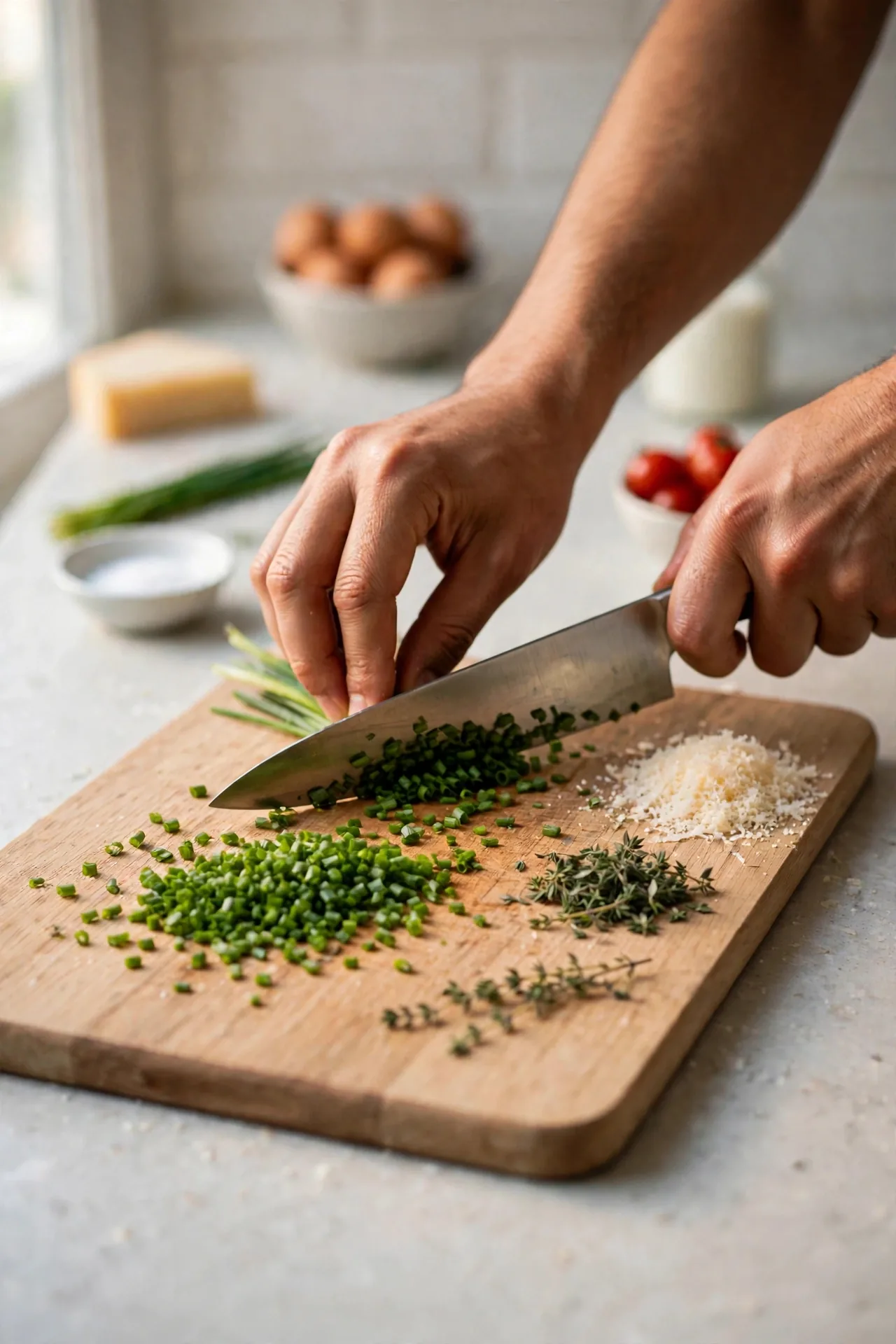
Chop the chives to get 2 tablespoons and strip the thyme leaves from their stems to get 1 teaspoon.
Step 2: Whisk the Savory Custard
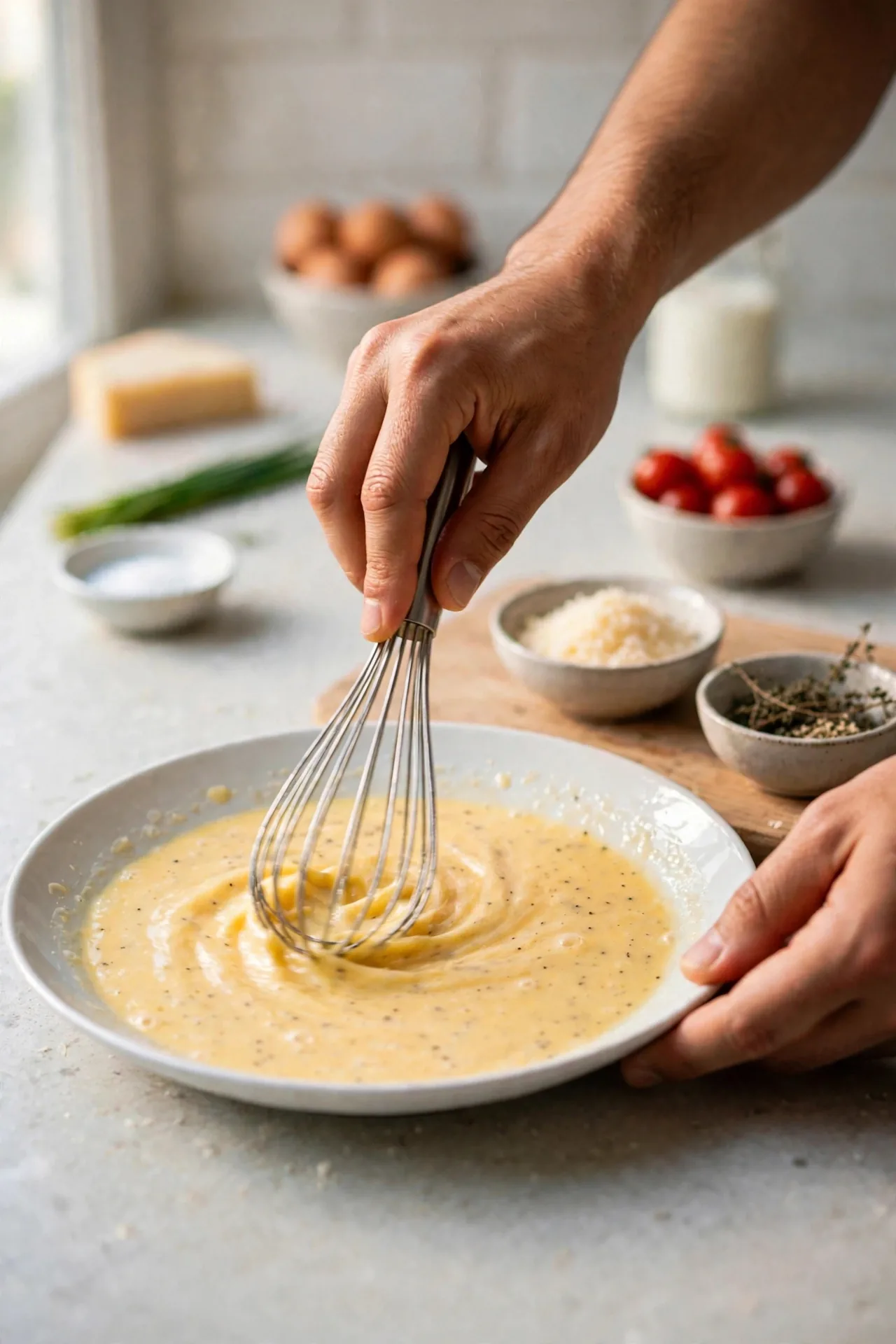
In a shallow dish, whisk the eggs with the milk, garlic powder, Dijon, salt, and pepper until the mixture is smooth and evenly yellow.
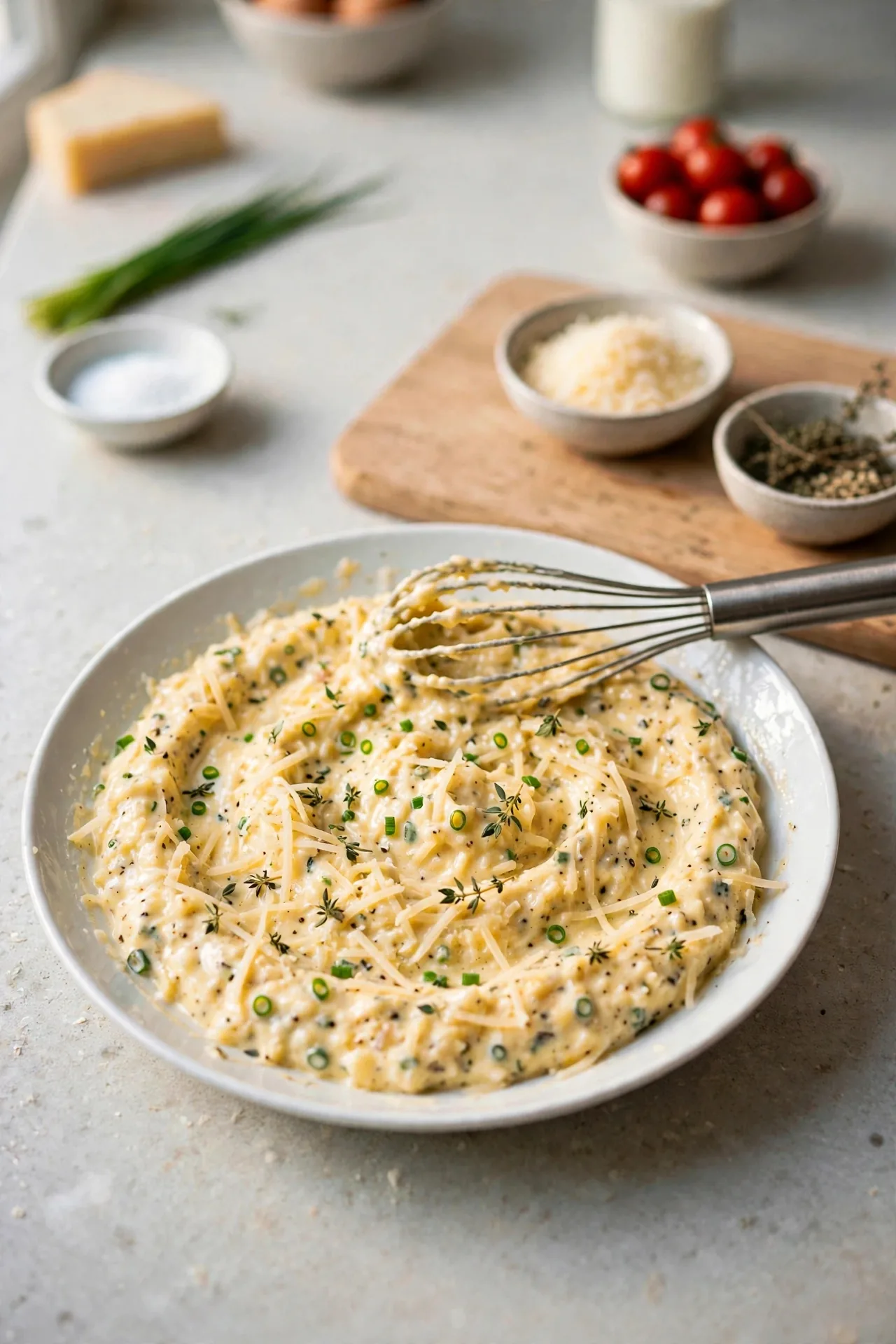
Stir in the Parmesan, chives, and thyme. The custard will thicken slightly as the cheese absorbs liquid.
Step 3: Soak the Sourdough
Sourdough is denser than brioche, so it needs a little longer. Lay a slice in the custard for 20 to 30 seconds per side. It should feel heavy and fully coated with herbs and cheese clinging to the surface. Let the excess drip off before it goes in the pan.
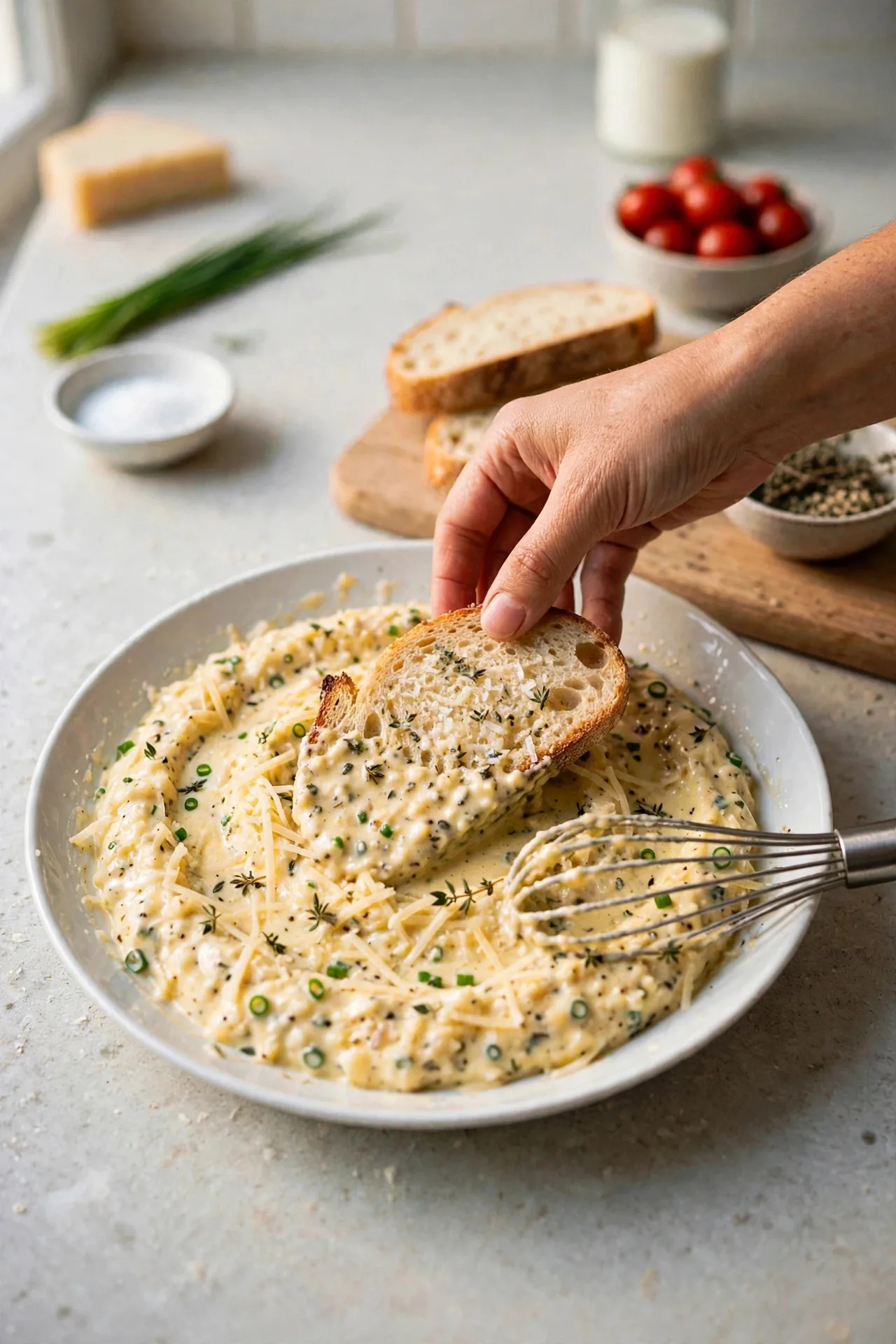
Step 4: Cook Until Crisp and Golden
Heat the oven to 200°F (95°C) with a wire rack on a sheet pan inside. Set the skillet over medium-low heat and add 2 teaspoons of olive oil and 1 teaspoon of butter.
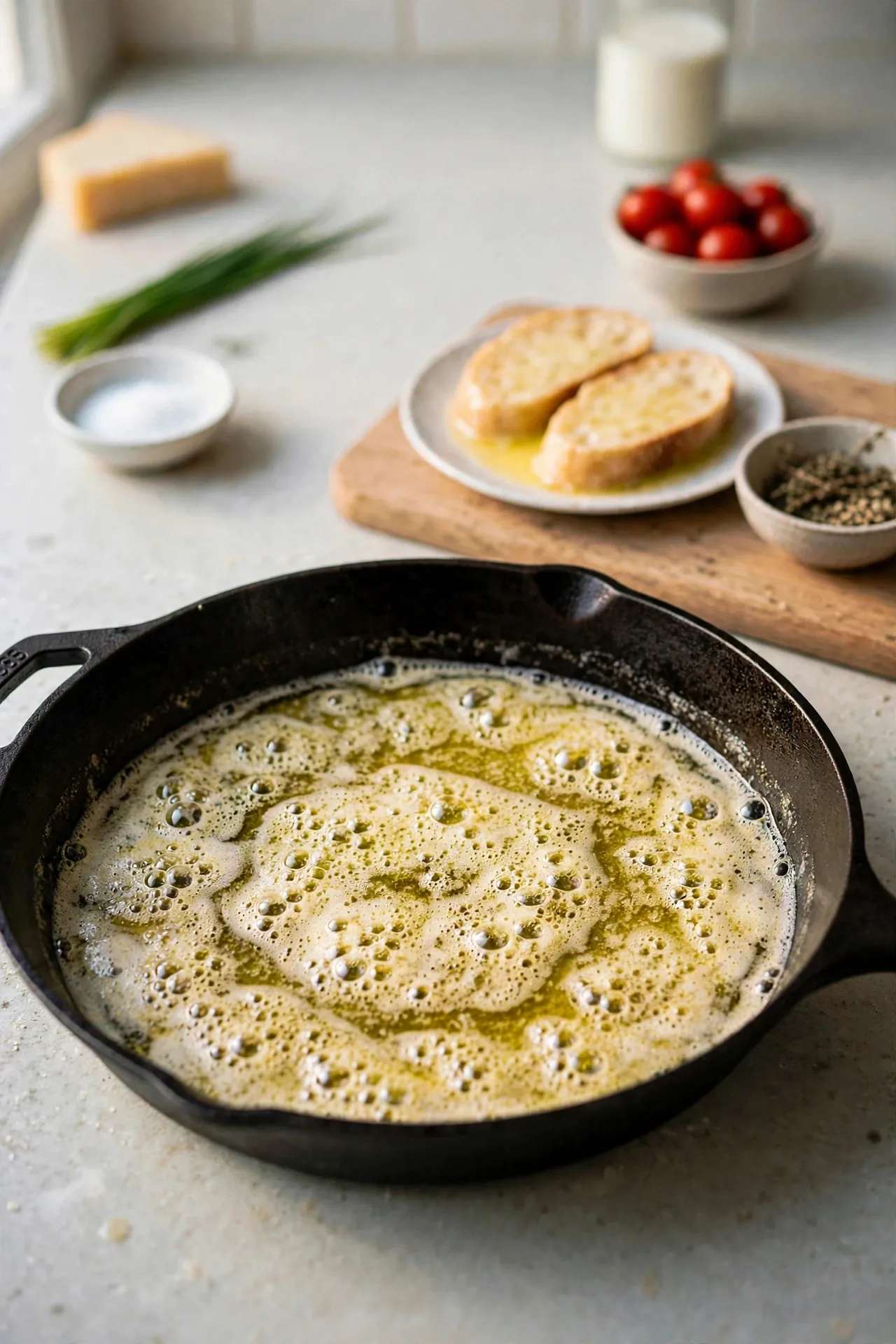
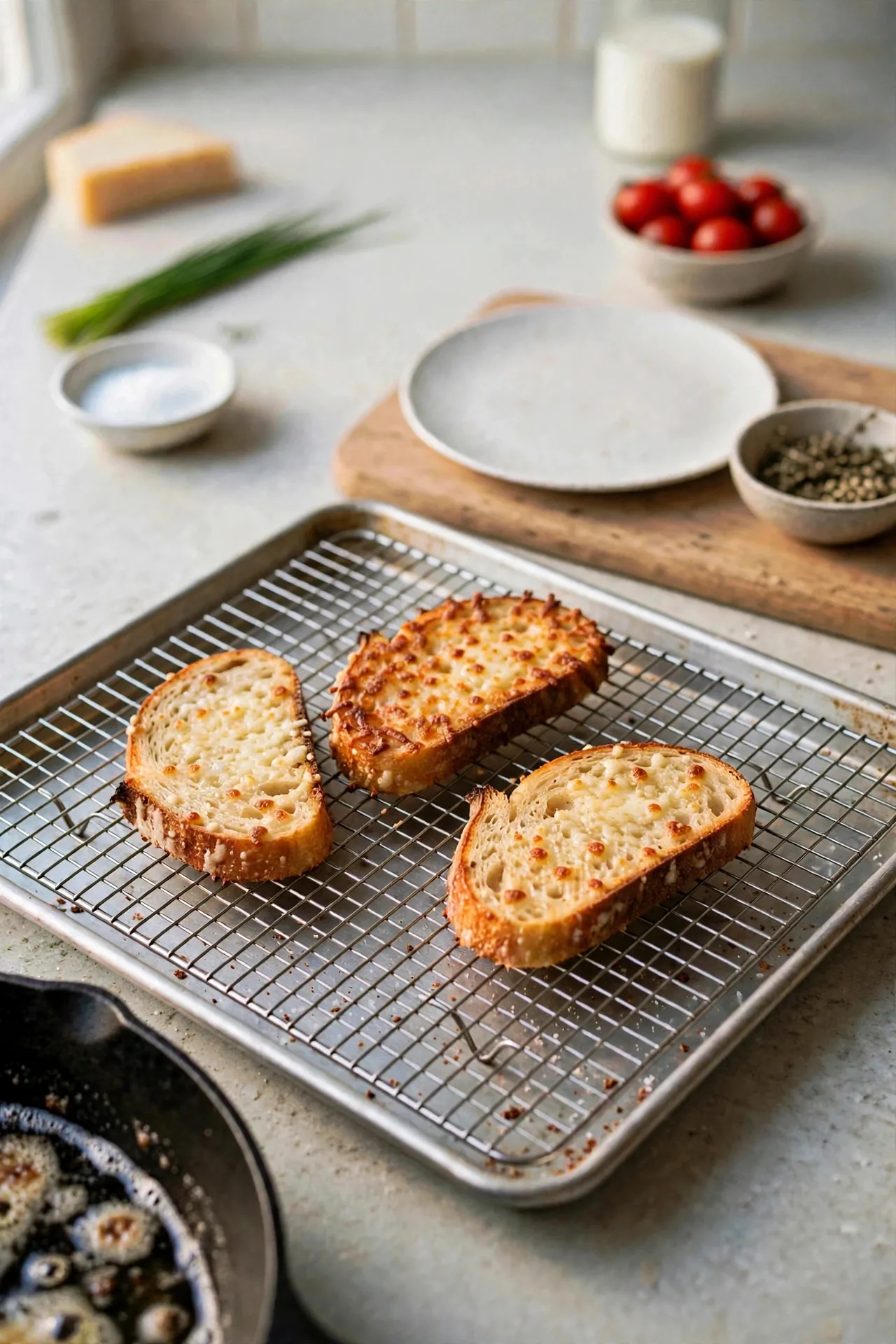
Lay 2 or 3 soaked slices in the pan and cook about 3 minutes, until the underside is deep golden and the cheese specks are browning.
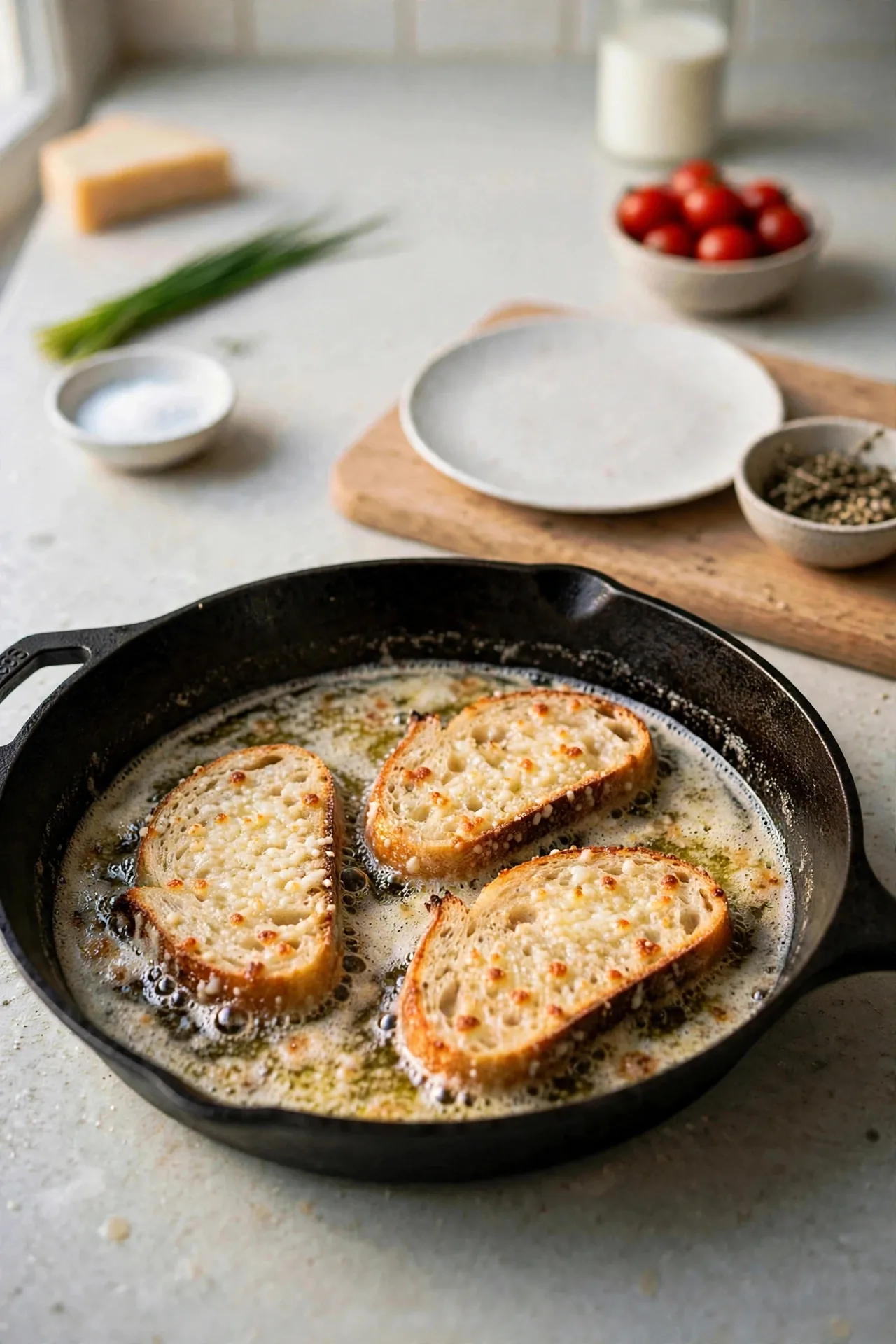
Parmesan browns faster than the bread. The cheese in the custard darkens before the center sets, so medium-low heat matters more here than in the sweet versions. If the cheese is deep brown before 3 minutes, lower the heat rather than flipping early.
Flip and cook about 3 minutes more, until the second side is golden and crisp at the edges.
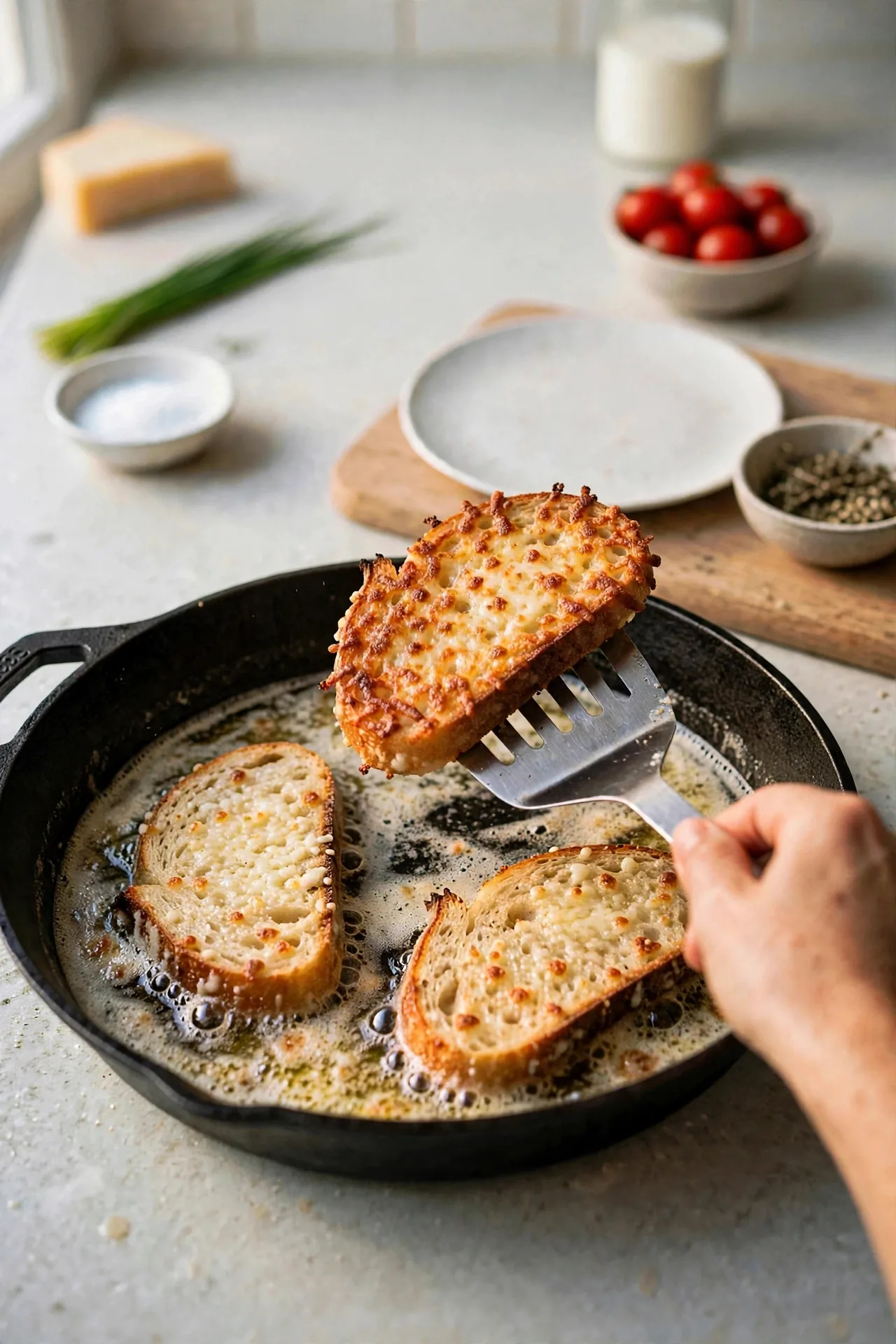
Move the cooked slices to the rack in the warm oven. Wipe the skillet and repeat with the remaining slices, adding fresh oil and butter for each batch.
Step 5: Blister the Tomatoes and Fry the Eggs
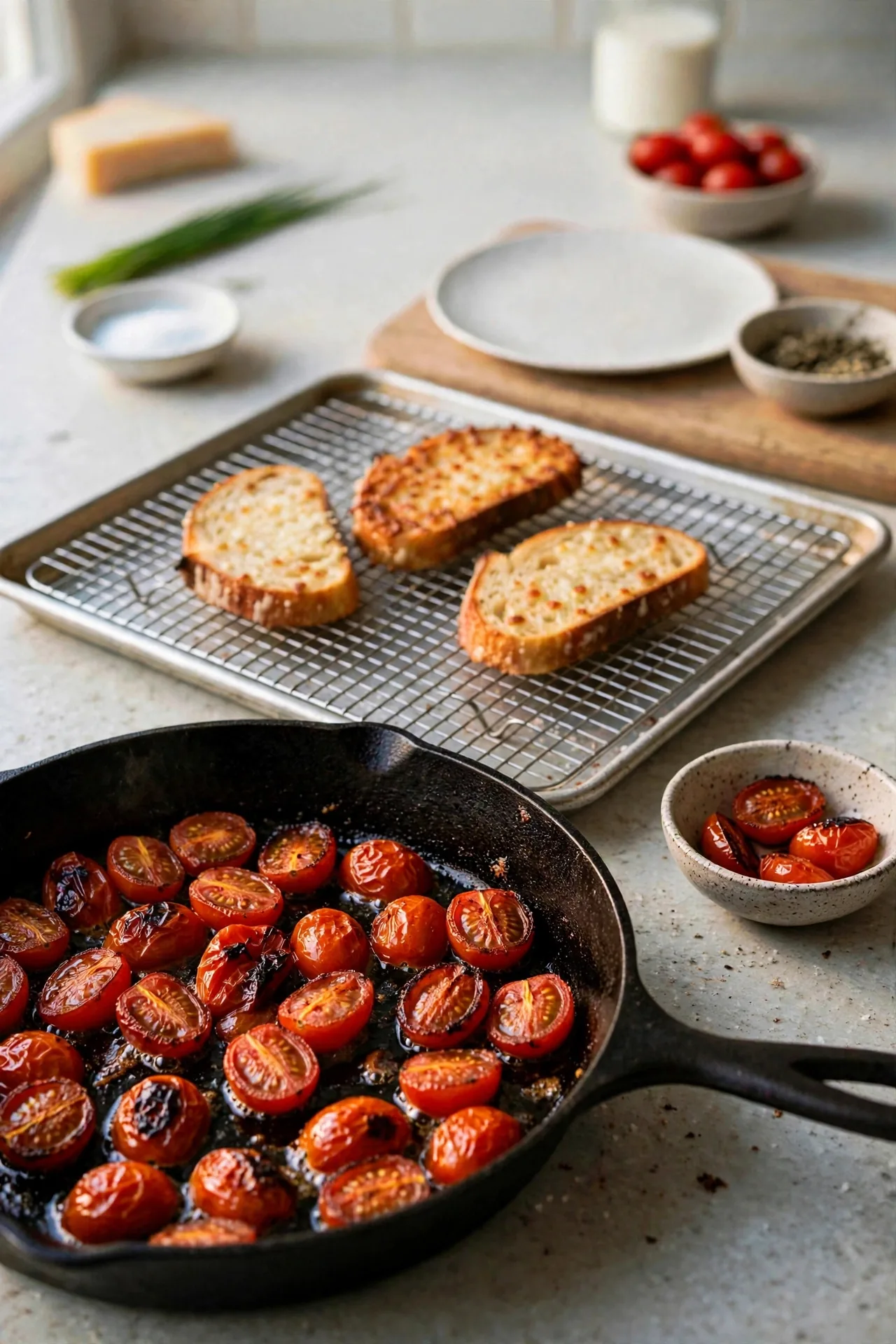
Wipe the skillet clean, set it over medium-high heat, and add the tablespoon of olive oil. Place the tomato halves cut side down and cook 3 to 4 minutes, until the skins wrinkle, blister, and the cut sides brown. Sprinkle with a pinch of salt and scoop them into a small bowl.
Lower the heat to medium and melt the tablespoon of butter. Crack in the eggs and cook 2 to 3 minutes, until the whites are set and the edges look lacy. The yolks should still look glossy if you like them soft.
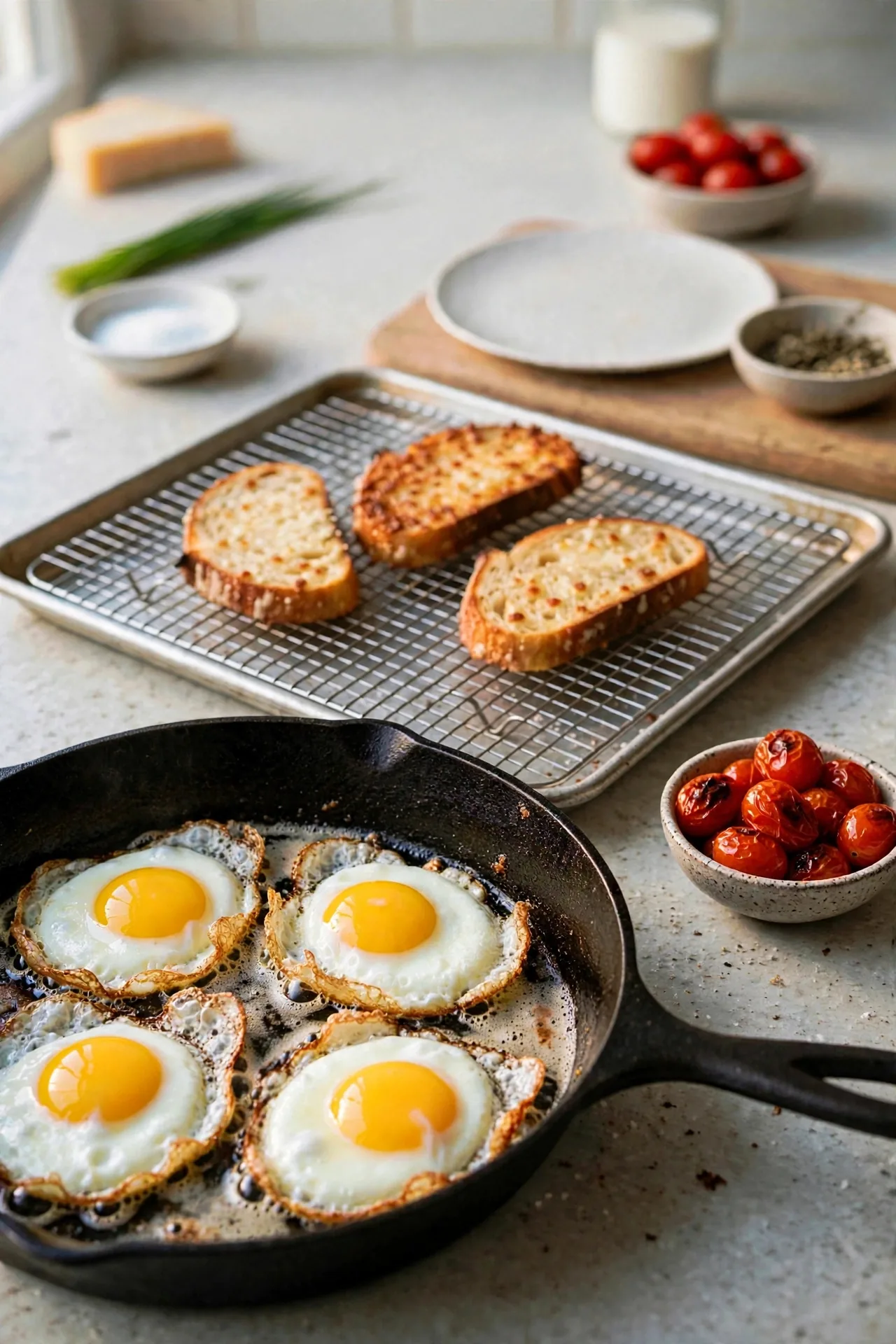
Egg safety note for soft yolks. Food safety agencies advise cooking eggs until both the white and the yolk are firm for young children, older adults, pregnant guests, and anyone with a weakened immune system. Cover the pan for the last minute, or flip the eggs, to firm the yolks.
Step 6: Assemble and Finish
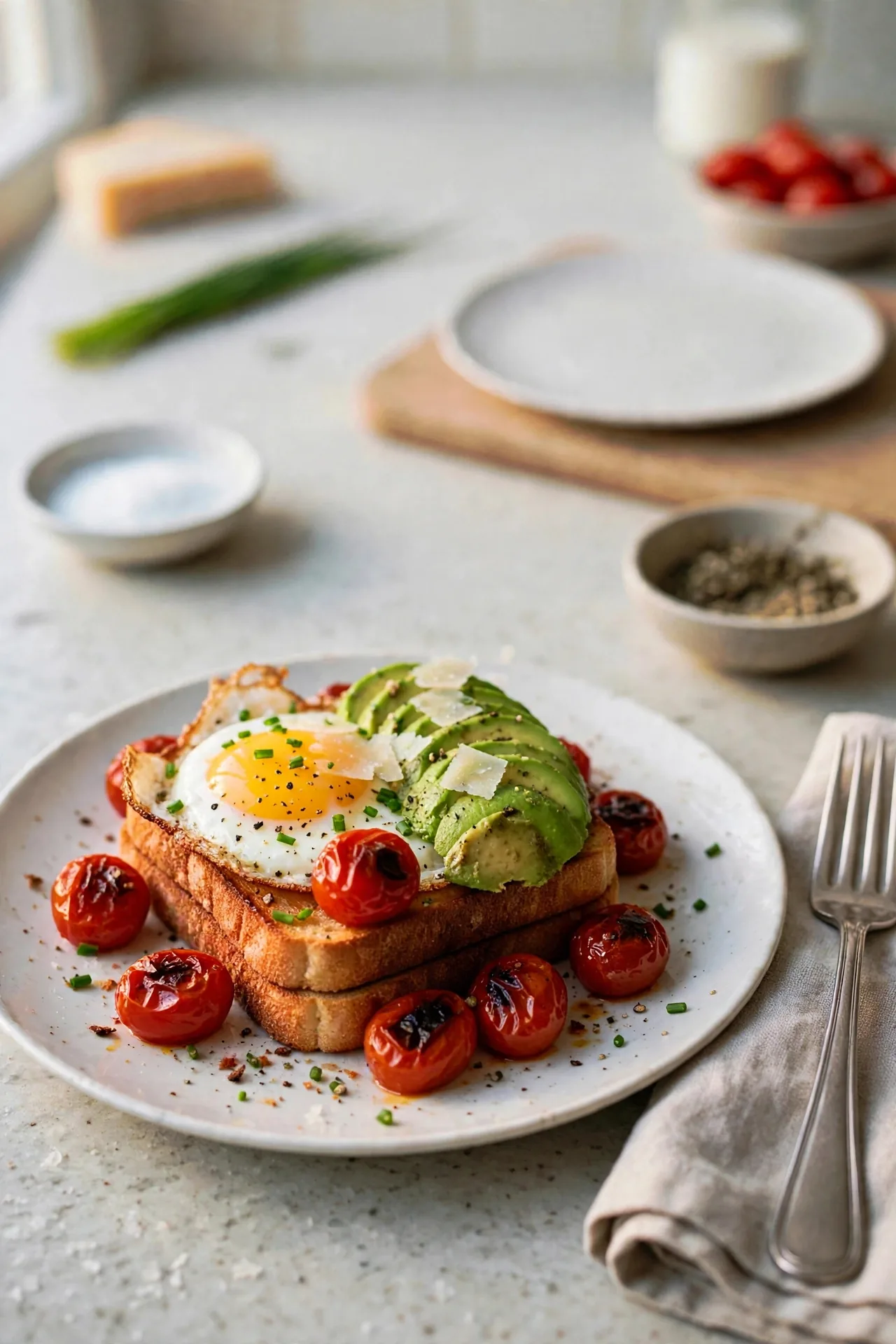
Stack 2 slices on each plate. Fan the avocado slices over the toast, spoon on the tomatoes, and set a fried egg on top.

Finish with shaved Parmesan, chives, and a few turns of black pepper.
Recipe Card: Savory French Toast
Savory French Toast
Ingredients
Method
- Finely grate the Parmesan, chop the chives, and strip the thyme leaves.
- Whisk the 4 custard eggs with the milk, garlic powder, Dijon, salt, and pepper. Stir in the Parmesan, chives, and thyme.
- Soak each slice 20 to 30 seconds per side and let the excess drip off.
- Heat the oven to 200°F (95°C) with a rack on a sheet pan. Heat 2 teaspoons oil and 1 teaspoon butter in a skillet over medium-low heat.
- Cook 2 to 3 slices at a time, about 3 minutes per side, until deep golden. Hold on the rack in the oven. Add fresh oil and butter for each batch.
- Wipe the skillet. Cook the tomatoes cut side down in 1 tablespoon oil over medium-high heat for 3 to 4 minutes until blistered. Season with a pinch of salt.
- Melt 1 tablespoon butter over medium heat and fry the 4 eggs 2 to 3 minutes, cooking yolks until firm if serving anyone at higher risk.
- Top the toast with avocado, tomatoes, and an egg. Finish with shaved Parmesan, chives, and pepper.
- Check that the toast center is set, or reads 160°F (71°C).
Notes
Swapping in What You Already Have
- No heavy cream (casserole or brioche): Use whole milk in its place, measure for measure. The custard will be a little less rich but sets the same way.
- Plant-based milk (stovetop versions): Unsweetened soy or oat milk tends to work, though browning and set can differ slightly from dairy milk.
- No brioche: Challah is the closest swap. Day-old French bread works as well, though the crumb is less rich.
- No Parmesan (savory): Aged Pecorino or Gruyère both melt and brown in a similar way. Check salt, since Pecorino is saltier.
Keeping Leftovers
- Casserole: Cover and refrigerate for 3 to 4 days, or wrap squares and freeze for up to 2 months. Reheat covered in a 350°F (175°C) oven until the center reaches 165°F (74°C).
- Brioche and cinnamon toast: Refrigerate for 3 to 4 days with parchment between the slices. Freeze flat, then bag, for up to 2 months. Reheat on a rack in a 350°F (175°C) oven or in a toaster oven until crisp and 165°F (74°C) in the center.
- Savory toast: Store only the toast. The fried egg, tomatoes, and avocado are better made fresh when you serve it.
Questions Readers Ask
Can I make the casserole without the overnight chill?
Yes. With dry bread, an hour in the refrigerator can be enough for a same-day bake, though the center cubes may be slightly less custardy than after a longer soak. Press the cubes down well so they all touch the custard.
Can I double the casserole?
Bake it in two dishes rather than one deeper dish. A thicker layer tends to bake unevenly, with a set top and a loose middle.
How long can stovetop batches wait in the oven?
About half an hour at 200°F (95°C) on a wire rack. Past that, the crust starts to dry and the edges turn tough.
Can I reuse leftover custard?
No. Custard that bread has touched is a raw egg mixture, and it should be discarded once the batch is cooked.
Which One to Make Next
Reach for the casserole when you have guests and want the oven to carry the morning, brioche when you want something rich and slow-moving at the table, the cinnamon version on an ordinary weekday, and the savory one when dinner is the meal in question. Of the four, only the casserole assembles ahead; for the others, slicing and drying the bread the night before is the one step that saves time without changing the result.
Emily Hart
Hi, I'm Emily! I develop cozy, doable recipes for busy home cooks — clear steps, honest ingredients, and flavors the whole table will love. Follow on Pinterest
Follow on Pinterest

Leave a Reply