German Chocolate Cake with Coconut Pecan Frosting (Classic, From Scratch)
 ""
 Pin it
In this post
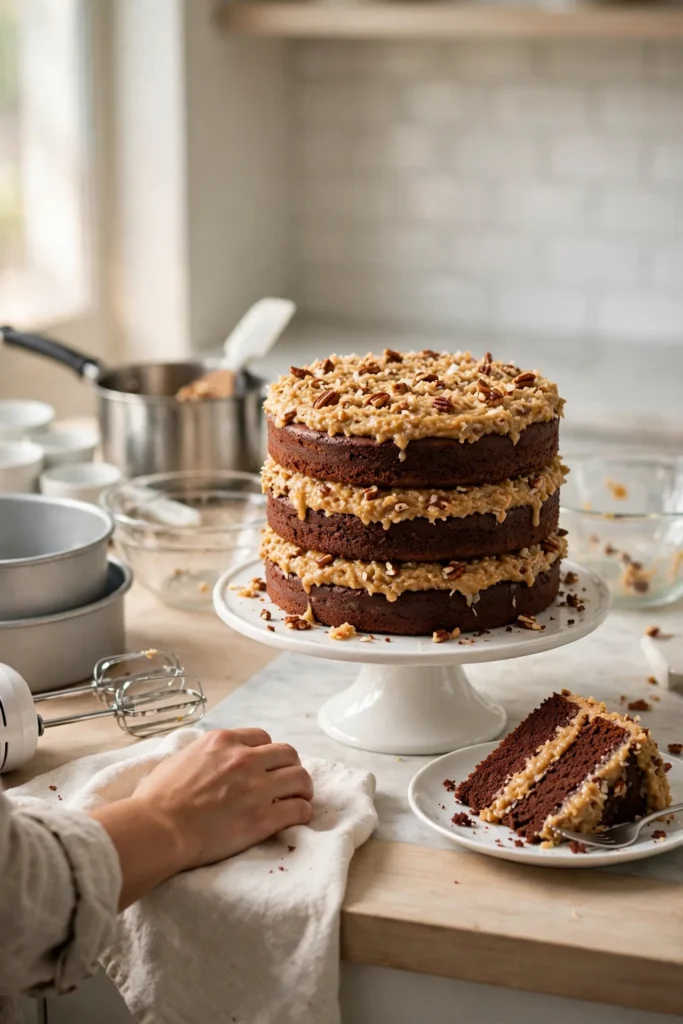
This German chocolate cake is the classic from-scratch version — three buttermilk layers, cooked coconut pecan frosting, and bare sides — so jump straight to the part you need.
- Quick Answer
- What Makes This German Chocolate Cake Different
- Recipe Overview
- Ingredients
- Ingredient Notes
- Before You Start
- How to Make German Chocolate Cake
- Step 1: Set Up the Pans, Oven, and Eggs
- Step 2: Melt the Chocolate
- Step 3: Cream the Butter and Sugar
- Step 4: Add the Yolks, Vanilla, and Chocolate
- Step 5: Alternate the Flour and Buttermilk
- Step 6: Whip and Fold In the Egg Whites
- Step 7: Fill the Pans and Bake
- Step 8: Cool the Layers
- Step 9: Toast the Pecans
- Step 10: Cook the Coconut Pecan Frosting
- Step 11: Assemble the Cake
- Step 12: Slice and Serve
- Make-Ahead Plan
- Variations
- Substitutions
- Where This Cake Usually Goes Wrong
- Storing and Reheating
- Facts About German Chocolate Cake
- FAQ
- Recipe Card
- Final Thoughts
Quick Answer
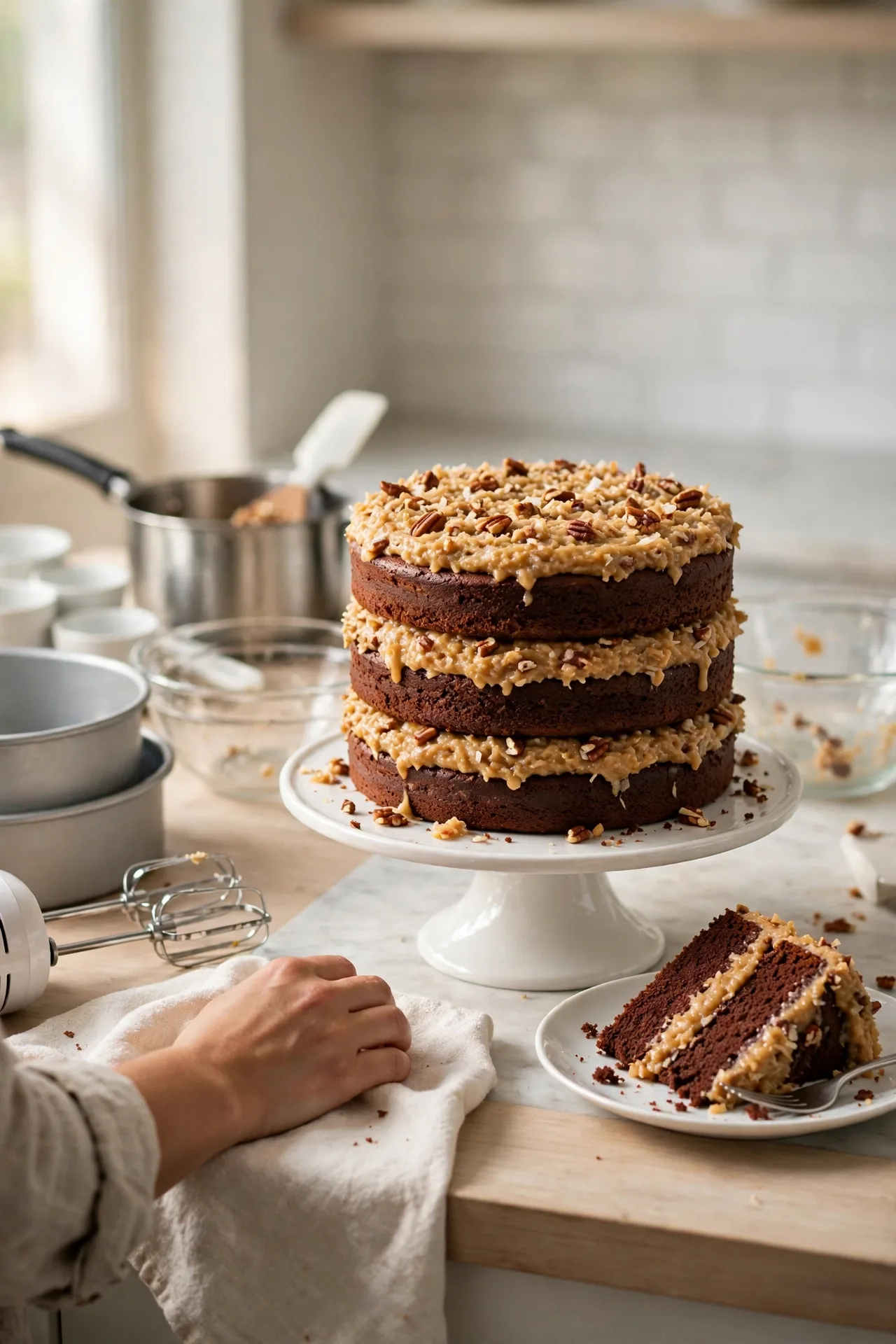
This is the classic version: three tender buttermilk chocolate layers made with sweet baking chocolate, stacked with a cooked custard-style frosting full of sweetened coconut and toasted pecans. The sides stay bare so you can see the layers. Bake the cake at 350°F (175°C) for 30 to 35 minutes, cook the frosting on the stovetop until thick and golden, and let both cool fully before you stack.
This one page covers the whole cake: the layers, the coconut pecan frosting, assembly, storage, fixes, and where the name actually comes from.
What Makes This German Chocolate Cake Different
German chocolate cake is a mild, tender chocolate cake, not a deep, dark, fudgy one. The chocolate flavor is lighter on purpose, because the frosting is the star: a cooked mixture of evaporated milk, egg yolks, butter, and sugar that turns into a thick, caramel-colored custard once coconut and pecans go in.
Two details set this version apart from a standard chocolate layer cake. The egg whites are whipped and folded in, which gives the crumb a soft, light structure. And the frosting is cooked on the stove, so the texture is gooey and spreadable instead of fluffy like buttercream.
Recipe Overview
| Yield | One 3-layer, 9-inch cake (12 to 16 slices) |
| Prep | About 40 minutes |
| Bake | 30 to 35 minutes |
| Frosting | About 15 minutes on the stove, plus cooling |
| Cooling | Allow at least 1 hour for the layers and frosting before assembling |
| Difficulty | Intermediate: separated eggs, folded whites, and a stirred custard |
| Equipment | Three 9-inch round cake pans, electric mixer, 3-quart saucepan, wire racks |
Ingredients
For the Cake Layers
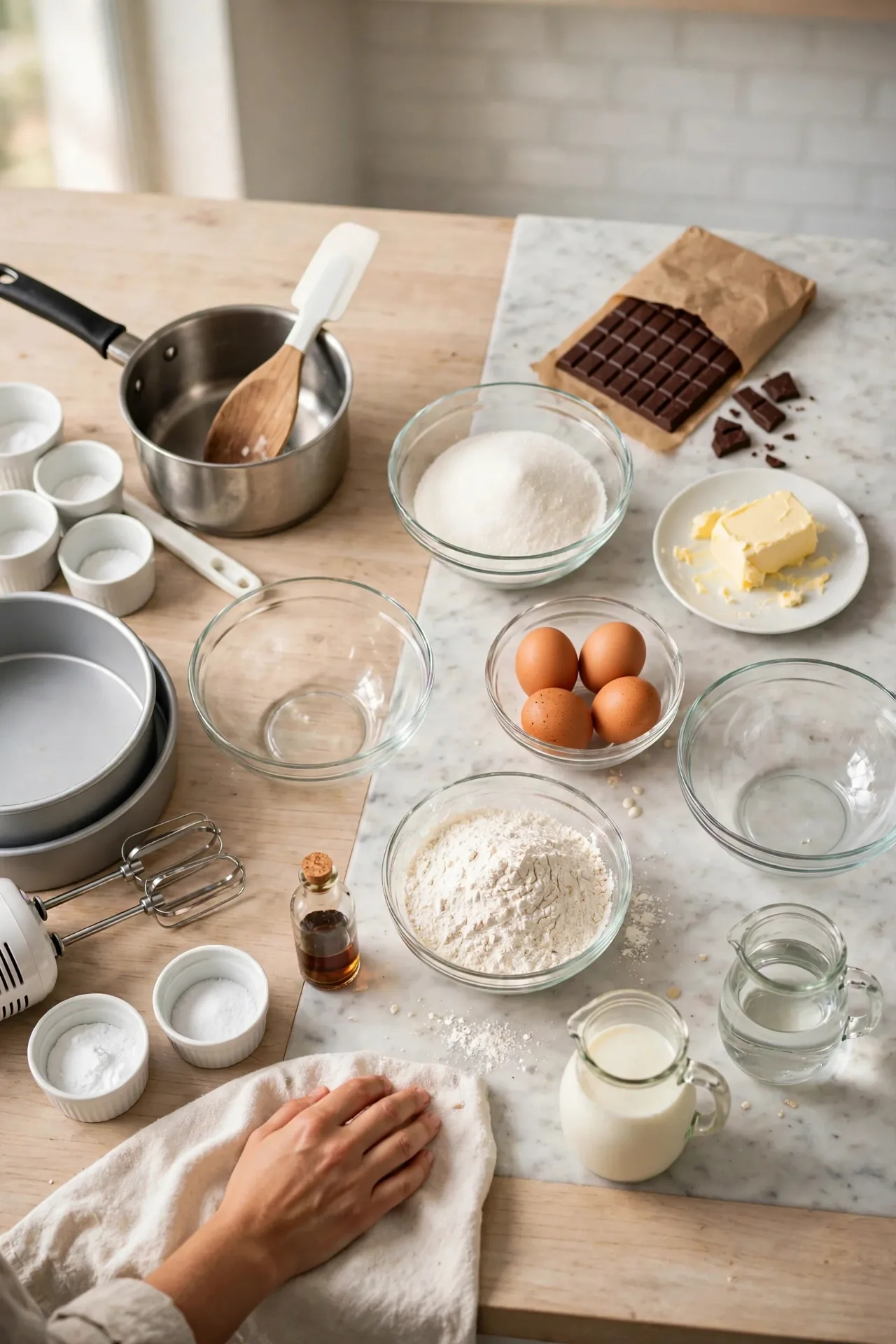
- 1 bar (4 ounces / 113 g) sweet baking chocolate, chopped
- ½ cup boiling water
- 1 cup (2 sticks / 226 g) unsalted butter, softened
- 2 cups (400 g) granulated sugar
- 4 large eggs, separated (yolks in the batter, whites whipped separately)
- 1 teaspoon vanilla extract
- 2½ cups (about 285 g) cake flour, spooned and leveled, then sifted
- 1 teaspoon baking soda
- ½ teaspoon salt
- 1 cup (240 ml) buttermilk, room temperature
For the Coconut Pecan Frosting
- 1 cup (240 ml) evaporated milk
- 1 cup (200 g) granulated sugar
- 3 large egg yolks
- ½ cup (1 stick / 113 g) unsalted butter, cut into pieces
- 1 teaspoon vanilla extract
- 1⅓ cups sweetened flaked coconut
- 1 cup chopped pecans, toasted
Allergens: eggs, milk, wheat, pecans (tree nut), and coconut. Check the chocolate label for soy and other allergens.
Ingredient Notes
Sweet baking chocolate. This is the chocolate the cake is named for. It already contains sugar, so it tastes milder than unsweetened or semisweet baking chocolate. If you cannot find it, a good dark baking bar will still make a fine cake, but expect a slightly less sweet, slightly deeper chocolate flavor. Do not swap in unsweetened chocolate.
Cake flour. It is lower in protein than all-purpose flour, which gives a softer crumb. If you only have all-purpose flour, a common stand-in is to remove 2 tablespoons from each cup and replace them with 2 tablespoons of cornstarch, then sift the mixture a few times. For 2½ cups, that means 2½ cups all-purpose flour minus 5 tablespoons, plus 5 tablespoons cornstarch.
Buttermilk. It reacts with the baking soda for lift and keeps the crumb tender. In a pinch, stir 1 tablespoon of lemon juice or white vinegar into 1 cup of milk and let it sit for 5 to 10 minutes. Bring it to room temperature so it does not firm up the creamed butter.
Evaporated milk. Use unsweetened evaporated milk, not sweetened condensed milk. They look alike on the shelf and behave very differently here.
Sweetened flaked coconut. This is what the frosting was built around, and it adds some of the sweetness. Unsweetened coconut will make a less sweet, drier-feeling frosting.
The extra egg whites. The frosting uses three yolks and no whites, so you will end up with three spare whites. Refrigerate them in a sealed container for another use.
Before You Start
- Take the butter, eggs, and buttermilk out of the refrigerator about an hour ahead so they come to room temperature.
- Measure flour by spooning it into the cup and leveling it off, or weigh it. Scooping straight from the bag packs in extra flour and gives a drier cake.
- Use a completely clean, dry bowl for the egg whites. A trace of fat or yolk stops them from whipping to stiff peaks.
- Have the three pans ready before you mix. The whipped whites start to lose volume the longer the batter waits.
How to Make German Chocolate Cake
Step 1: Set Up the Pans, Oven, and Eggs
Heat the oven to 350°F (175°C) with a rack in the center.
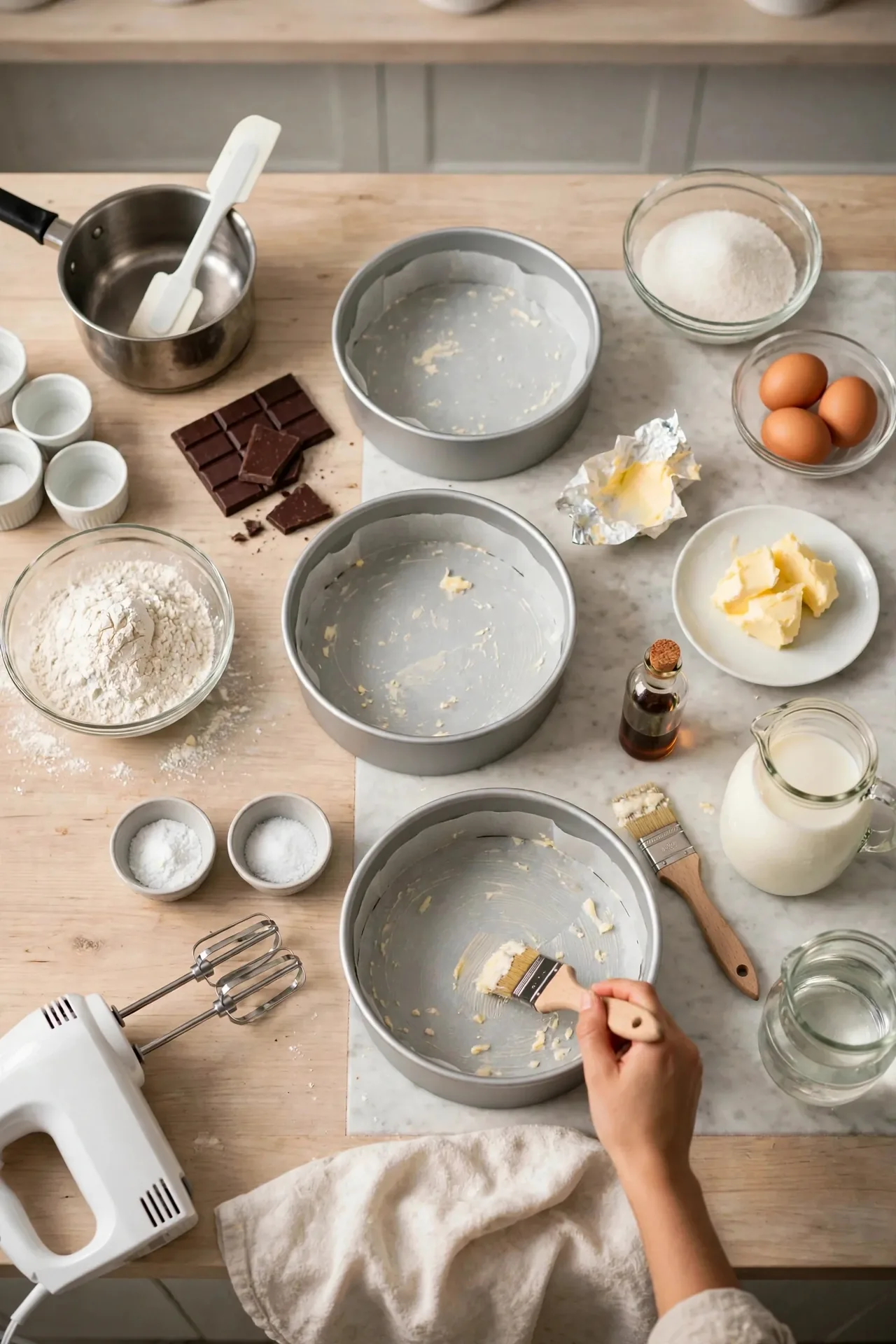
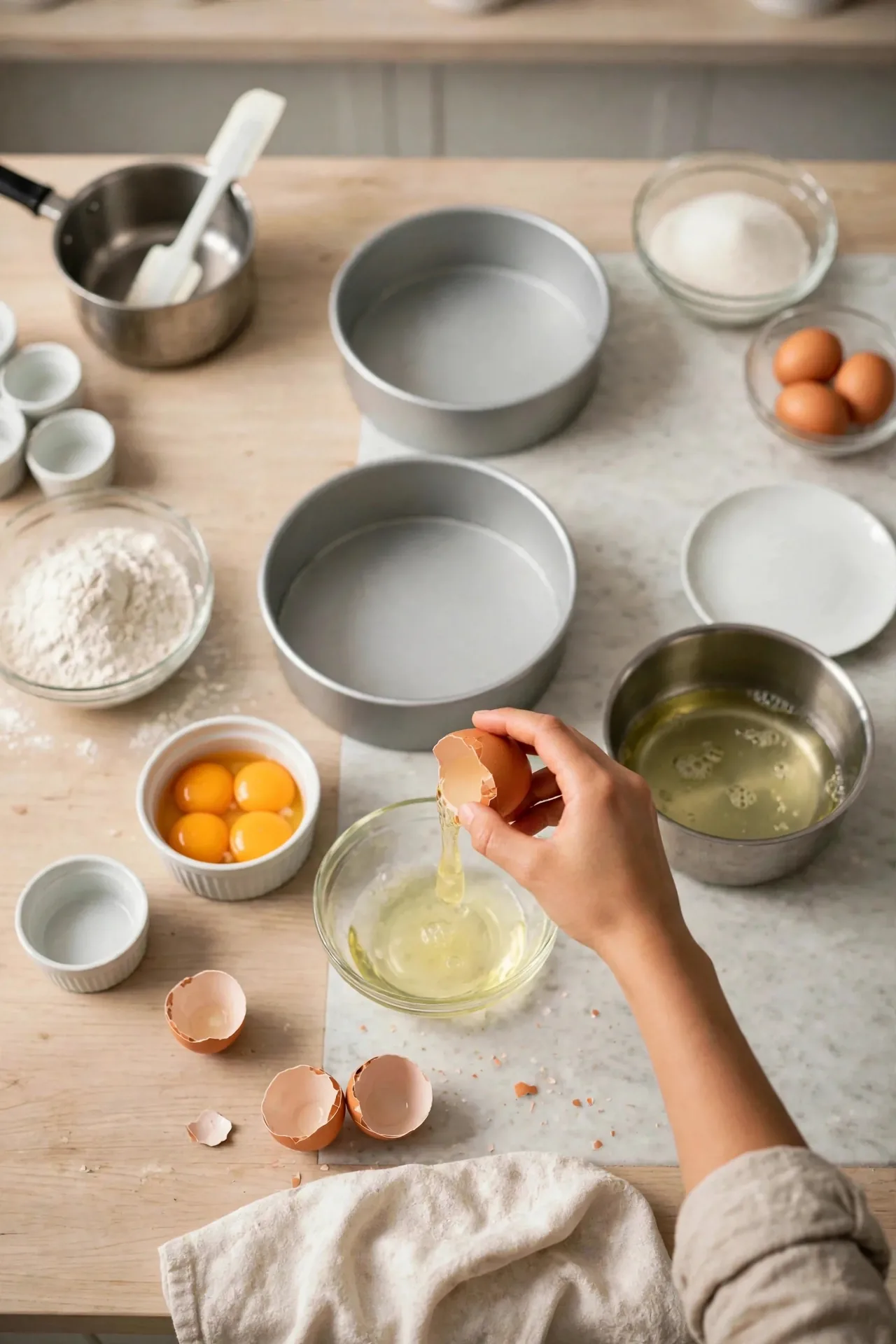
Grease three 9-inch round pans, line the bottoms with parchment rounds, and grease the parchment lightly.
Separate the four eggs, one at a time, over a small bowl so a broken yolk never contaminates the whites. Put the yolks in one bowl and the whites in a very clean, dry bowl.
Step 2: Melt the Chocolate
Chop the chocolate bar into small, even pieces and put it in a heatproof bowl. Pour the boiling water over it.
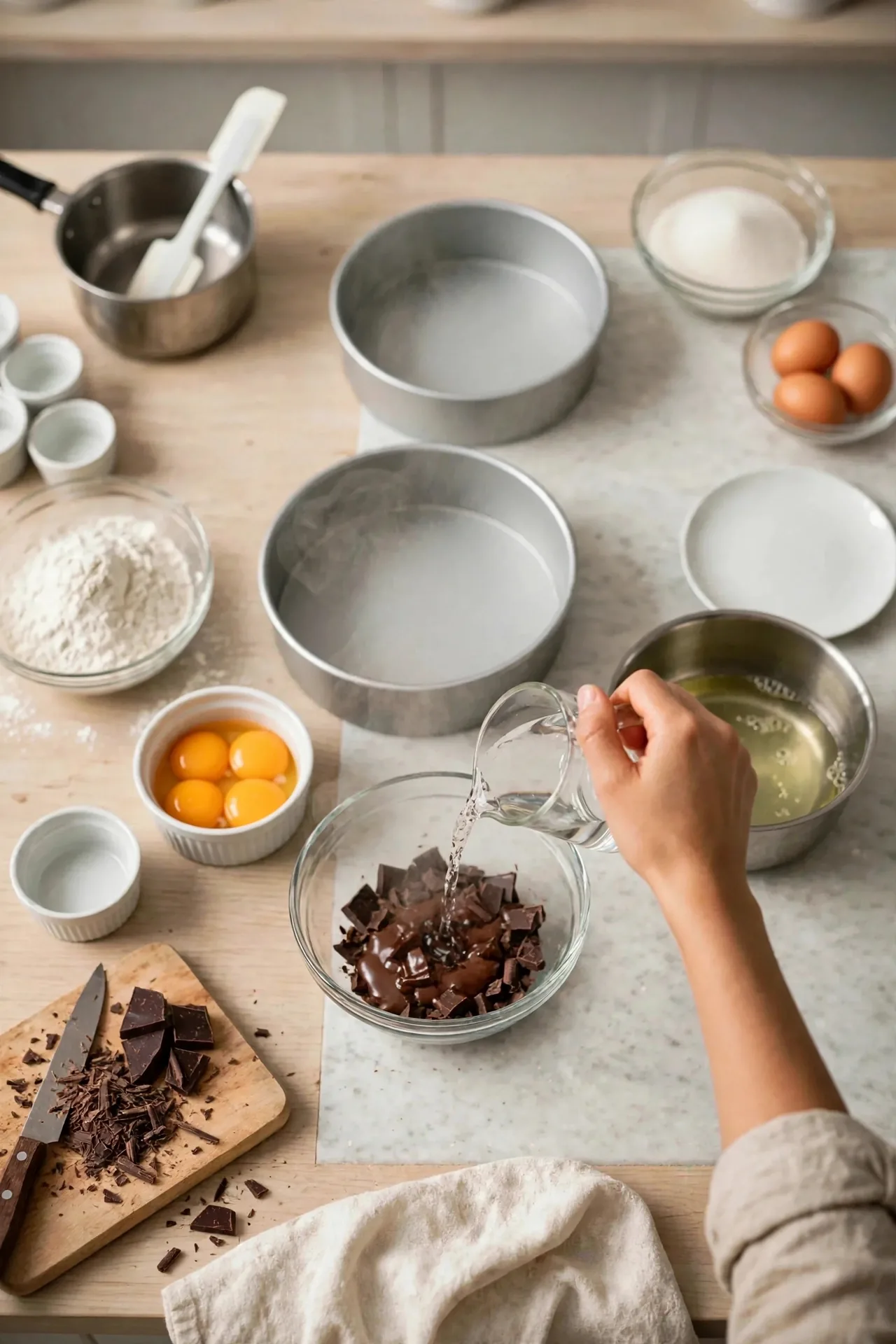
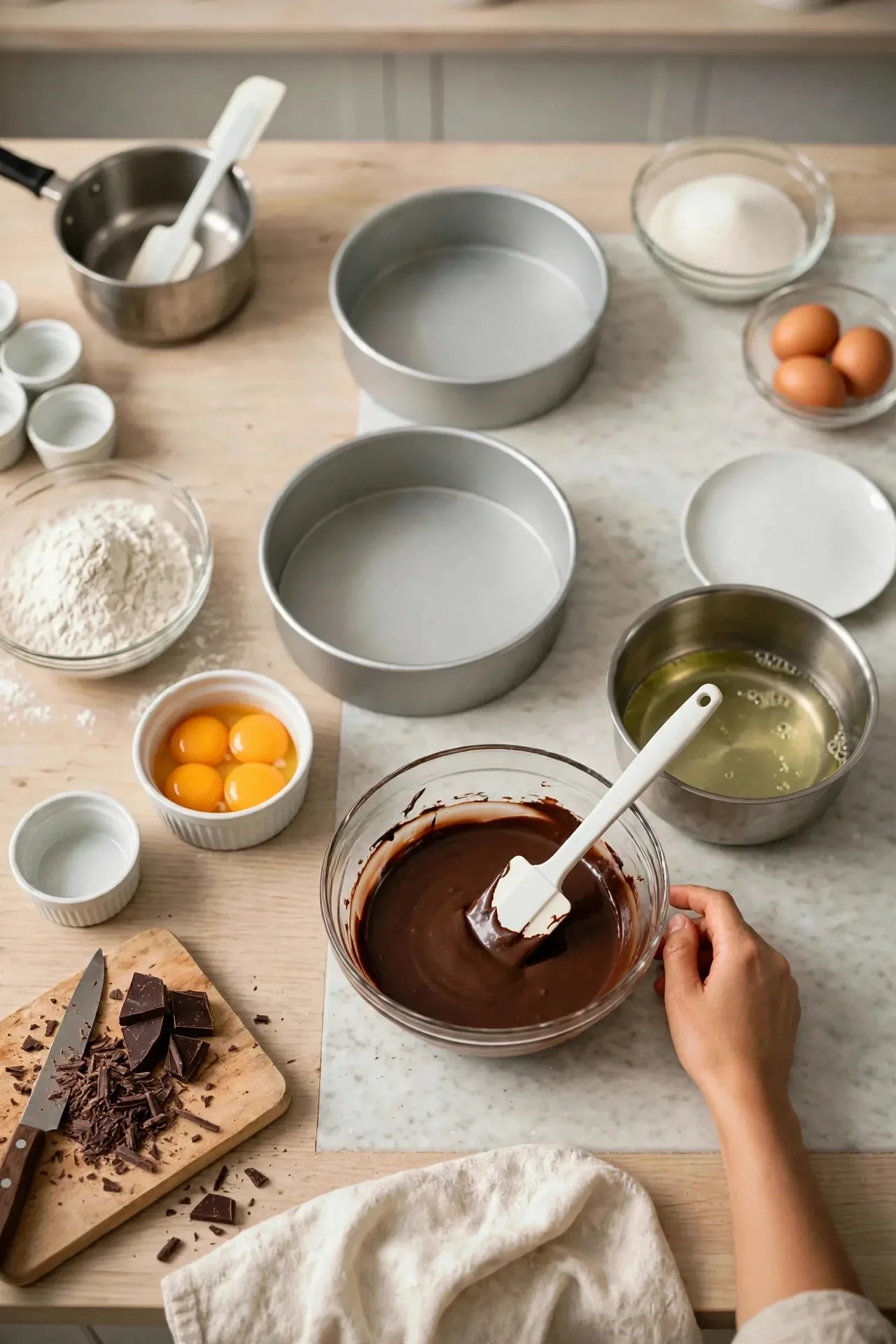
Stir until the chocolate is completely smooth, then set it aside to cool to room temperature. Hot chocolate stirred into the batter would start to melt the butter and cook the yolks.
Step 3: Cream the Butter and Sugar
Put the softened butter and the sugar in a large bowl.
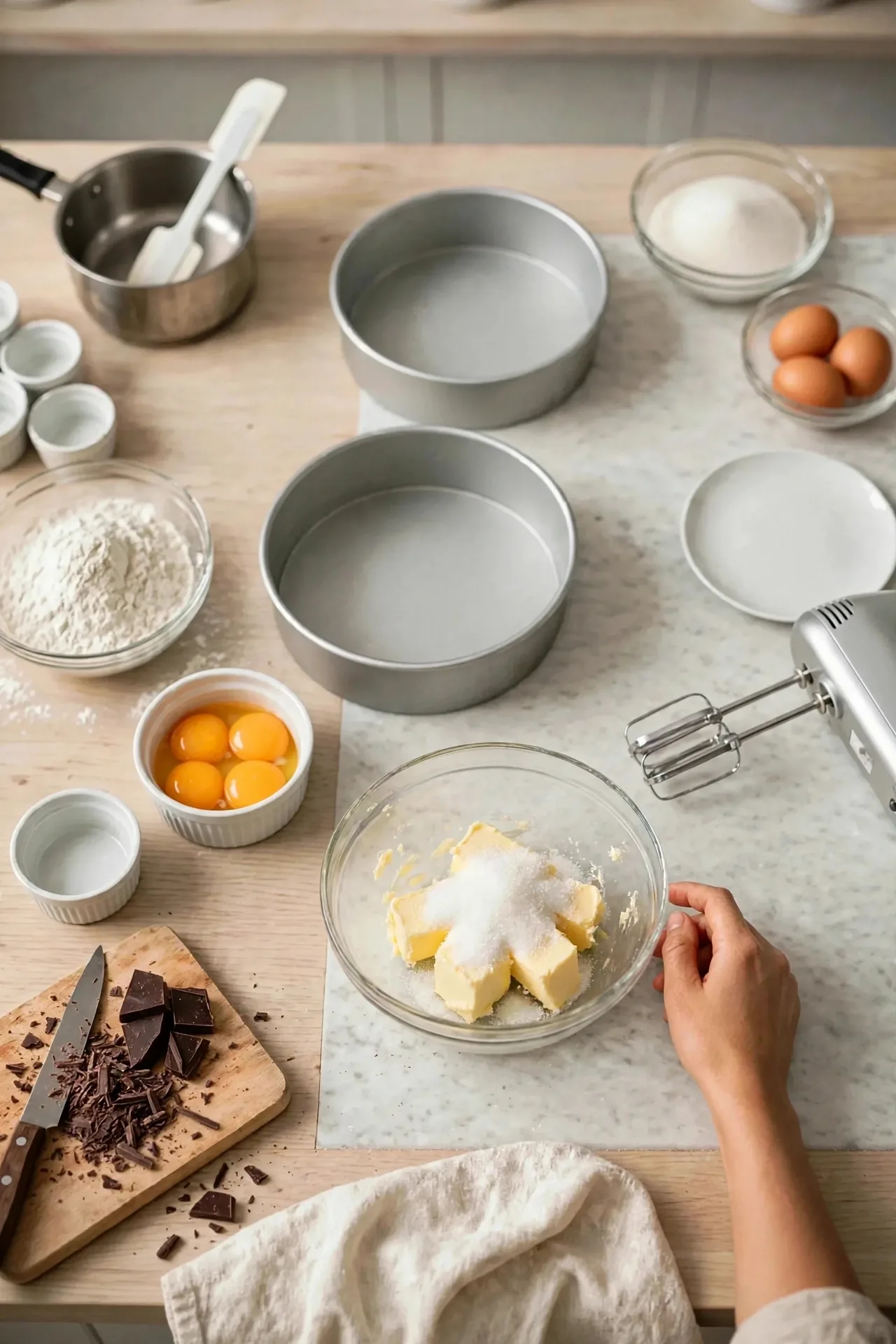
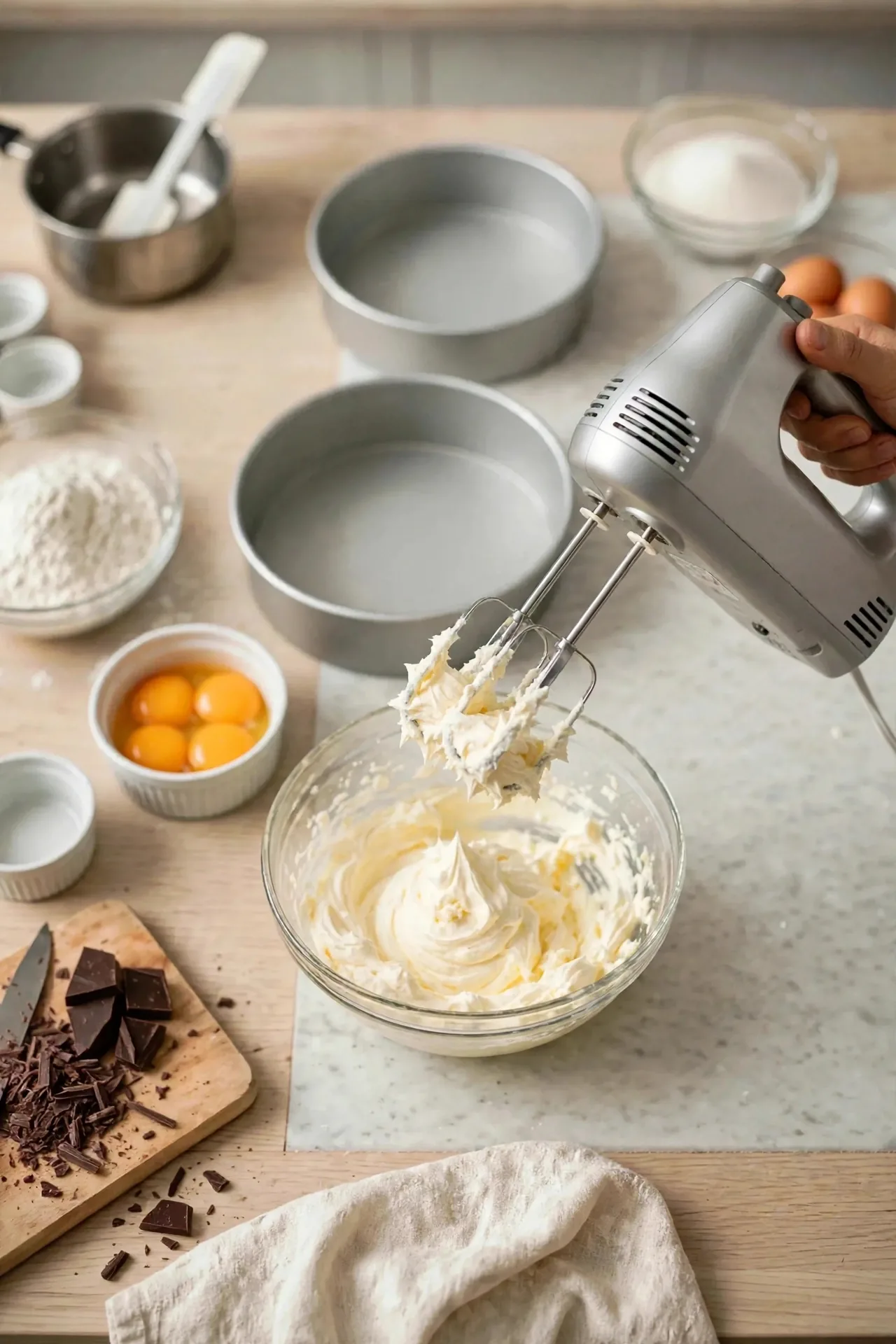
Beat with an electric mixer on medium-high speed for 3 to 4 minutes, scraping the bowl once or twice, until the mixture turns pale and fluffy. This is where most of the cake’s lift starts, so do not shorten it.
Watch For: Butter That Is Too Soft
Butter that has turned shiny or greasy will not hold air. It should dent when pressed with a finger but still keep its shape. If it has gone soft and oily, chill the bowl for 10 minutes and beat again.
Step 4: Add the Yolks, Vanilla, and Chocolate
Add the four yolks one at a time, beating well after each so the mixture stays smooth.
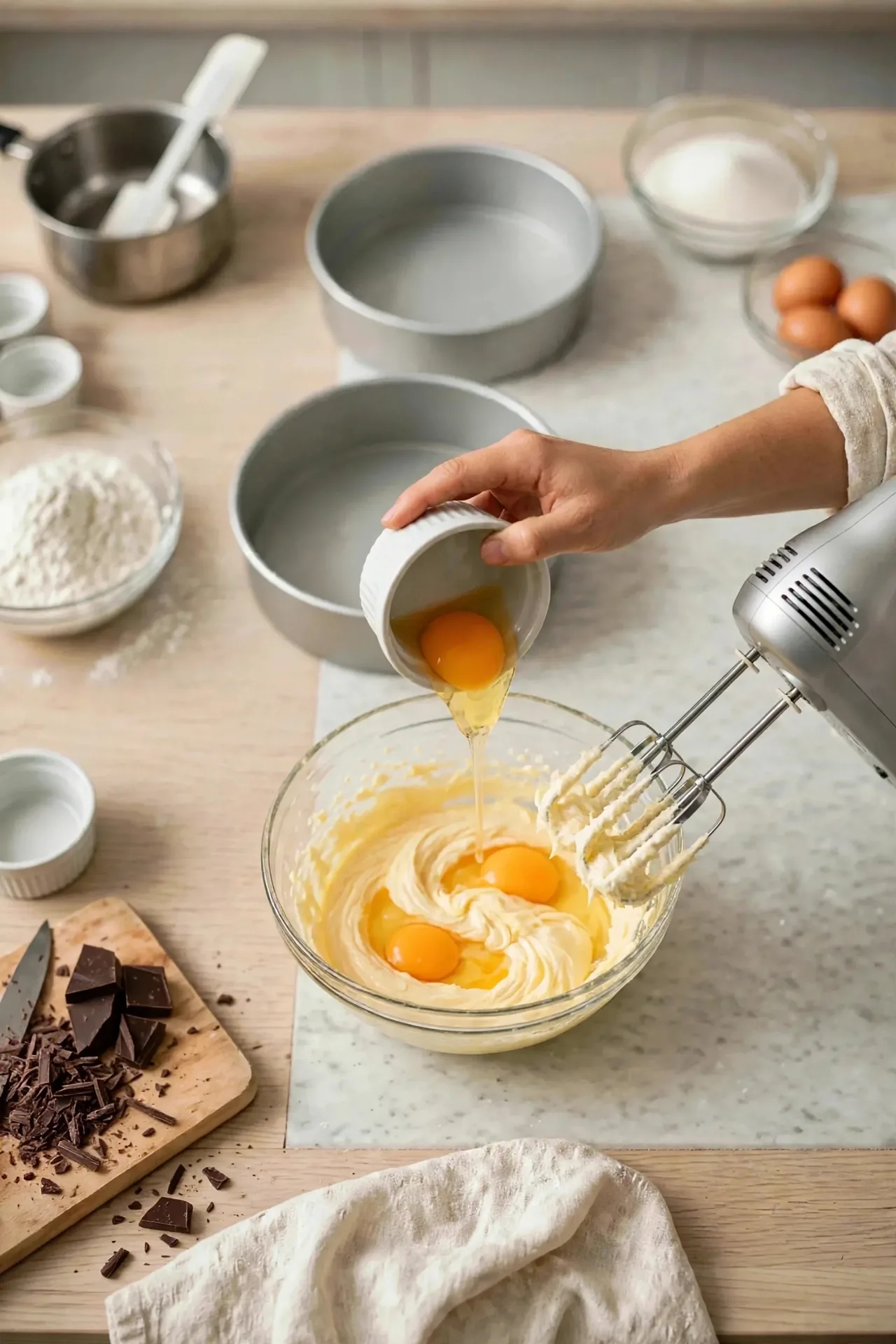
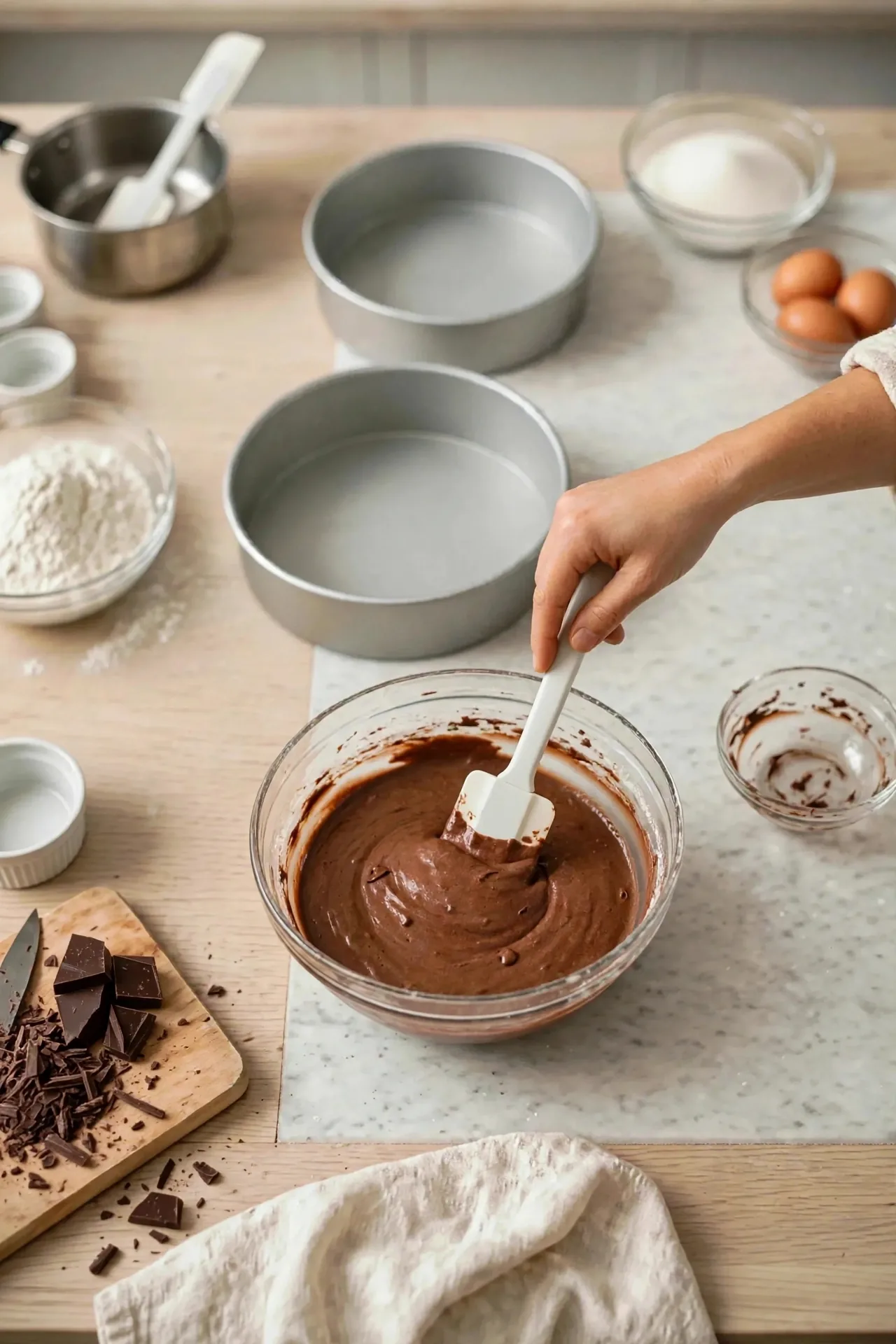
Mix in the vanilla and the cooled chocolate until the batter is an even, uniform brown.
Step 5: Alternate the Flour and Buttermilk
Whisk or sift the cake flour, baking soda, and salt together in a separate bowl.
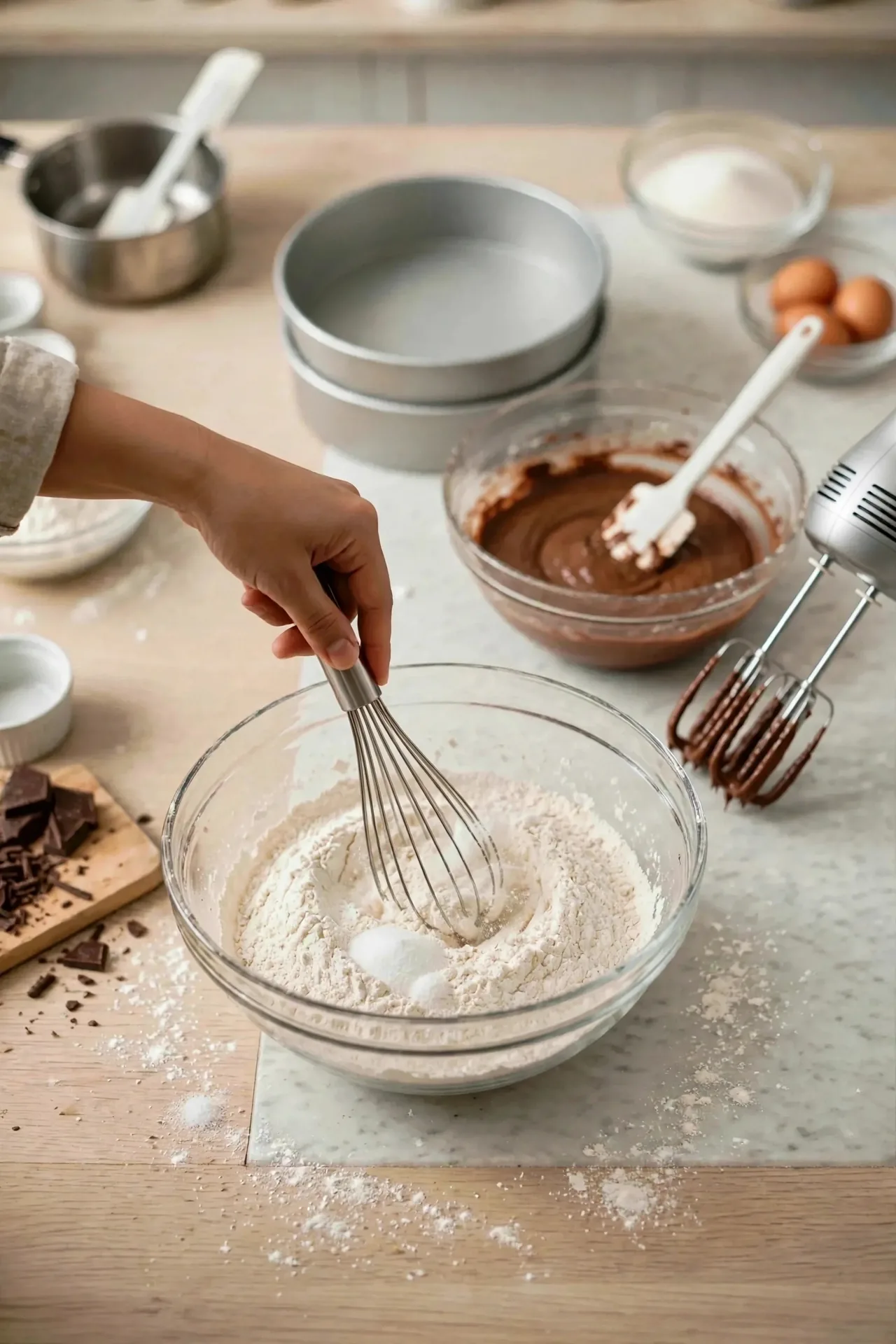
Add about one-third of the dry mixture to the batter and mix on low just until it disappears.
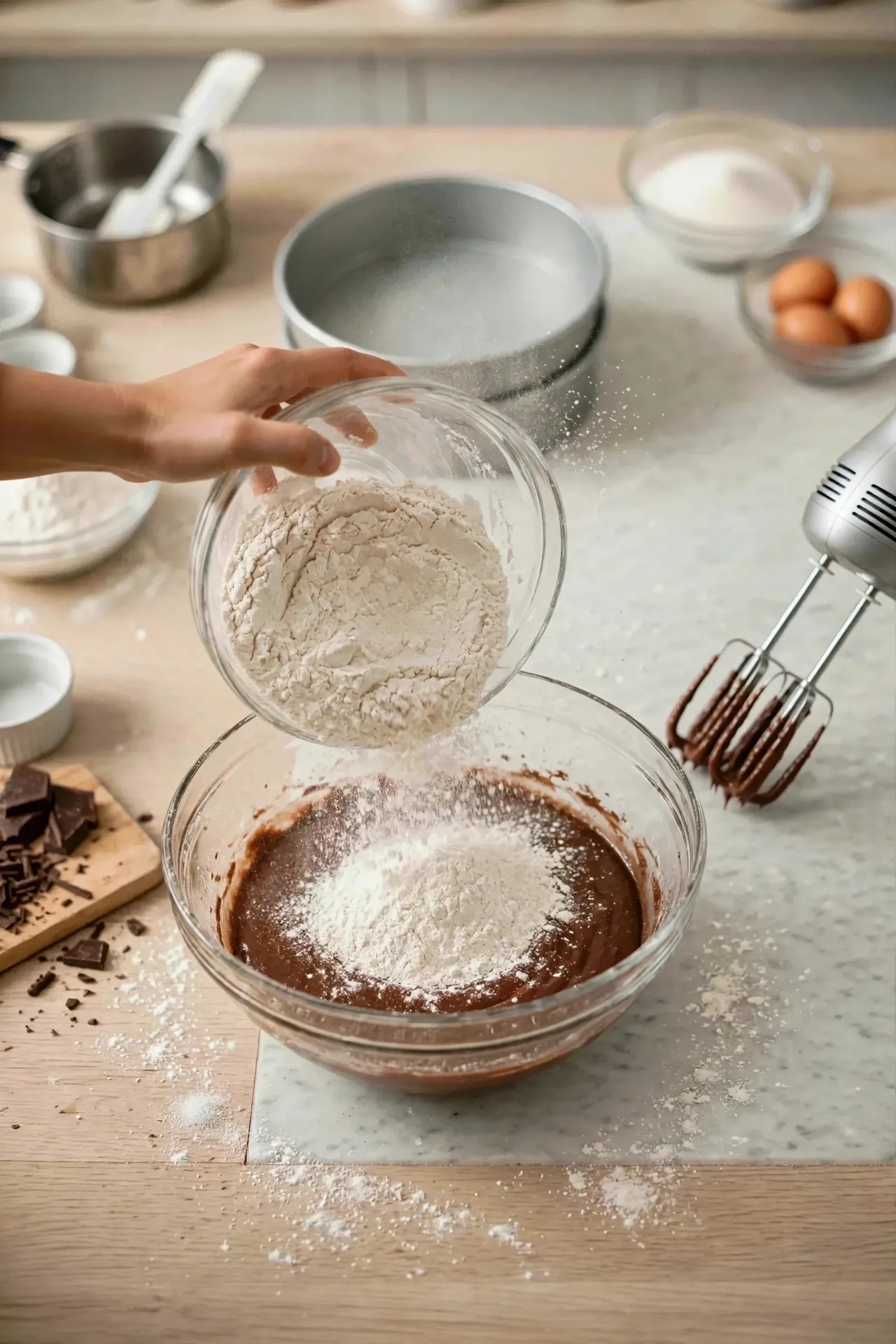
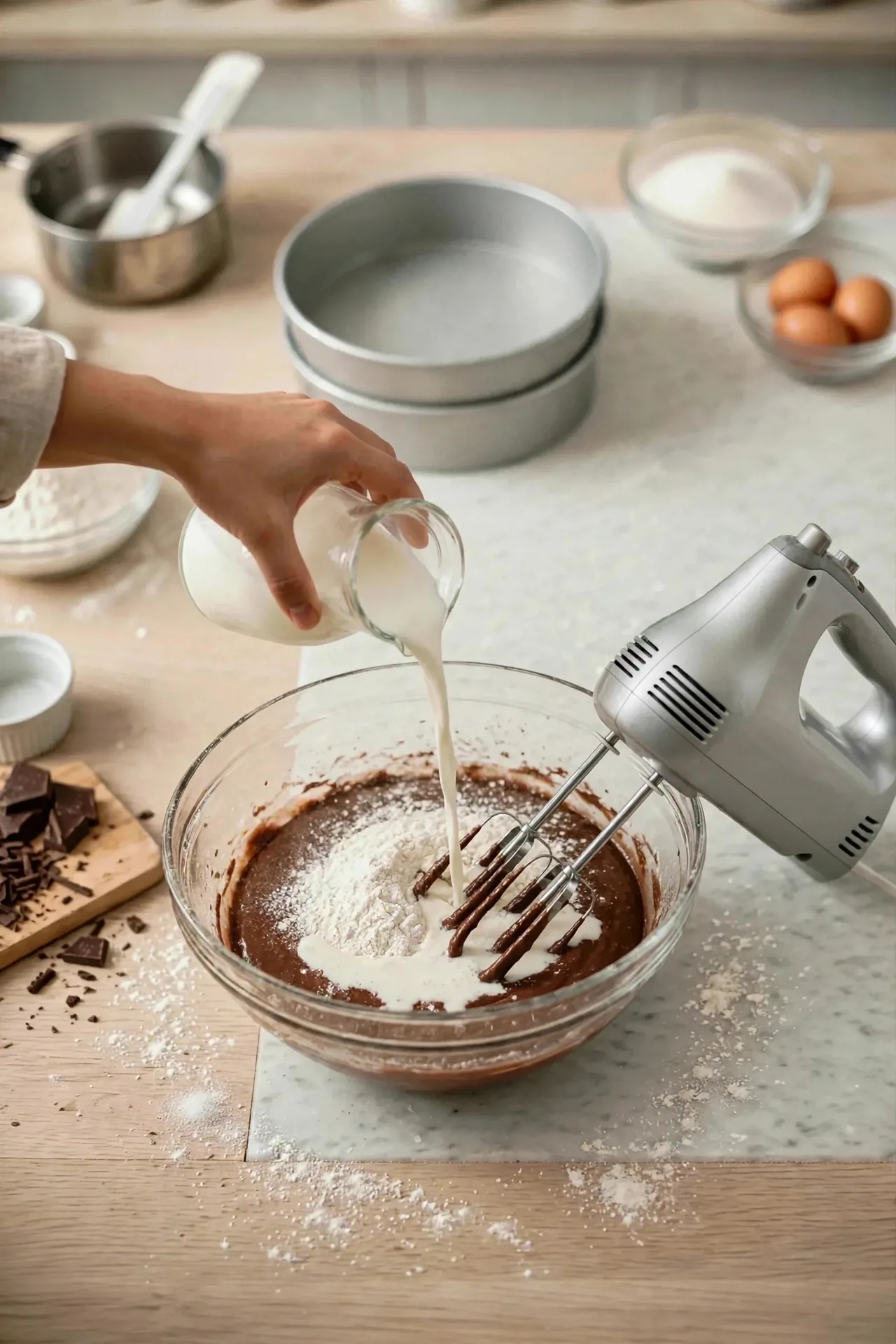
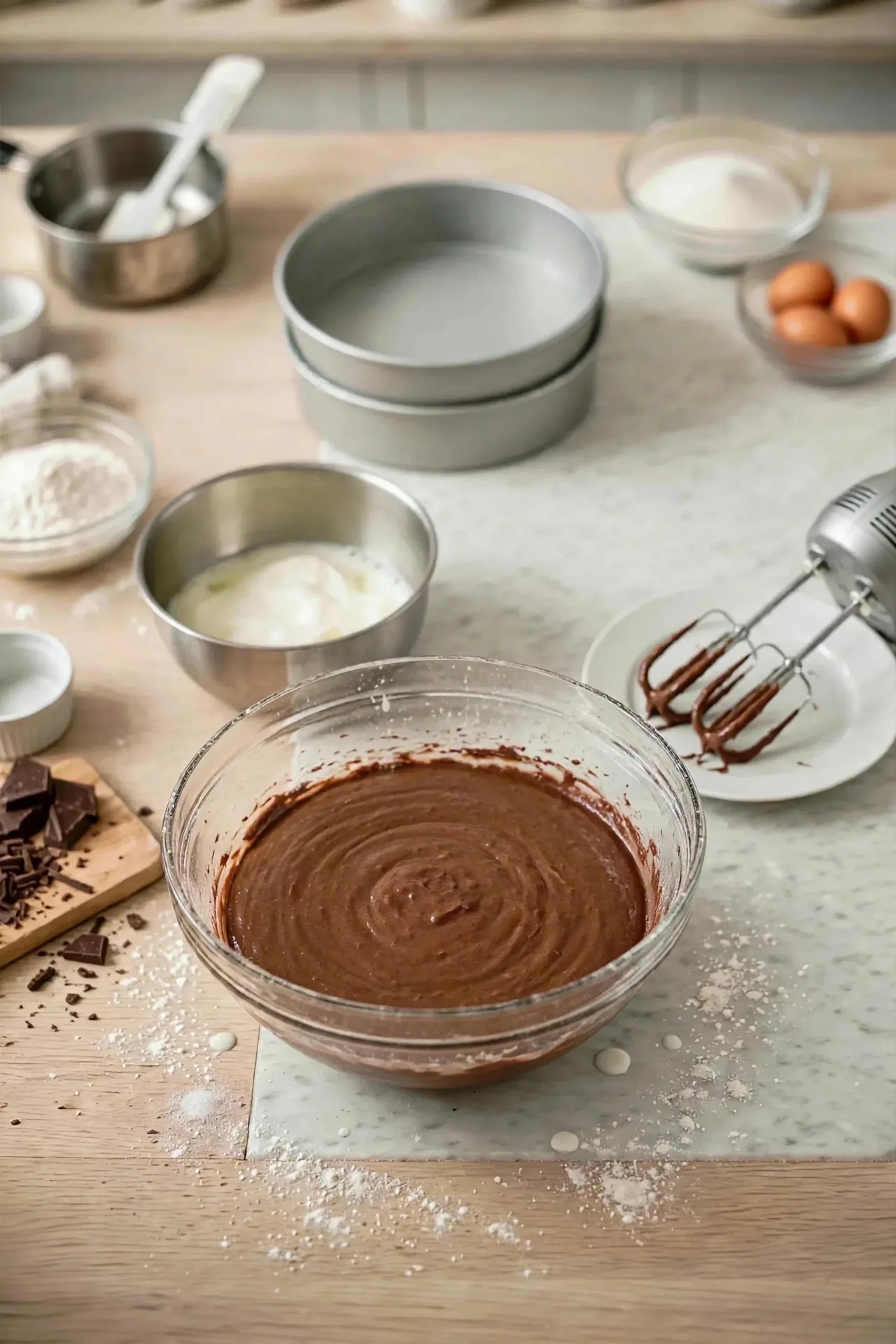
Pour in half of the buttermilk and mix on low. Continue alternating, dry, buttermilk, dry, buttermilk, dry, ending with the dry ingredients. Mix only until you no longer see streaks of flour.
Why the Order Matters
Starting and ending with flour keeps the batter from splitting, because the dry ingredients soak up the liquid in small amounts. Beating past the point where the flour disappears develops gluten and makes the layers tougher.
Step 6: Whip and Fold In the Egg Whites
Beat the four egg whites in the clean bowl, starting on medium and moving to high, until they hold stiff, glossy peaks: when you lift the beaters, the peak should stand up straight and the whites should not slide when you tilt the bowl.
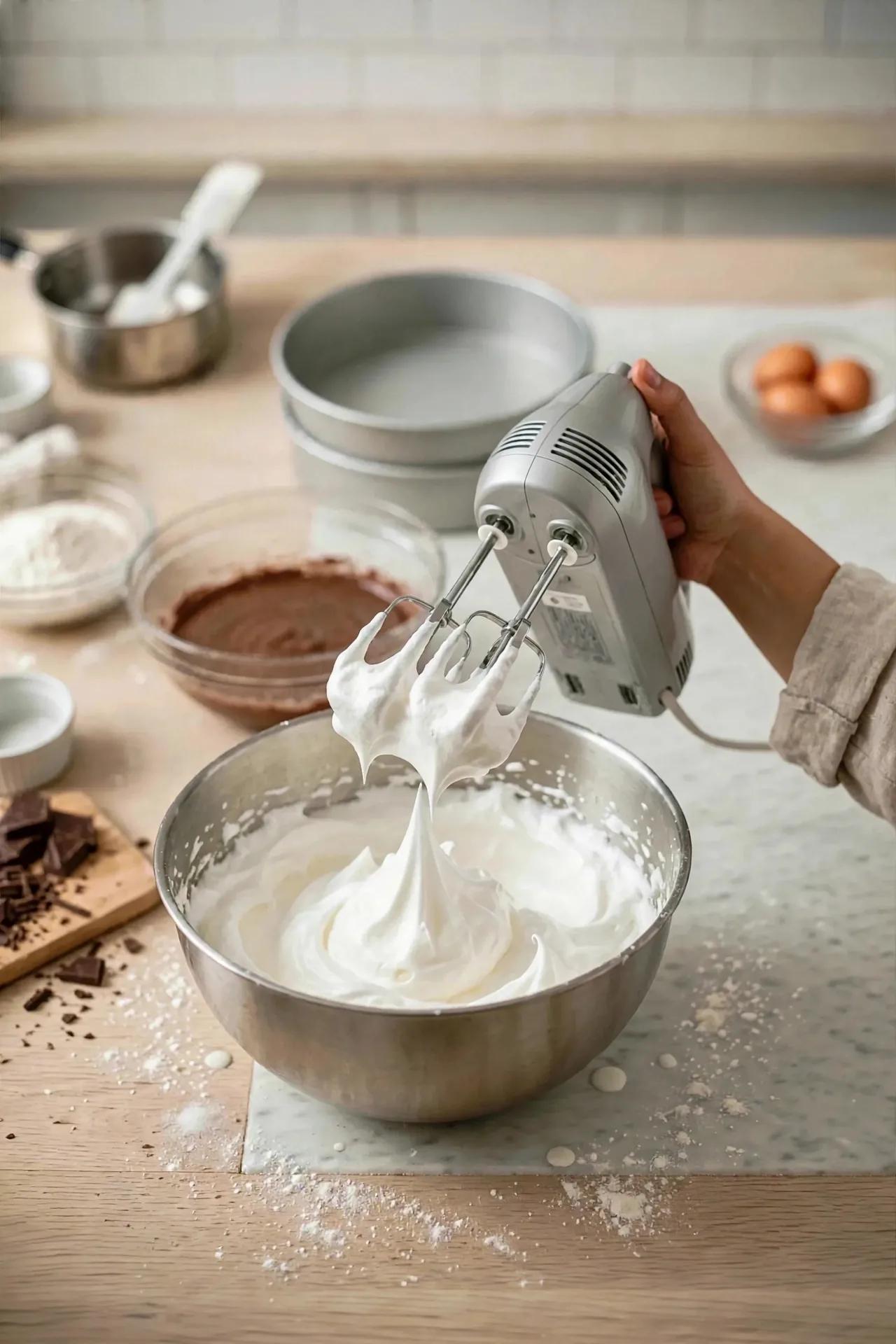
Scoop about a third of the whites into the batter and fold them in with a rubber spatula to lighten it. Cut down through the center, sweep along the bottom, and turn the batter over, rotating the bowl as you go.
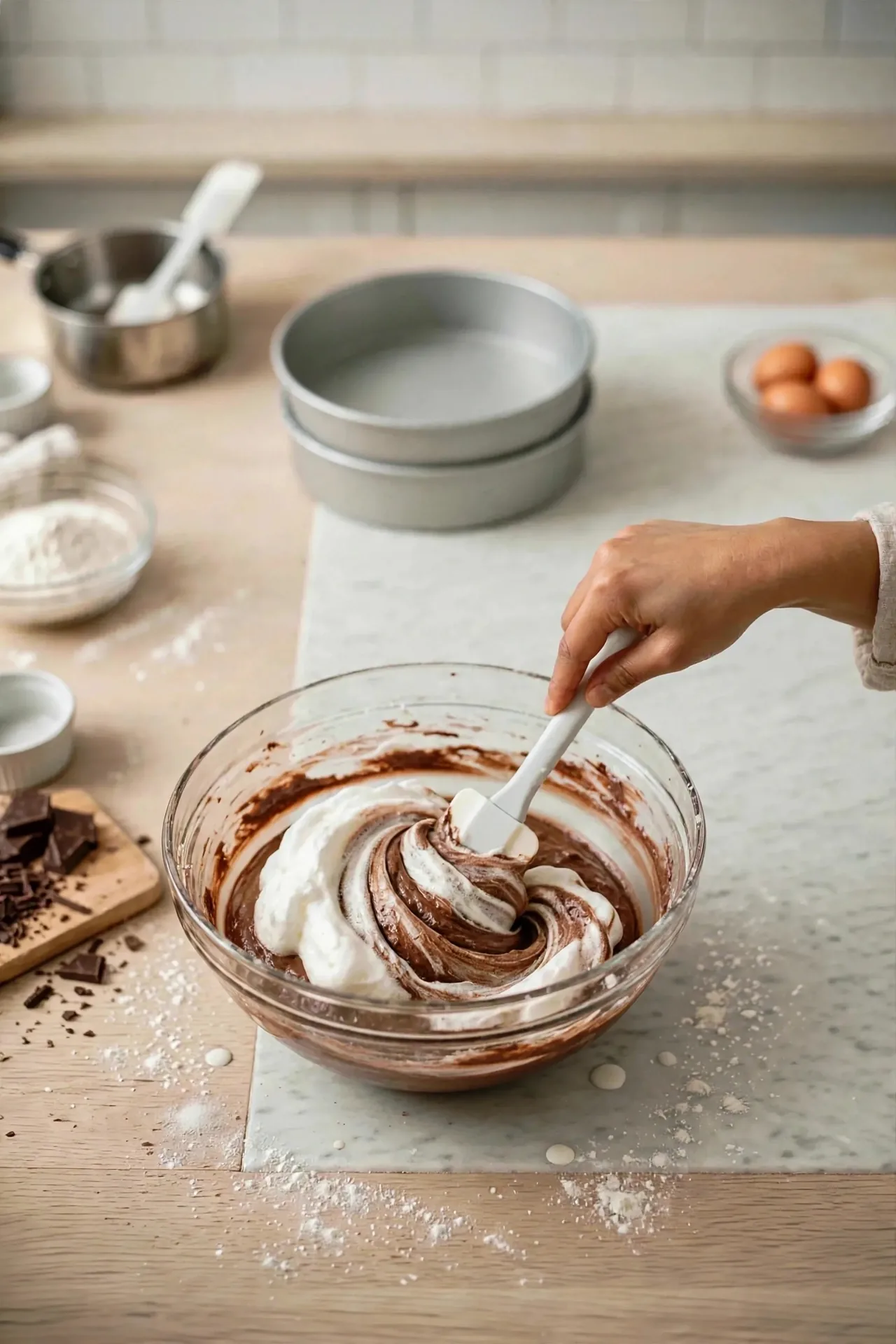
Fold in the remaining whites in two more additions, stopping when you no longer see white streaks. The batter should look light and airy, not dense.
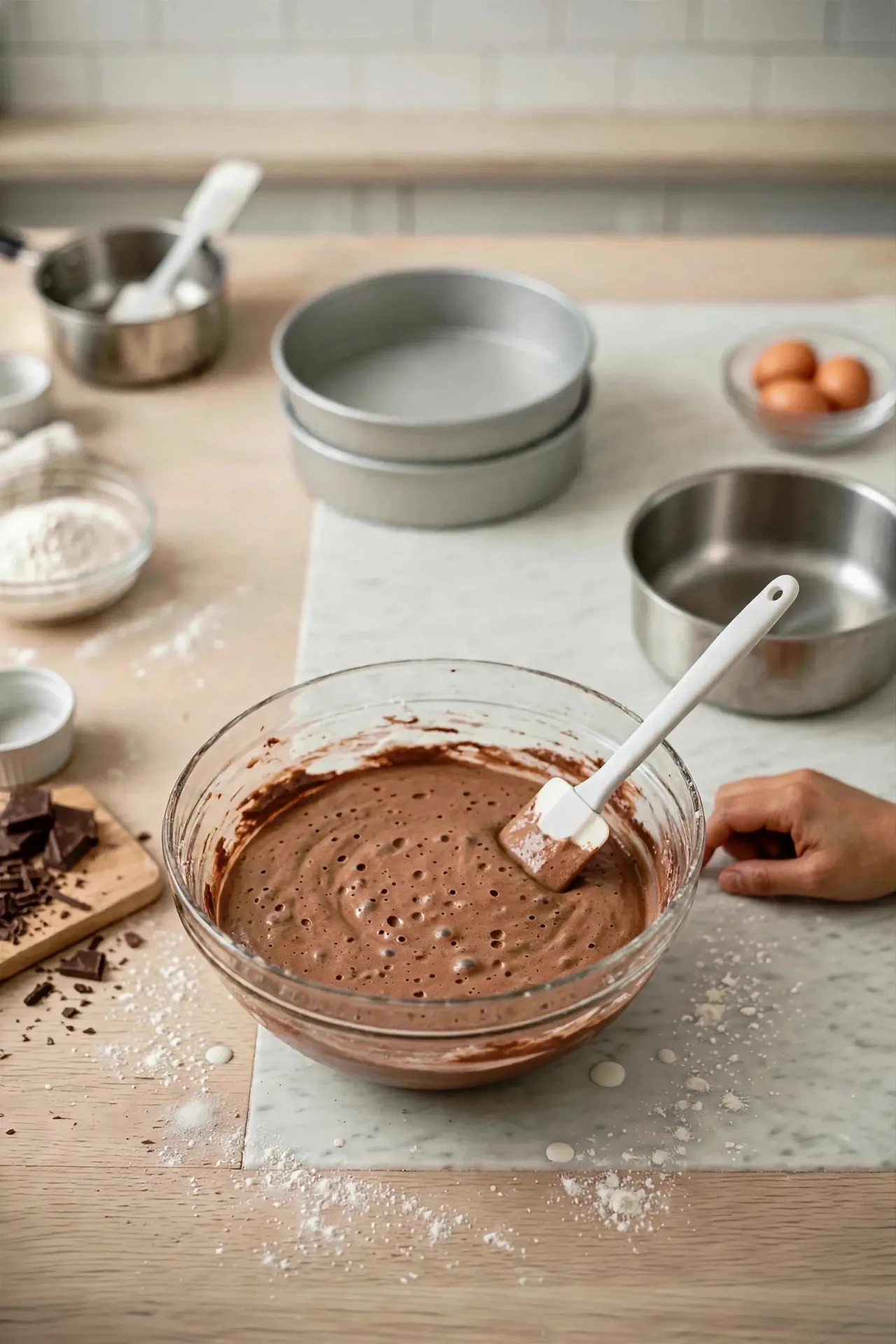
Mistake Alert: Deflating the Whites
Stirring instead of folding, or folding for too long, knocks out the air you just whipped in. The layers then bake up flat and dense. Fold gently and stop as soon as the streaks are gone, even if a few small bubbles of white remain.
Step 7: Fill the Pans and Bake
Divide the batter among the three pans. A kitchen scale makes this exact: aim for the same weight in each pan so the layers bake at the same pace and stack evenly.
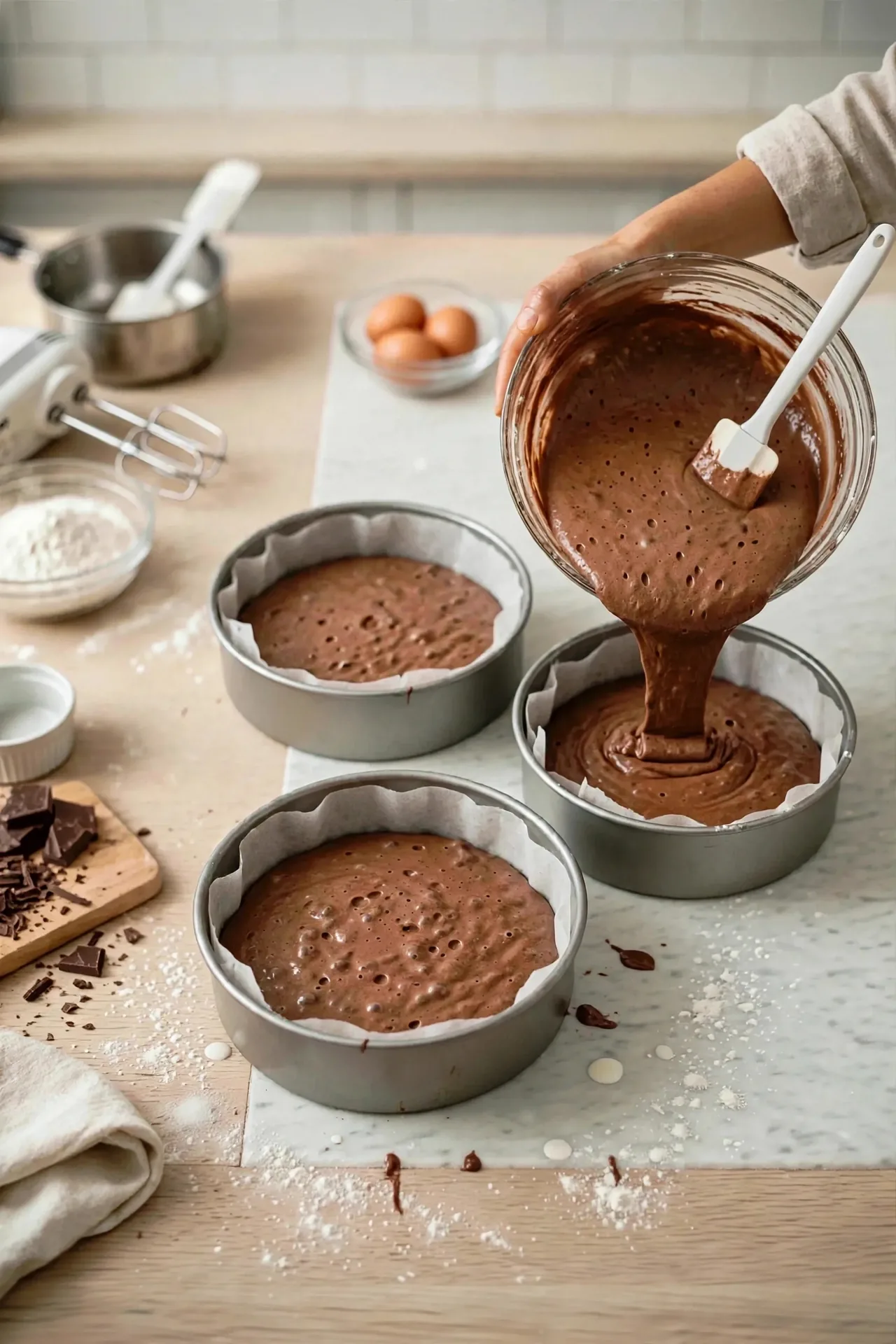
Smooth each top with an offset spatula, then give each pan one gentle tap on the counter to settle the batter.
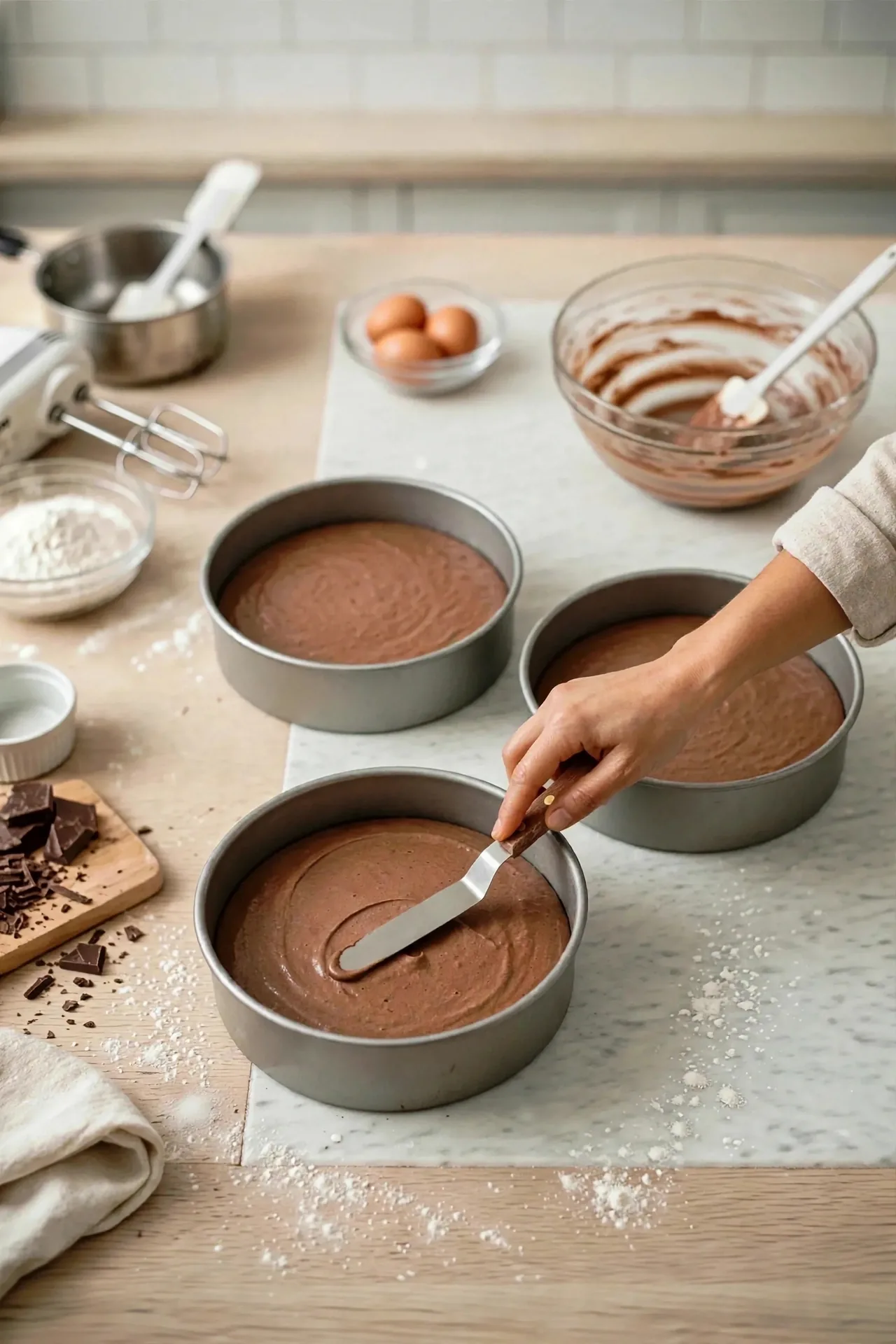
Bake for 30 to 35 minutes. If your oven fits only two pans on one rack, put the third on a different rack, offset so it is not directly under another pan, and swap positions halfway through.
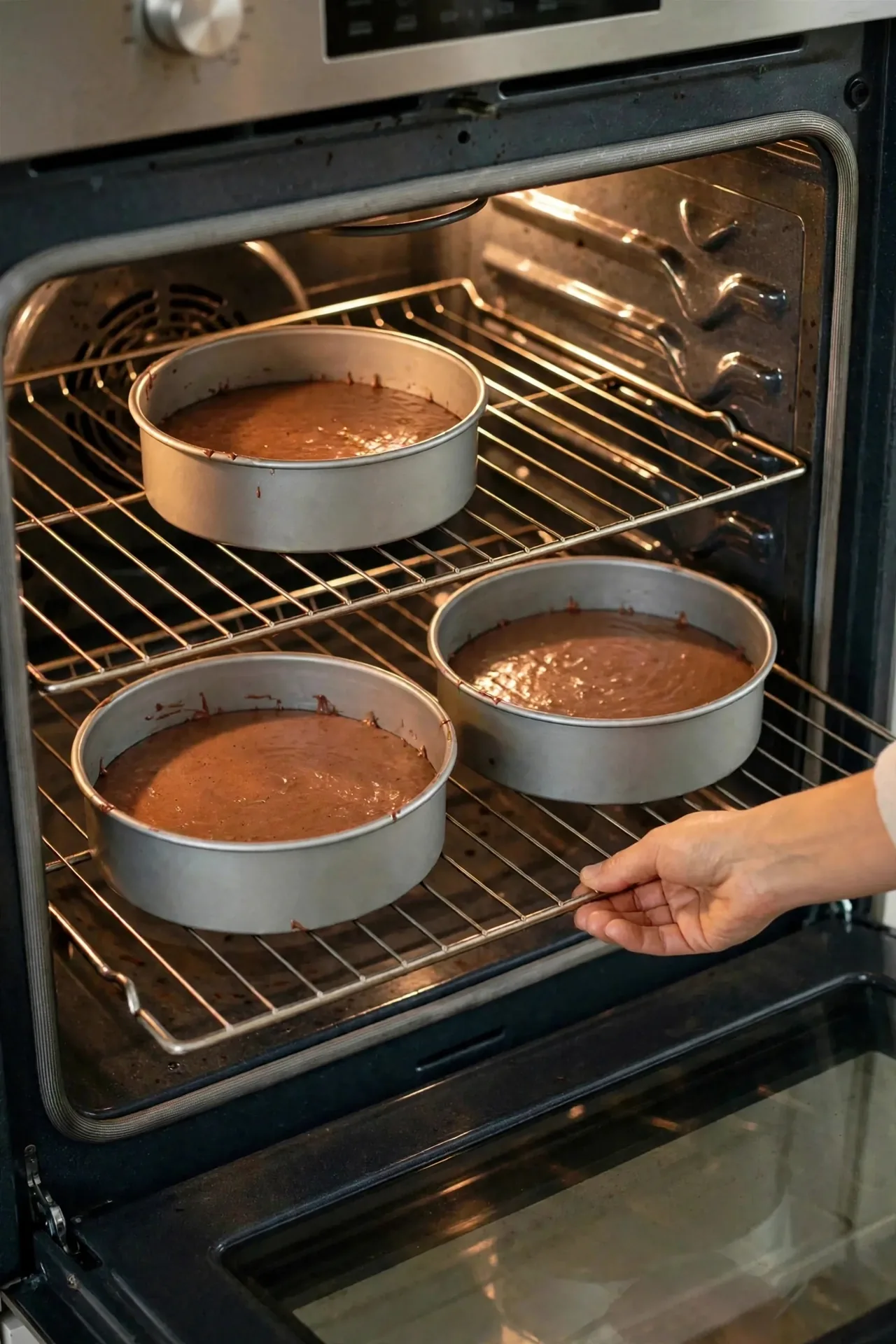
Check for doneness at 30 minutes. The layers are done when the tops spring back lightly when touched and a toothpick inserted in the center comes out clean or with a few moist crumbs, not wet batter.
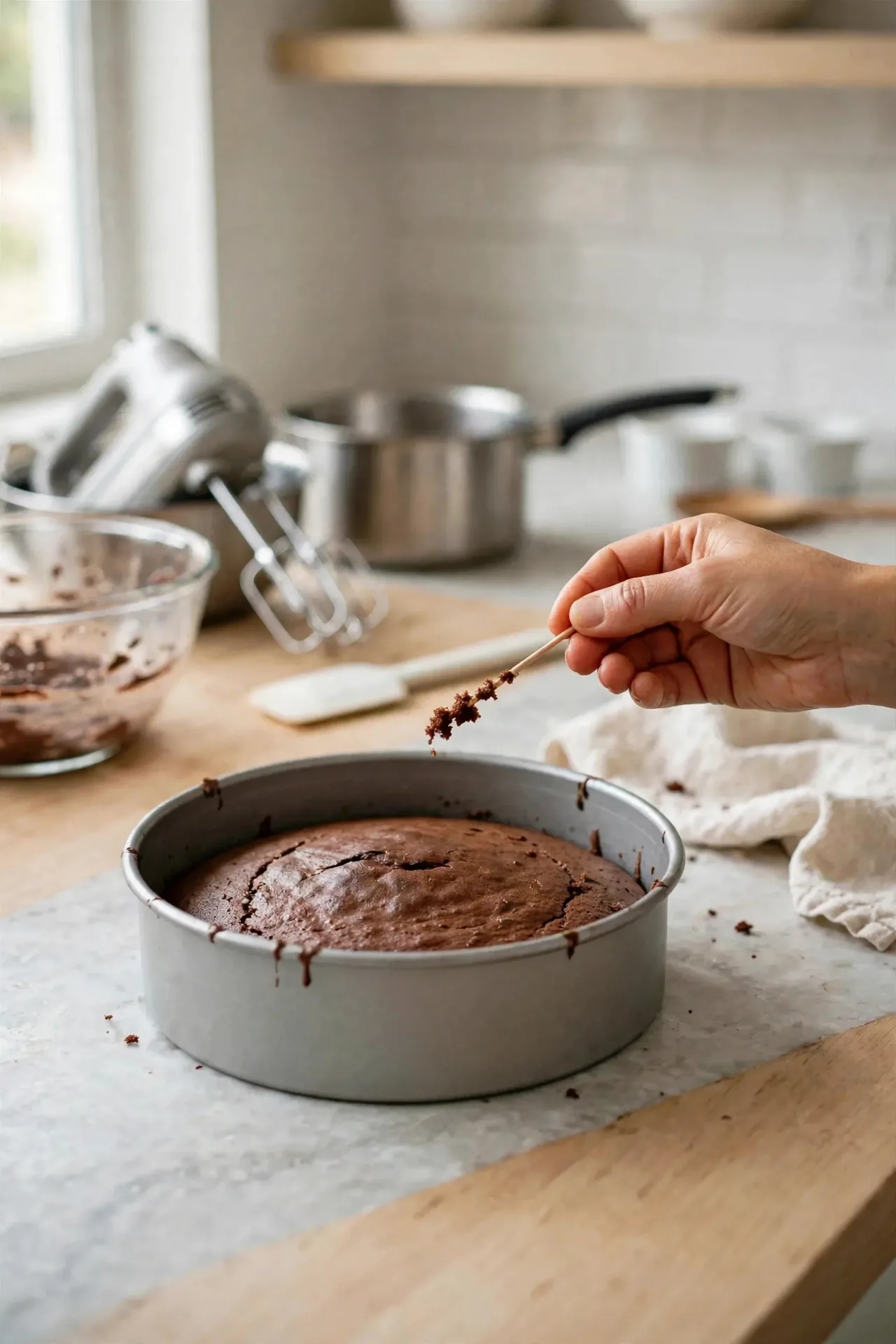
Doneness Check: Do Not Overbake
This is a tender, mildly flavored cake, and it dries out quickly. Start testing at 30 minutes. If the toothpick shows wet batter, bake another 3 to 5 minutes and test again. If the edges have already pulled away from the pan sides and the top has set, it is done.
Step 8: Cool the Layers
Let the layers cool in their pans on a wire rack for 15 minutes. They are fragile while hot and cooling briefly lets them firm up enough to release cleanly.
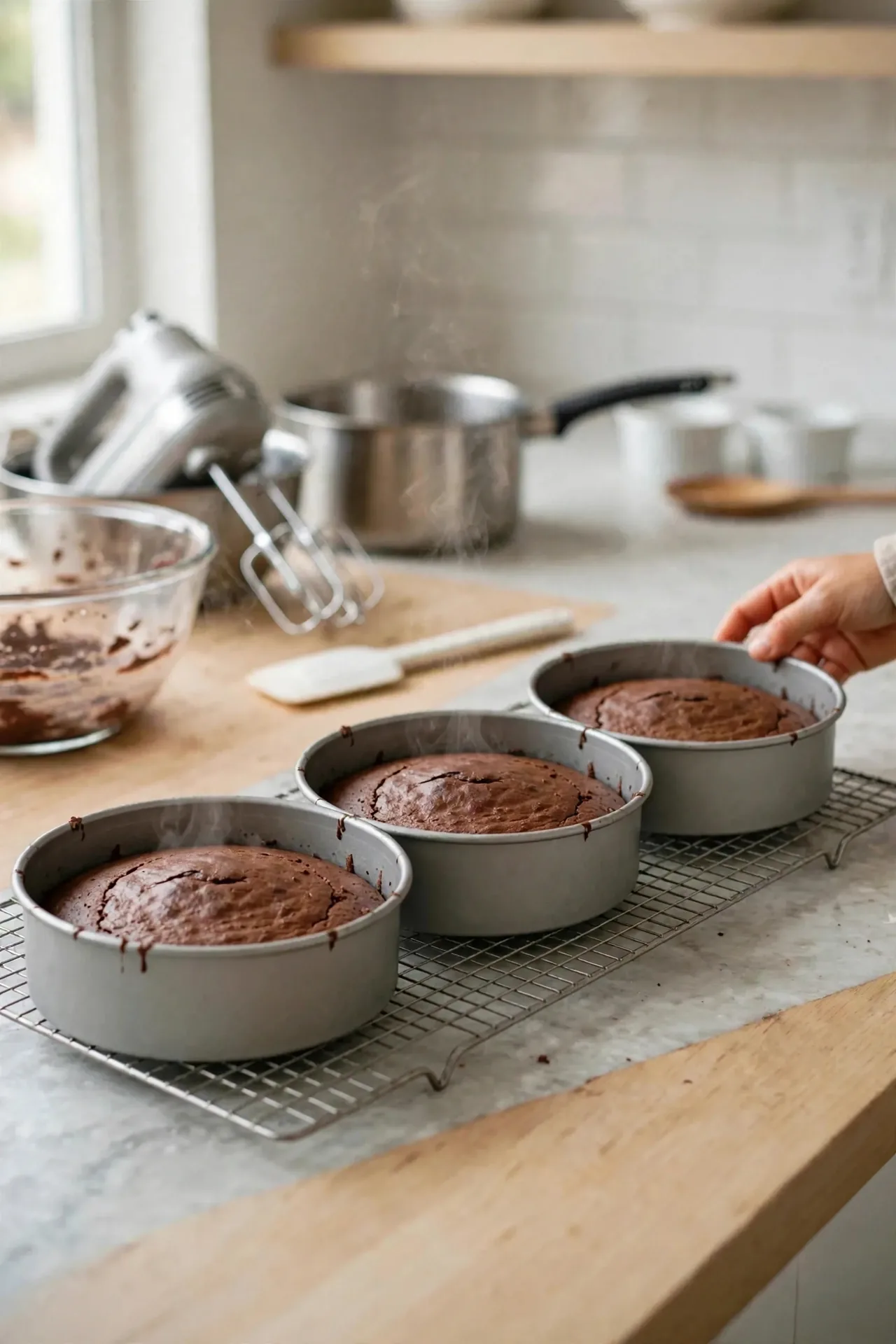
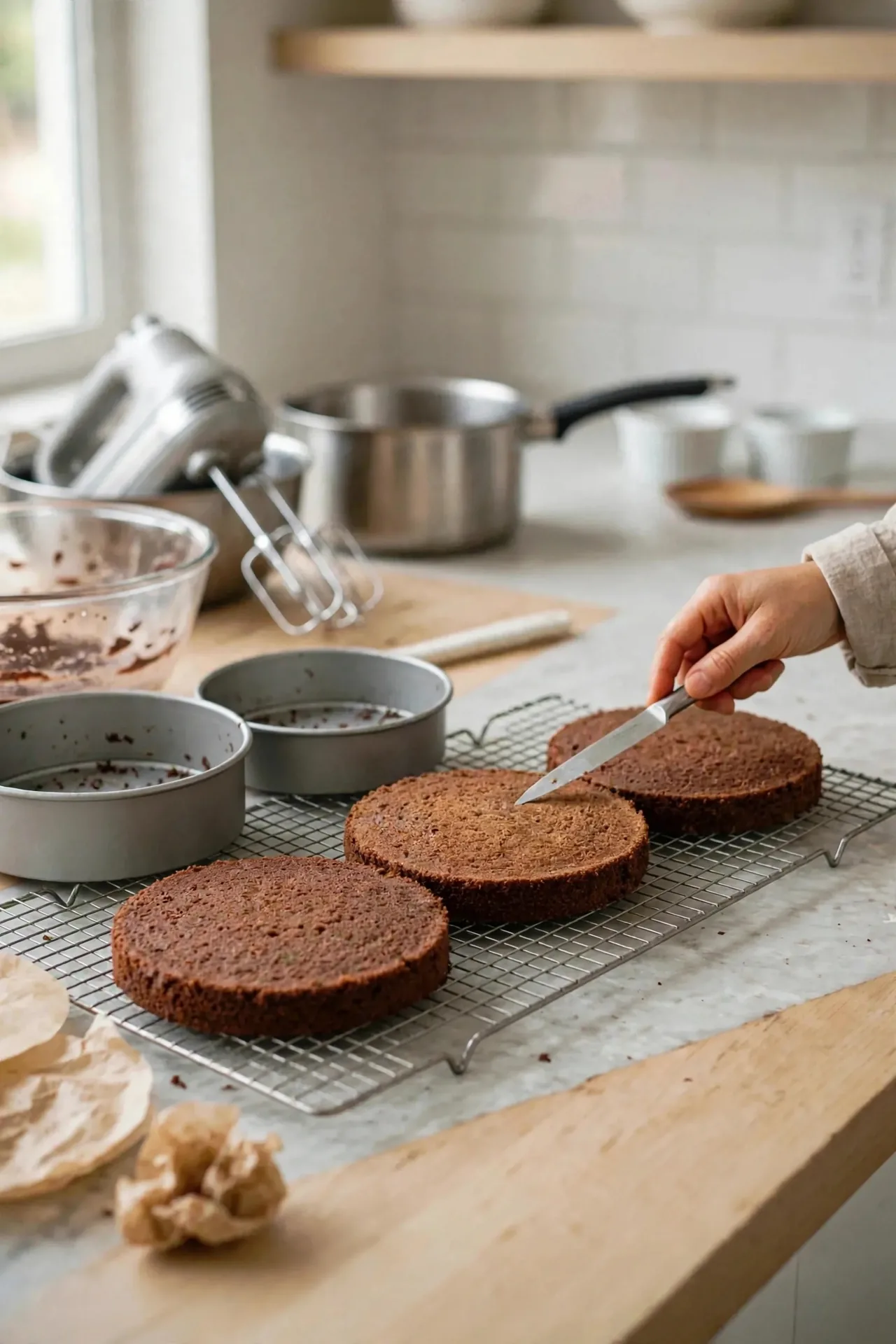
Run a thin knife around each edge, turn each layer out onto the rack, peel off the parchment, and let the layers cool completely before frosting. Warm layers melt the frosting and slide.
Step 9: Toast the Pecans
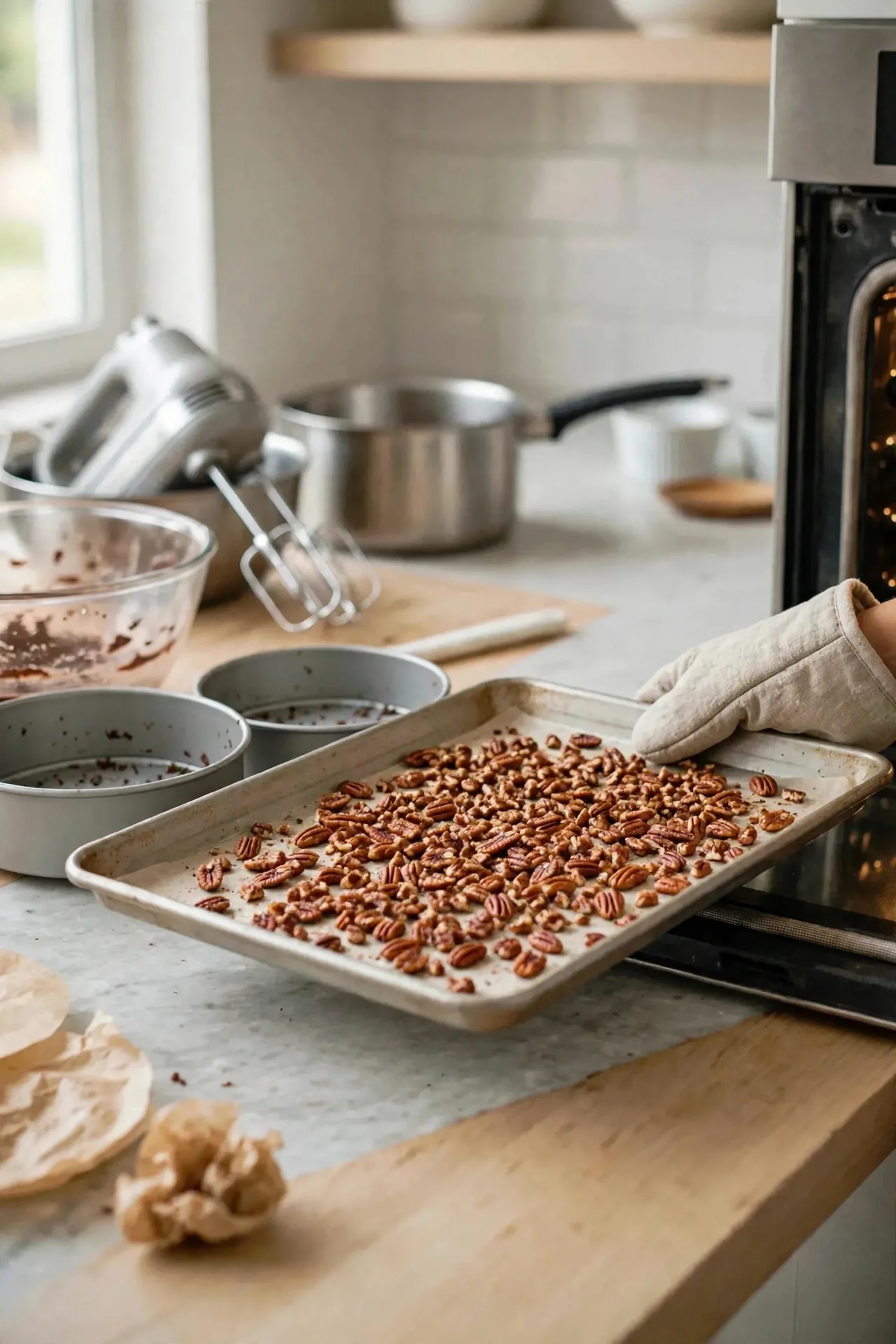
While the oven is still hot, spread the chopped pecans on a rimmed baking sheet and toast them for 6 to 8 minutes, checking from 5 minutes. They are ready when they smell nutty and look a shade darker. Pecans go from toasted to bitter quickly, so do not walk away.
Step 10: Cook the Coconut Pecan Frosting
Have the coconut and pecans measured before you start. The custard needs constant stirring and you will not have a free hand later.
Combine the evaporated milk, sugar, three egg yolks, butter, and vanilla in a 3-quart saucepan.
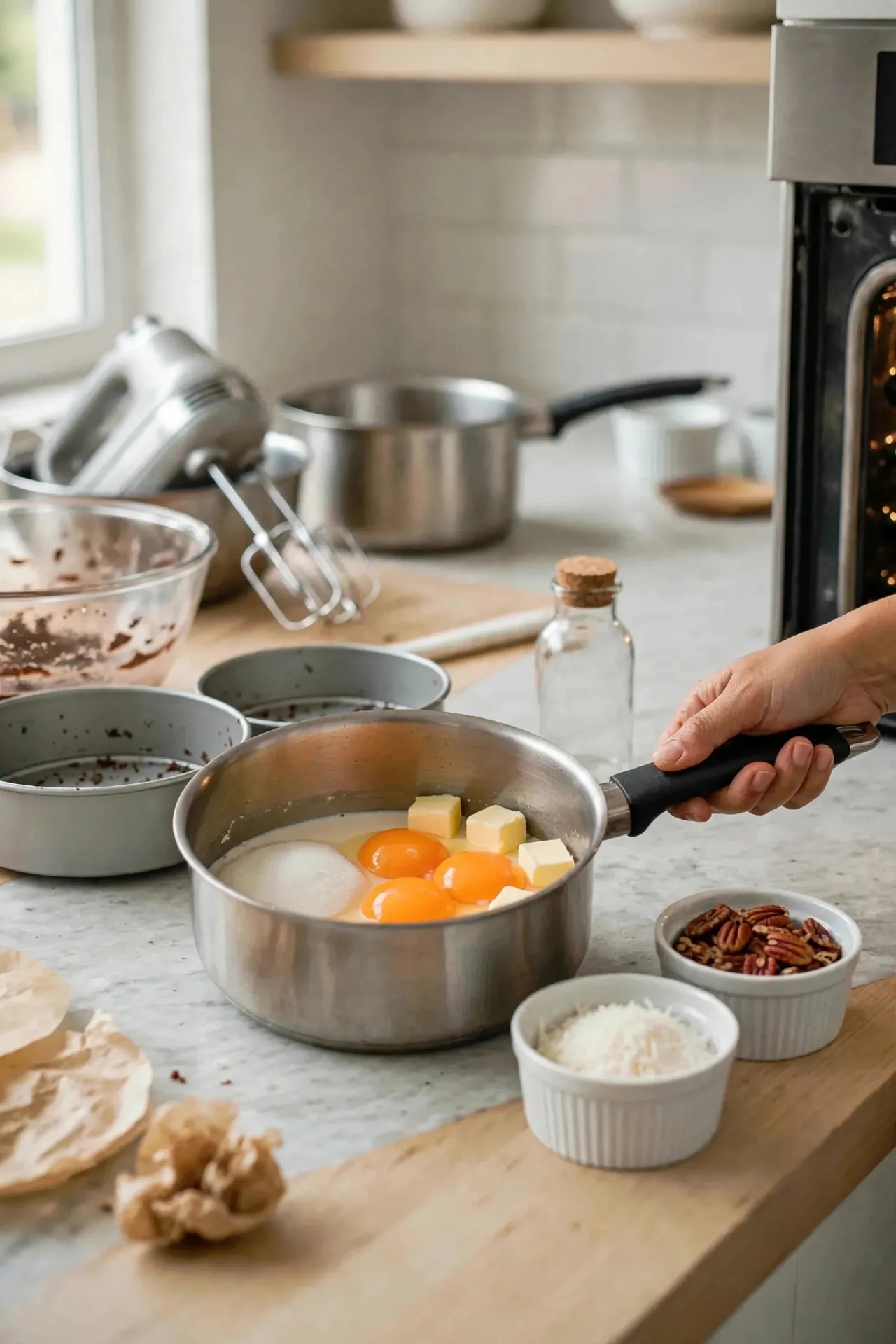
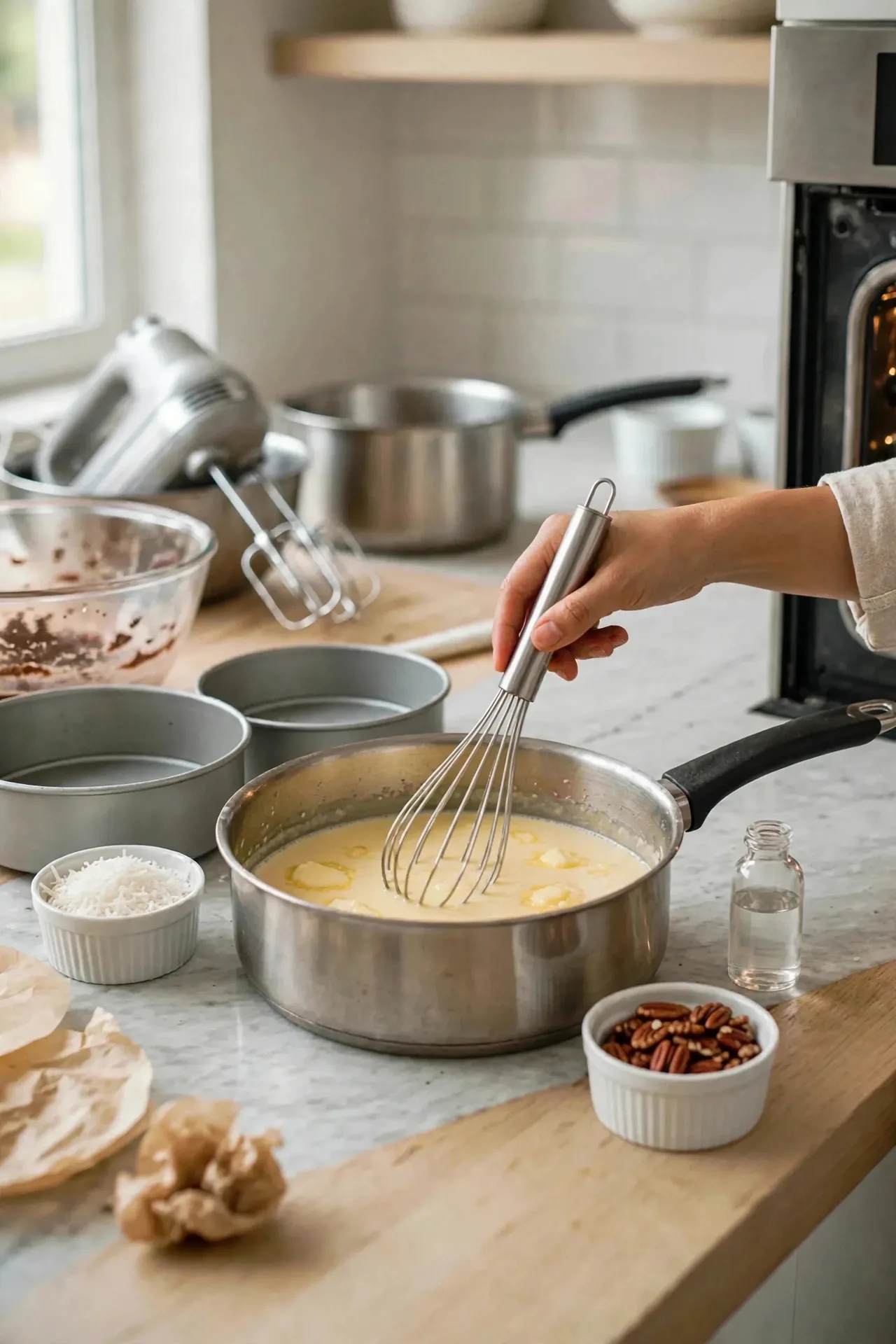
Whisk it together while the mixture is still cold so the yolks blend in evenly.
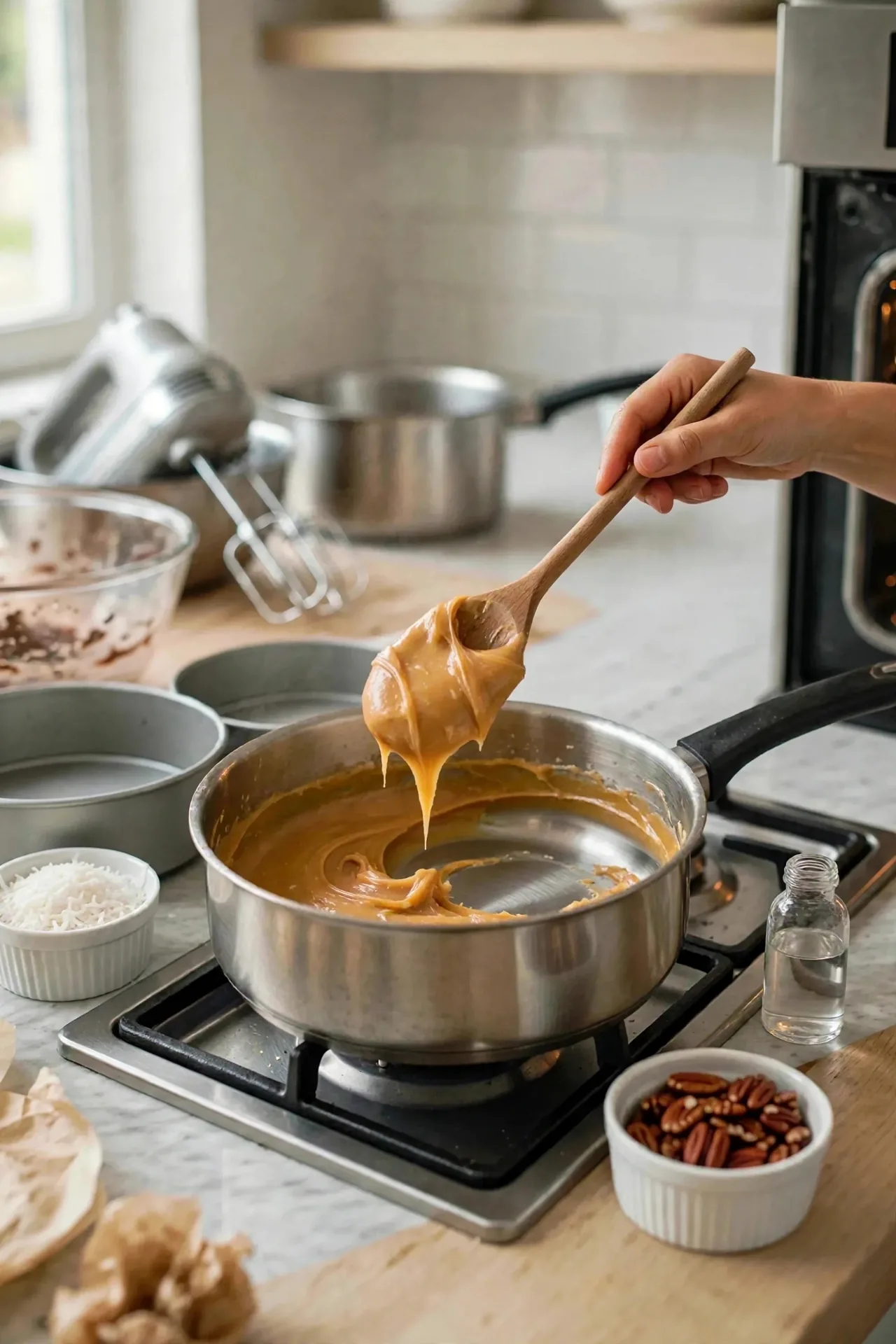
Set the pan over medium heat and stir constantly, scraping the bottom and corners, for about 12 minutes. The mixture will look thin and pale yellow at first, and then it will start to thicken and darken.
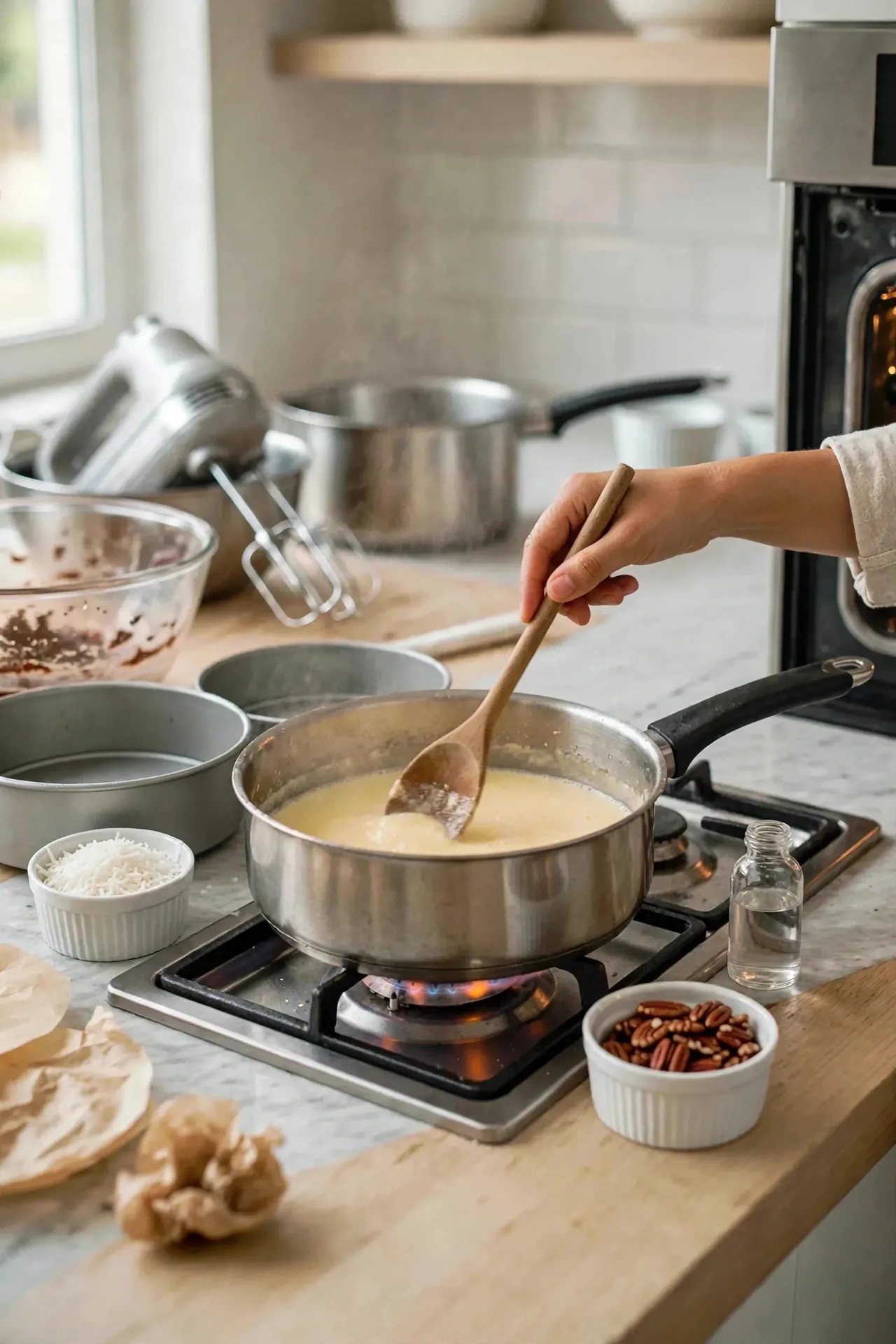
It is ready when it is thick, golden, and coats the back of a spoon, and a finger drawn across the spoon leaves a clean line. If you have an instant-read thermometer, the mixture should be well above 160°F (71°C), the USDA’s figure for egg dishes, by the time it has thickened. Remove the pan from the heat.
Mistake Alert: Scrambled Yolks or Scorched Custard
High heat or stopping the stirring cooks the yolks into bits and scorches the bottom. Keep the heat at medium and stir the whole time. If you see small lumps, pour the mixture through a fine-mesh sieve before adding the coconut and pecans. A scorched taste cannot be fixed, so if it catches, stop and start again.
Stir in the coconut and the toasted pecans until evenly mixed.
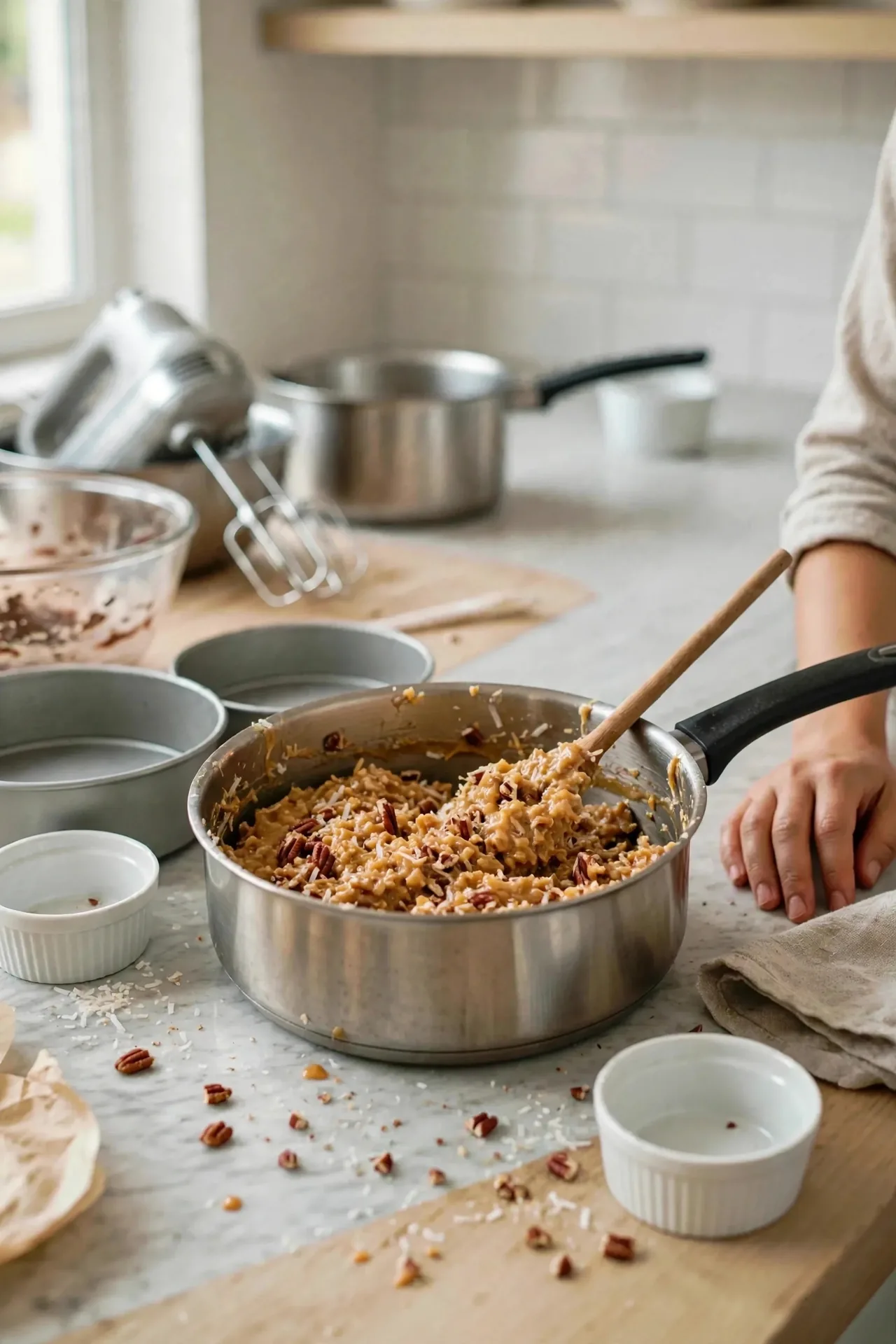
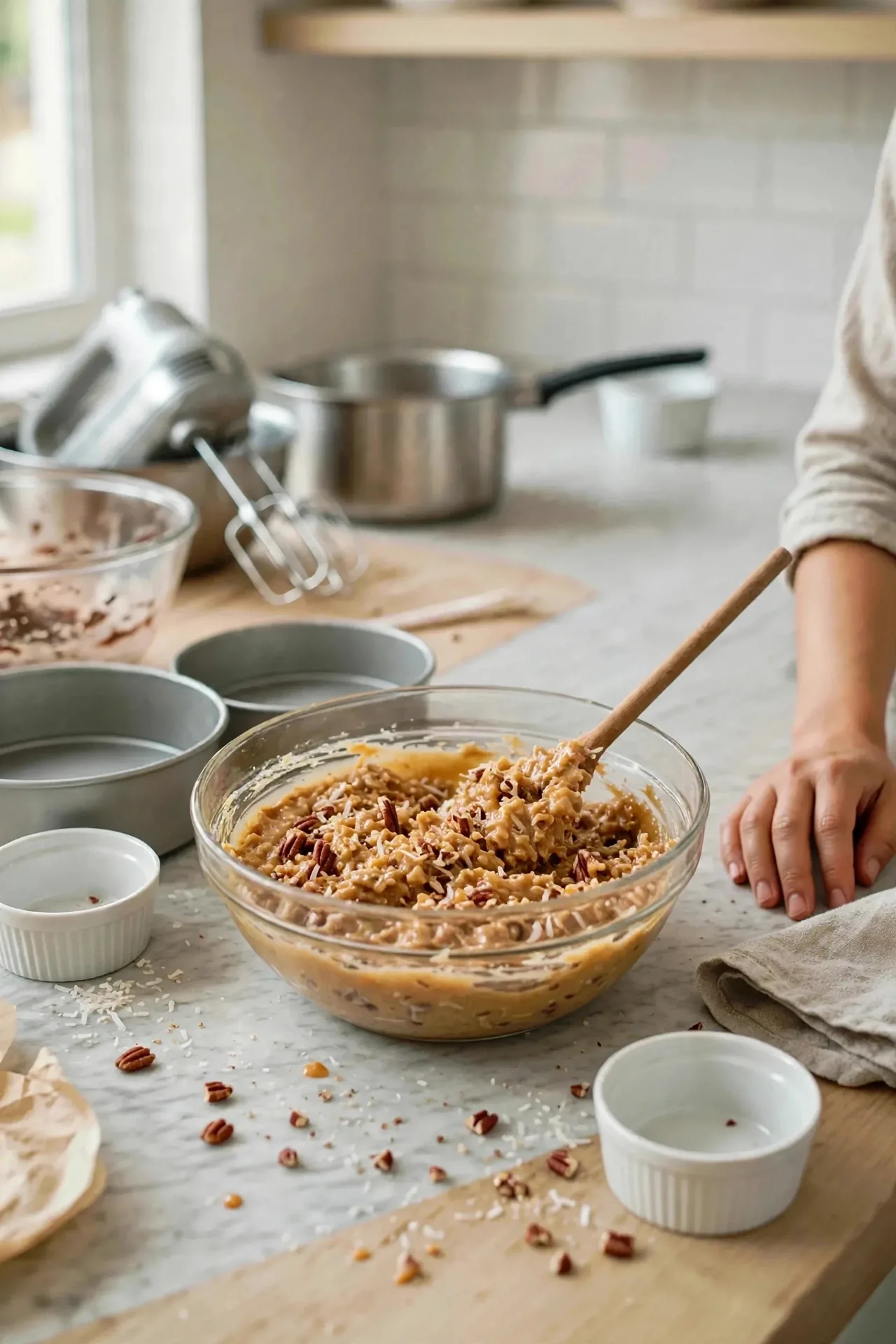
Transfer the frosting to a bowl and let it cool for about an hour, stirring occasionally, until it is thick, spreadable, and no longer warm. It will keep thickening as it cools.
Step 11: Assemble the Cake
Slide strips of parchment under the edges of a cake plate or stand to catch drips, then place the first layer on it, flat side up.
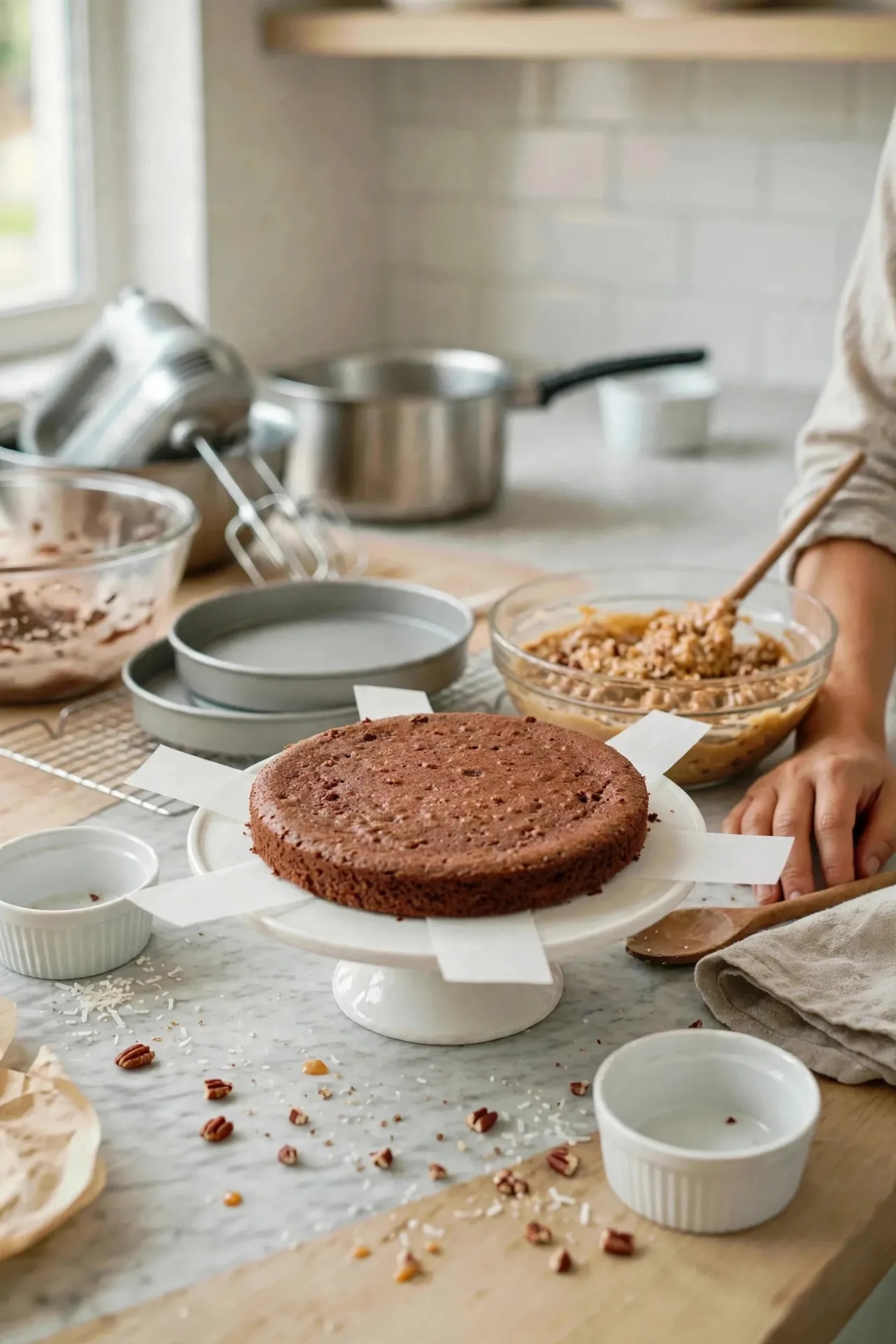
Spread about one-third of the frosting evenly over the layer, all the way to the edge.
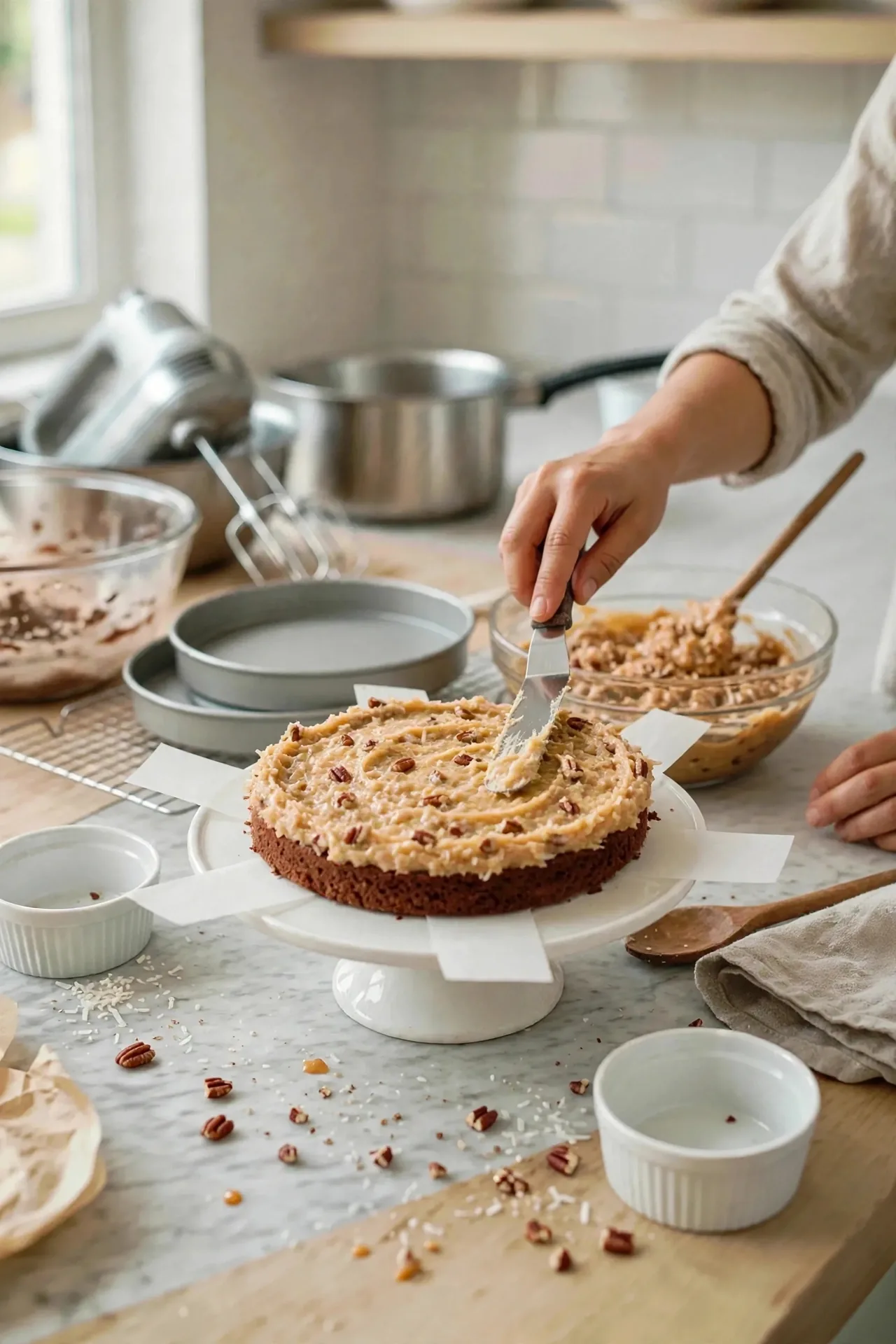
Set the second layer on top and press down gently.
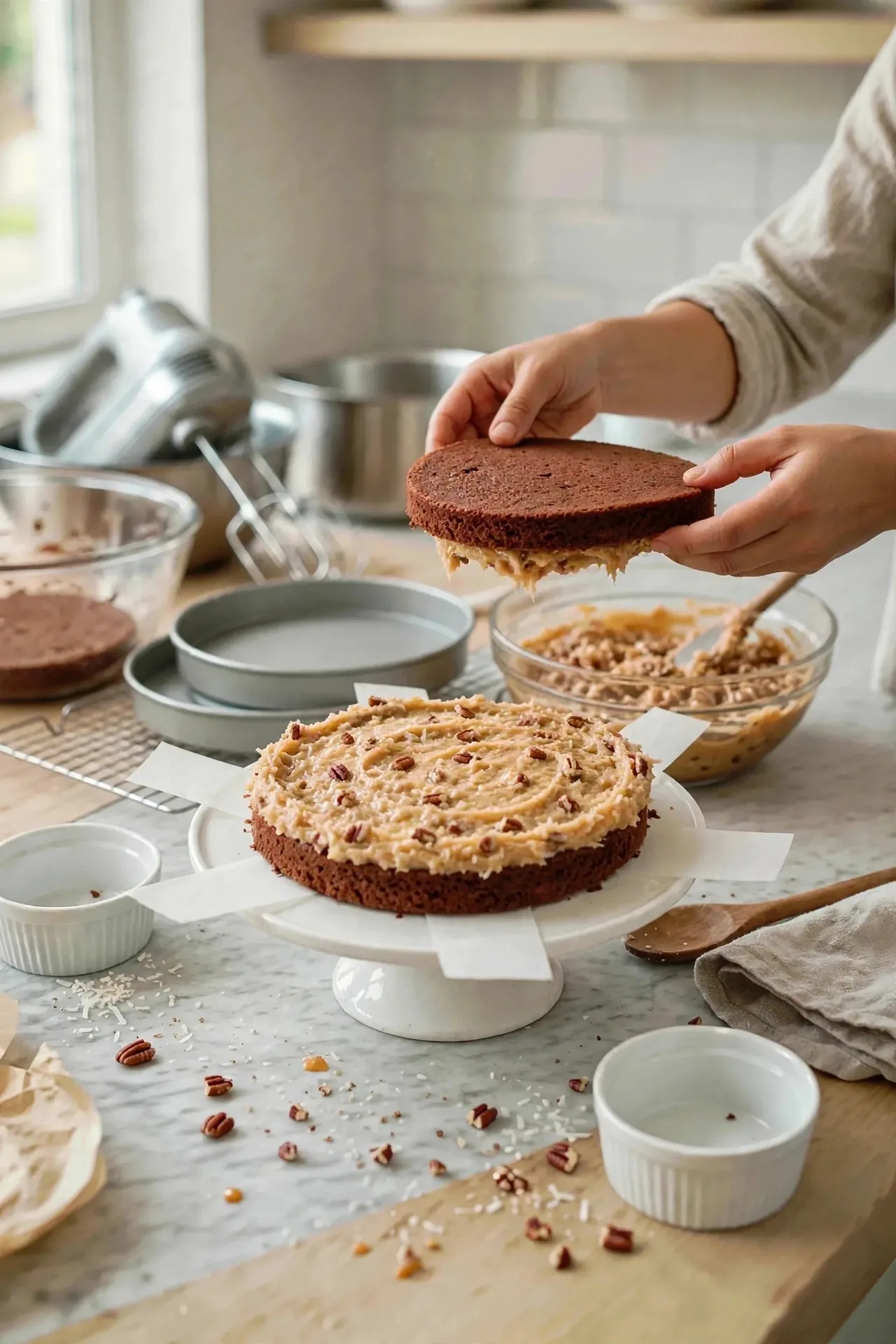
Spread another third of the frosting over it.
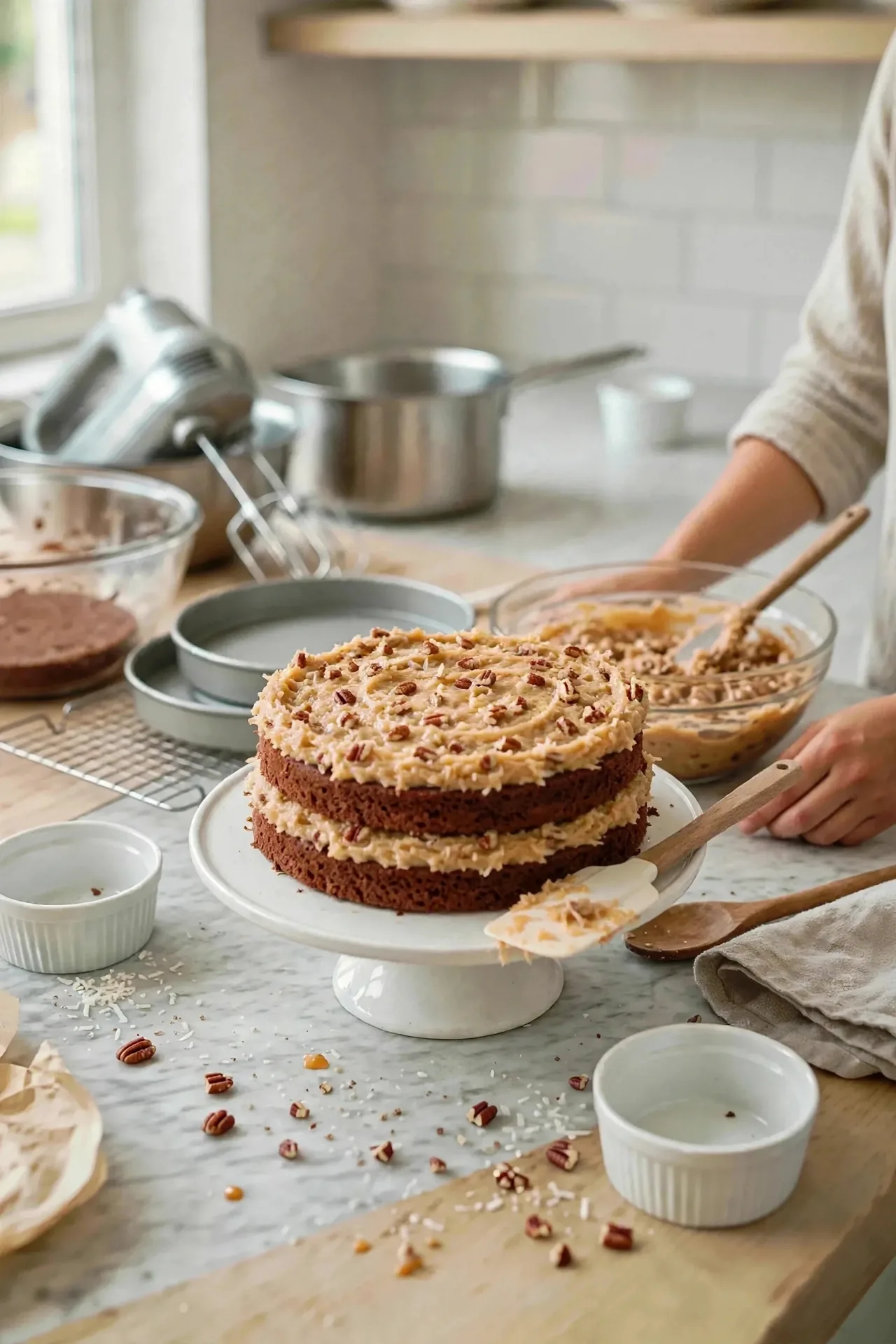
Place the third layer on top, bottom side up for the flattest surface.
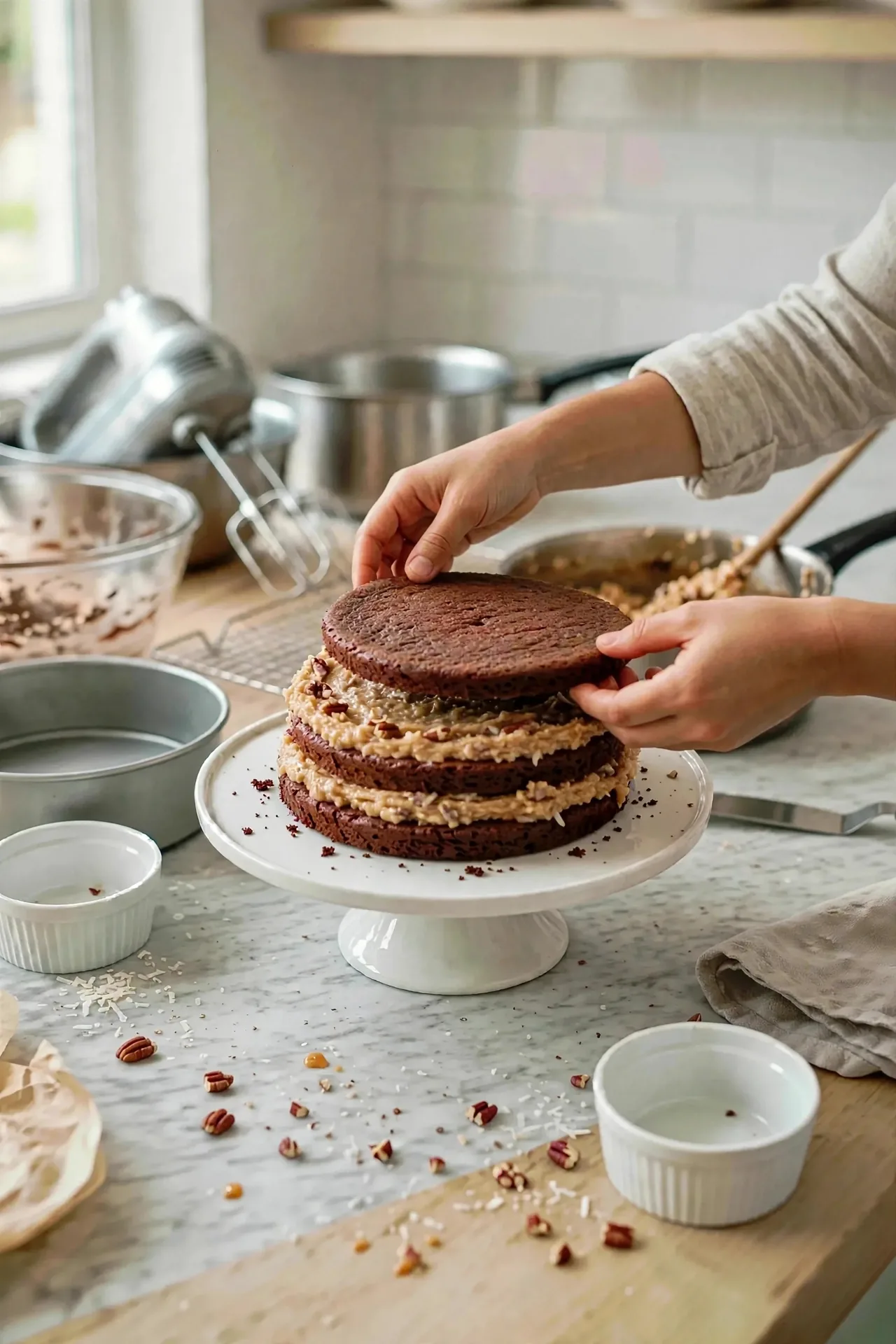
Spoon the remaining frosting onto the top and spread it into an even layer, leaving the sides bare so the layers show.
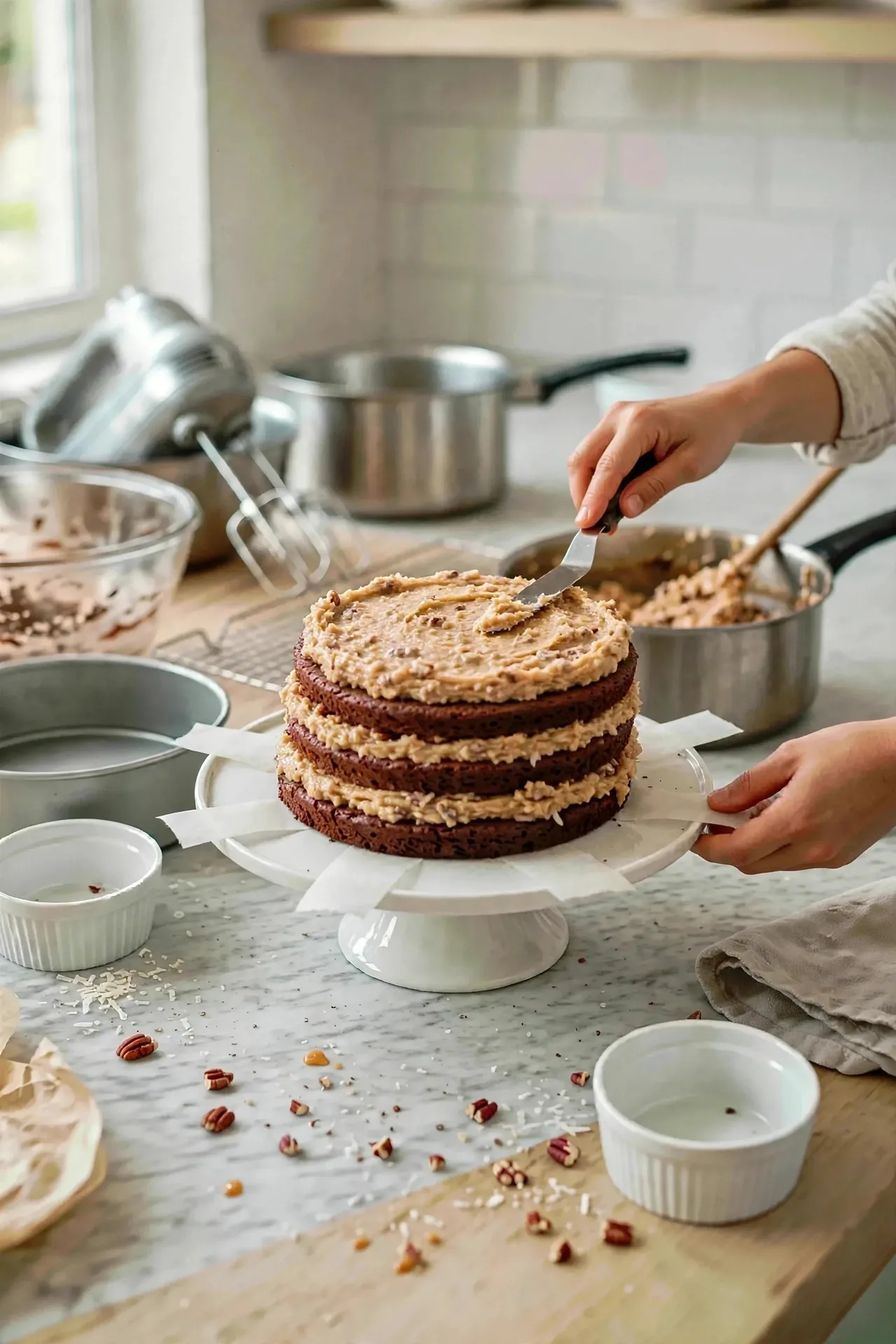
Pull the parchment strips out from under the cake.
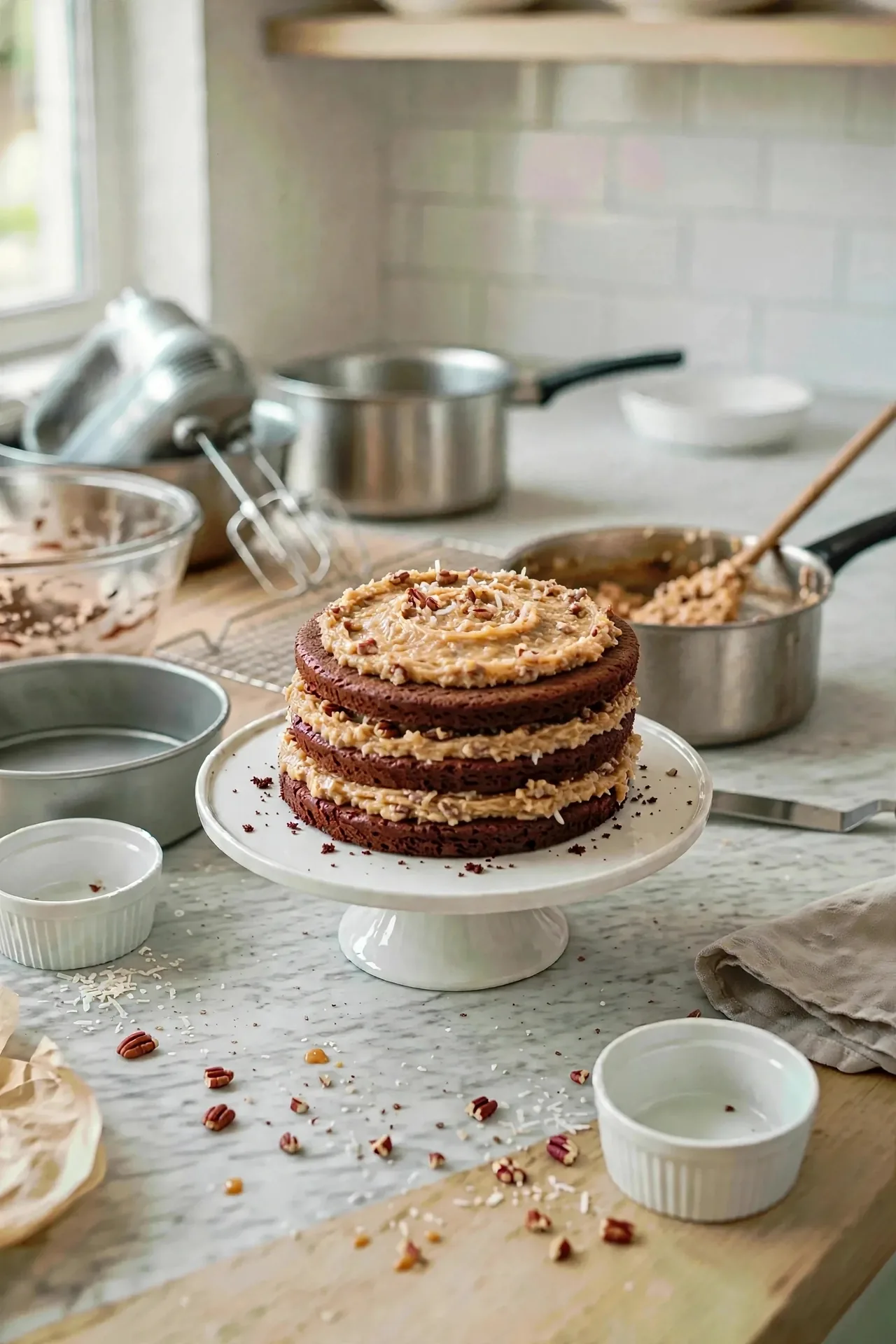
Step 12: Slice and Serve
Chill the cake for about 30 minutes before slicing, just until the frosting firms up. Cut with a long, sharp knife, wiping the blade clean with a damp towel between slices.
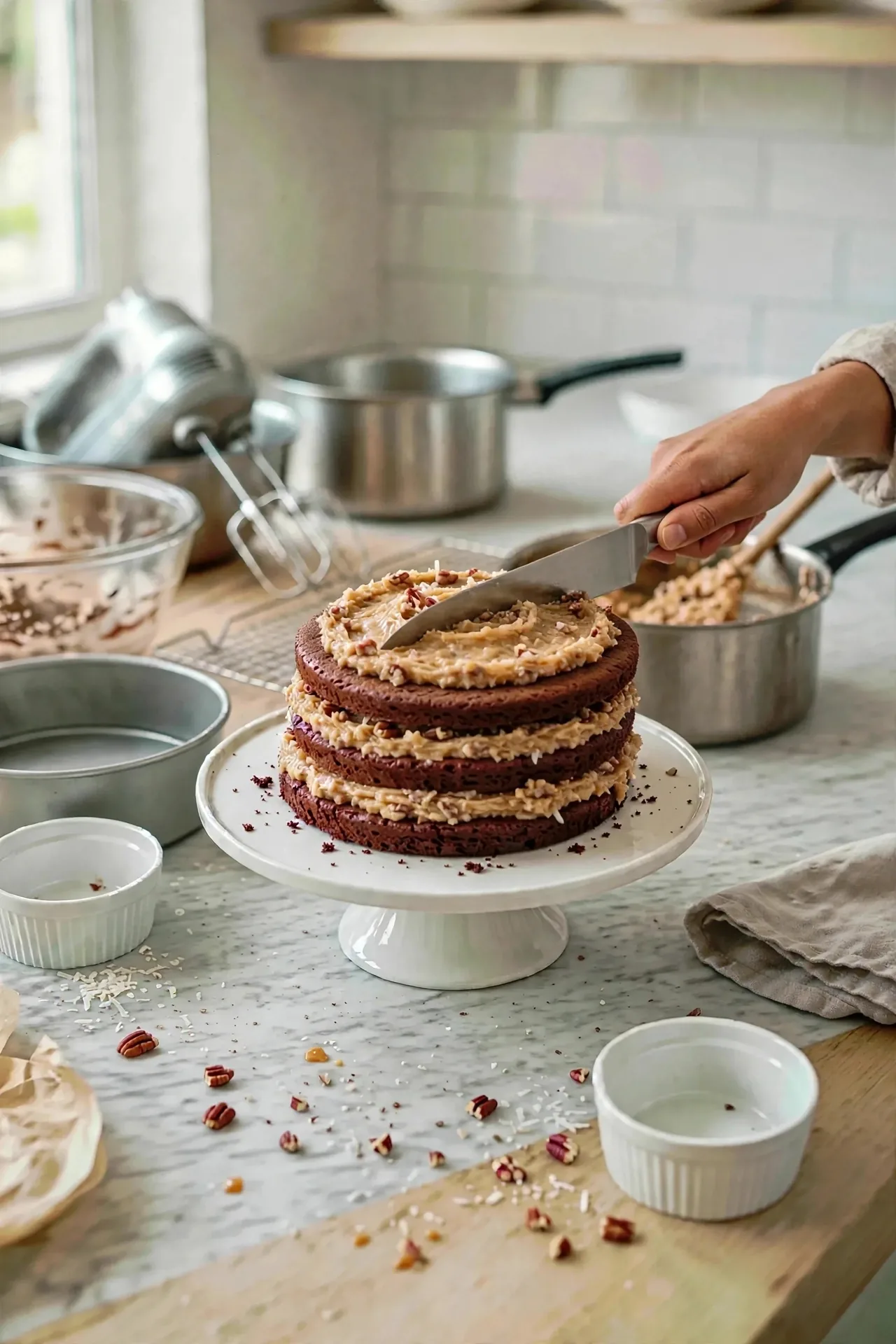
Serve at cool room temperature so the cake is tender and the frosting is soft.
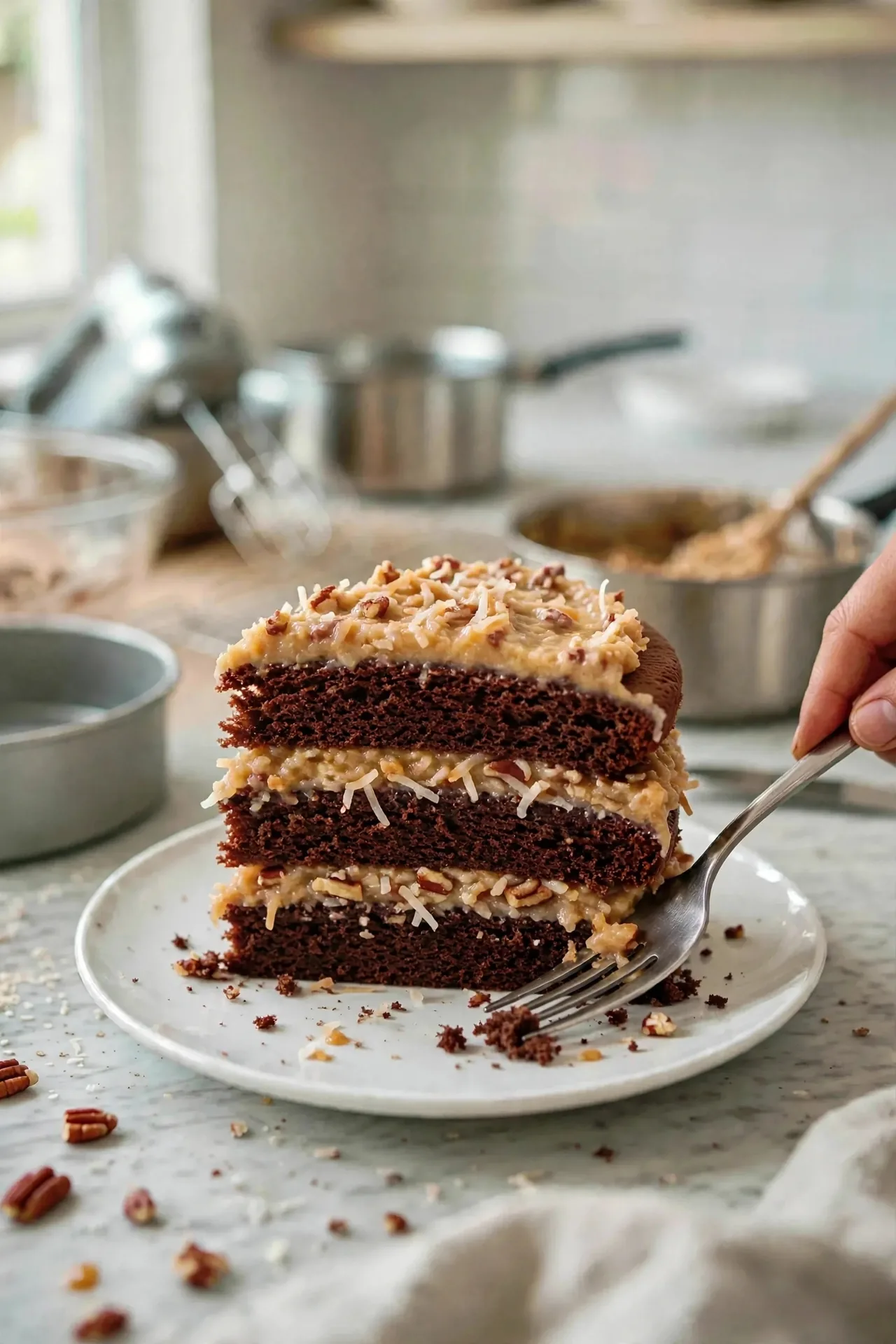
Make-Ahead Plan
- Layers: Bake up to 1 day ahead, cool completely, wrap each layer in plastic, and keep at room temperature. For longer, wrap well and freeze, then thaw before frosting.
- Frosting: Make up to 2 days ahead and refrigerate in a covered container. Let it sit at room temperature until spreadable, stirring first, before assembling. If it has firmed up too much, a few seconds of gentle warming helps.
- Assembled cake: Refrigerate. See storage below.
Variations
- Extra-gooey frosting. If you want a thicker layer of frosting between the layers, double the frosting recipe. The cooking time is longer because the pan is fuller, so keep stirring and judge by the same cues.
- Chocolate frosting around the sides. Some versions add a chocolate buttercream or ganache on the sides and as a border. The classic version leaves the sides bare, as in the photos above.
- Cupcakes. The batter can go into lined muffin tins. Start checking for doneness much sooner than the 30-minute mark for layers, since small cakes bake faster.
- Box-mix shortcut. Some bakers use a German chocolate cake mix for the layers and make the cooked frosting from scratch. The frosting recipe above works the same way.
Substitutions
- Cake flour: see Ingredient Notes for the all-purpose and cornstarch stand-in.
- Buttermilk: milk plus lemon juice or vinegar works, though the crumb may be a little less tender.
- Pecans: walnuts can replace them, but the flavor of the frosting will change and become more bitter.
- Sweet chocolate: a dark baking bar works with a milder sweet taste, as noted above.
Where This Cake Usually Goes Wrong
| Problem | Likely cause | What to do |
|---|---|---|
| Dense, flat layers | Whites were stirred or over-folded, or the batter sat before baking | Fold gently and bake right away. Unfortunately it cannot be fixed after baking, but the layers still taste good with extra frosting. |
| Dry layers | Baked too long or too much flour | Start testing at 30 minutes and measure flour by spooning and leveling. |
| Frosting too runny | Not cooked long enough or not cooled | Cool longer, stirring occasionally. If it is still thin once cold, cook it a little longer next time. |
| Frosting too stiff | Chilled or cooked very thick | Let it sit at room temperature and stir. A few seconds of gentle warming also helps. |
| Frosting has little lumps | Heat too high or stirring paused | Strain through a fine sieve before adding the coconut and pecans. |
| Frosting slides off | Layers or frosting still warm | Wait until both are completely cool. |
Storing and Reheating
Because the frosting contains cooked egg yolks and milk, refrigerate the finished cake. Cover it loosely or keep it in a cake carrier, and plan to eat it within about 4 days. Let slices sit at room temperature for 20 to 30 minutes before serving so the cake is soft and the frosting is spreadable again.
Unfrosted layers freeze well when wrapped tightly, for best quality within a couple of months. Freeze the cooled frosting separately in an airtight container if you want to get ahead.
Facts About German Chocolate Cake
- The “German” is a person’s name, not a country. The cake is named after Sam German, an English-born American who developed a sweetened dark baking chocolate for Baker’s Chocolate Company in the early 1850s. It was sold as “Baker’s German’s Sweet Chocolate.” Over time the possessive dropped off the name, which made the cake sound like a German import.
- It is an American cake with Texas roots. A recipe titled “German’s Chocolate Cake” ran in The Dallas Morning News in 1957, credited to a Dallas homemaker, Mrs. George Clay. Earlier versions are recorded in Texas newspapers, but the 1957 recipe is the one that spread nationally.
- The recipe boosted sales of the chocolate. Baker’s owner at the time noticed the cake’s popularity and sent the recipe to other newspapers, and the cake’s popularity grew along with sales of the chocolate.
- Sweet baking chocolate is what keeps the flavor mild. It already contains sugar and is lighter than the unsweetened chocolate in many other chocolate cakes, which is why this cake tastes gentler than devil’s food.
FAQ
Is German chocolate cake actually German?
No. It is an American cake. The name comes from Sam German’s sweet baking chocolate, not from Germany.
Why is the frosting cooked?
The egg yolks, evaporated milk, sugar, and butter thicken into a custard on the stove. That gives the filling its caramel color and soft, gooey texture, which a no-cook buttercream cannot match.
Why is my frosting not thickening?
It usually needs a few more minutes of constant stirring over medium heat. Also remember it thickens a lot as it cools, so judge by the spoon-coating cue, not by how it looks while hot.
Can I make the cake in two pans?
You can use two 9-inch pans for thicker layers, but the baking time will be longer and the layers are harder to cut cleanly. Check with a toothpick, starting a few minutes after the 35-minute mark, and keep the oven temperature unchanged.
Do I have to refrigerate it?
Yes, once it is frosted, because of the cooked egg and milk frosting. Bring slices to cool room temperature before serving.
Can I use unsweetened coconut?
You can, but the frosting will be less sweet and less moist. Sweetened flaked coconut is what the classic recipe is built around.
Recipe Card
Ingredients
Method
- Heat the oven to 350°F (175°C). Grease three 9-inch round pans, line with parchment, and grease the parchment.
- Separate 4 eggs. Pour the boiling water over the chopped chocolate, stir until smooth, and cool to room temperature.
- Beat the butter and sugar on medium-high for 3 to 4 minutes until pale and fluffy.
- Beat in the 4 yolks one at a time, then the vanilla and the cooled chocolate.
- Whisk the flour, baking soda, and salt. Add to the batter in three parts, alternating with the buttermilk in two parts, beginning and ending with the flour. Mix just until combined.
- Beat the 4 whites to stiff, glossy peaks. Fold into the batter in three additions until no streaks remain.
- Divide among the pans, smooth the tops, and bake 30 to 35 minutes, until the tops spring back and a toothpick comes out clean or with a few moist crumbs.
- Cool 15 minutes in the pans, turn out onto racks, peel off the parchment, and cool completely.
- Toast the pecans on a baking sheet at 350°F for 6 to 8 minutes until fragrant.
- Whisk the evaporated milk, sugar, 3 yolks, butter, and vanilla in a saucepan. Cook over medium heat, stirring constantly, for about 12 minutes until thick, golden, and coating the back of a spoon. Remove from heat and stir in the coconut and pecans. Cool about 1 hour, stirring occasionally, until spreadable.
- Place one layer on a plate. Spread one-third of the frosting over it. Repeat with the second layer, then add the third layer and spread the remaining frosting on top. Leave the sides bare.
- Chill about 30 minutes, slice with a clean sharp knife, and serve at cool room temperature. Refrigerate leftovers and eat within about 4 days.
Notes
Final Thoughts
Three things decide how this cake turns out: whipping the whites to stiff peaks and folding them in gently, pulling the layers out as soon as a toothpick shows a few moist crumbs, and letting both layers and frosting cool completely before stacking. Get those right and the frosting does the rest.
For serving, a cold glass of milk or hot coffee suits the sweetness. If you are making it for an event, bake the layers and cook the frosting the day before, then assemble on the day.
Emily Hart
Hi, I'm Emily! I develop cozy, doable recipes for busy home cooks — clear steps, honest ingredients, and flavors the whole table will love. Follow on Pinterest
Follow on Pinterest
Leave a Reply